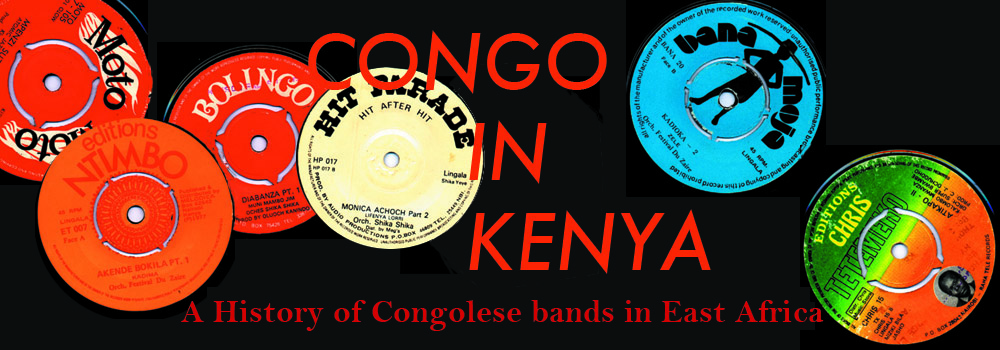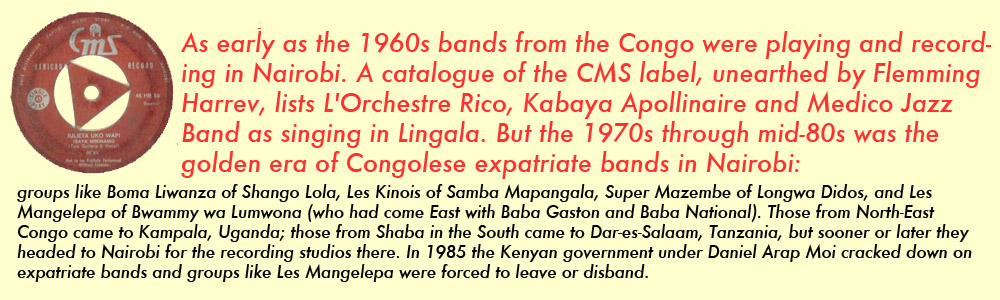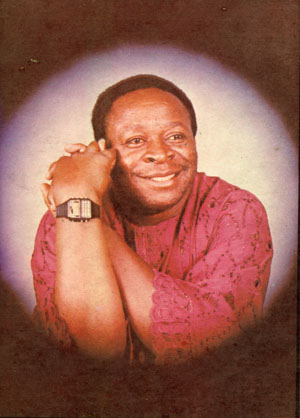
Baba Gaston |
BABA GASTON
Baba Gaston was born on July 5, 1936 at Likasi, near Lubumbashi in Shaba Province, Eastern DR Congo. He changed his name to Ilunga Chenji Kamanda wa Kamanda Gaston Omer after Mobutu decreed that Zaire nationals replace their Christian names with African ones.
He picked up his early musical training from a Greek pianist, Leonides Rapitis, and had a hit with "Barua kwa Mpenzi Gaston" while he was still in school. When he was 20 he formed the Baba National Orchestre, which he took on an extended tour through Zambia, Zimbabwe and several European countries before becoming one of the first Congolese musicians to settle in East Africa in the early 70s.
Evani Kabila Kabanze, who was later to star with Les Mangelepa, sang with Orchestra Baba Nationale in Lubumbashi. The band used to travel to Kinshasa to record. According to Kabanze, sometime in 1971, because of the poor roads in the Congo, they took the Kisangani route through Kilemi which lies on the Congolese border with Tanzania. But, instead of proceeding to Kinshasa, they decided to enter East Africa, having heard of the region's superb studios.
The band settled in Dar-es-Salaam for four years. They found it cheaper there and built a strong fan base. For recording they would cross the border and travel to Nairobi. But, four years later, in 1975, Baba Gaston decided to move the band to Nairobi when they realised they had an even bigger following there.
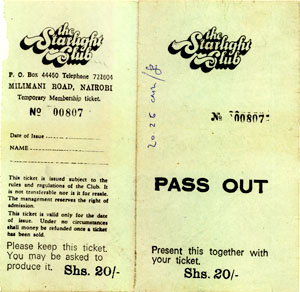
Congolese musicians have been making waves in Kenya since the late 1950s. It was the Congolese OS Africa Band that opened Nairobi's famous Starlight Club back in 1964. But it wasn't until the mid-1970s, after the passing of the American soul craze, that music from Zaire began to dominate the city nightclubs. As a composer and band leader, Baba Gaston was prominent in the music scene in Kenya for three decades, and is considered one of the godfathers of Kenyan pop.
He sang mostly in Swahili. His tunes were hugely popular and remain evergreen. "Kakolele Viva Christmas" (lead vocals by Kasongo Wakanema who later joined Super Mazembe) earned him a golden award, selling over 60,000 for Polygram. Other memorable hits were "Ilunga Ilunga," "Kai Kai," and "Mayasa." He rarely dabbled in politics, but a praise song for Mobutu in 1983 earned him a gold disc from the president.
Baba Gaston once proudly claimed he had played with more than 700 musicians and that his band was a virtual training school. There was another side to the statistic, however, as Hanz Kinzl, manager of Phonogram, the second biggest label in Kenya, has said, "Baba is an extraordinary person. He has this fatherly image on him, and I think it's quite genuine. In Africa you're wealthy if you have a big stomach. If you can show that you're a big man then you are also regarded as a rich man and an important personality. Which means that he takes the majority of whatever income his music provides him with, to the dissatisfaction of the band members. Consequently there is hardly any band in Nairobi and Kenya which has broken up as often as Baba's".
Mounting dissatisfaction for two years came to a head in July 1976 when several members including Bwami Walumona, Kasongo Wakanema, Evani Kabila Kabanze (vocalist/composer), Kalenga Nzaazi Vivi (vocalist/composer), Lutulu Kaniki Macky, and Twikale wa Twikale split from Baba Nationale to form Orchestra Les Mangelepa. Other splits led breakaway members to Bwambe Bwambe, Pepelepe, and Viva Makale.
Names that rose to prominence with Baba Gaston include Starzo ya Esta (the force behind Festival du Zaire), BadiBanga wa Tshilumba Kaikai (vocalist/composer, later with Les Mangelepa), Koko Mukala Kanyinda, a.k.a. Mukala wa Mulumba "Bebe", drummer and vocalist who paid his dues alongside Nico, Mangwana and Papa Noel in bands like Vox Africa & Cercul Jazz before joining Les Mangelepa in Nairobi in 1977 (also in Orch. Mbuta Mbuta, possibly in Orch Bana Sambo with bassist Manitcho, now based in London), Jimmy Kanyinda, Aloni Vangu, Zainabu (later in Popolipo and Shika Shika), Pepe Mato (who formed Pepelepe), Yassa Bijou Ley (now in Mombasa, Kenya), Lisasi Ebale Mozindo, Nzengele Saida (guitarist of Bana Moja/Bana Ngenge), William Tambwe Lokasa (bassist of same, also in Mangelepa), Kasongo Fundi (drummer and bassist, another Mangelepa member), Kazadi Mbiya Saleh wa Bambu, Medico Bwala, Lukangika Maindusa Moustang (lead guitarist with Mangelepa), Lumwamga Mayombo Ambassedeur (rhythm guitarist with Mangelepa), and Tshimanga Zadios (sax with Mangelepa).
A female vocalist who sang with Gaston was Nana Akumu wa Kudu. She is also remembered for her singing with Pepelepe in Nairobi before joining Franco and OK Jazz in the hit song "Mamou." She still performs in Brussels, backed by her husband Djo Mali and ex-Les Noirs guitarist Dieudos. Tabu Nkotela Kiombwe "Super Sax" is apparently working in Japan. Lutulu Kaniki Macky (vocalist/composer), performed in England in 2018.
Other alumni who have now died include John Ngereza (who later led Les Wanyika until his death in February 2000), Shoushou (Tchou Tchou), and Bosho Kayembe Nyonga (who led Festival Libaku in Nairobi before his death).
Baba Gaston died on March 25, 1997, while living across the border in Tanzania, where he had moved since his retirement from the music scene in 1989. He is buried at the Lang'ata cemetery in Nairobi. A prolific musician and apparently also a prolific father.
collated by Paul Johnston from: Peter Ingolo, Odindo Ayieko, Muttu Mondiya Mama: Music and Musicians in Eastern and Central Africa [articles no longer on line]
Graeme Ewens, Africa O-Ye!, Da Capo, 1991
Douglas Paterson, "Kenya: The life and times of Kenyan pop" in The Rough Guide to World Music Vol 1 (Africa, Europe and the Middle East) by Simon Broughton, Mark Ellingham, Richard Trillo (Editors), London, Rough Guides, 1999
Disclaimer: I claim no credit for any of this writing. It is a collation from the sources mentioned above. If material from other sources has crept in it is unintentional. Please let me know so that I can give credit where it is due. (PMJ/20 Nov 2006). Edited by Peter Toll, 22 March 07.
|
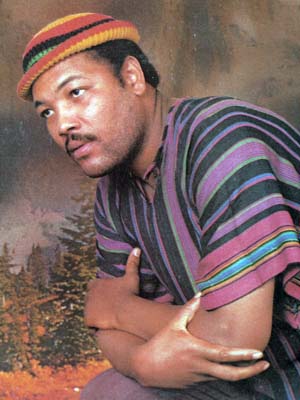
Sax player Kikuni Mbongo Pasi |
BOMA LIWANZA
Peter Toll reports:
Jim Monimambo must have come to Kenya in the mid 1970s (note: See his info in the liner notes to Special Liwanza below). He might have arrived there in 1975 with Kalombo Mwanza's Orch. Bassanga, a band that also included Tabu Batchalinge Ogolla and guitarist Loboko Pasi who joined Orch. Boma Liwanza soon after getting to Nairobi. Apparently Orch. Bassanga fell apart in Tanzania because this is what Loboko Pasi said in an article in The Nation (June 17, 2006):
"I had heard about Franco's tours to Kenya and how he would attract crowds in Nairobi and Kisumu. I was very excited about the tour. I had also heard that Nairobi was the London of East Africa, the land of milk and honey. If I couldn't get to London, I told myself, Nairobi would do," adds Pasi.
The tour was to take Orchestra Bassanga through Uganda and Tanzania followed by a grand performance in Nairobi before returning home. So after a rather lukewarm reception in Uganda and a low-key performance in Tanzania, the band, led by Kalombo Mwanza, set out for Nairobi. However, somewhere along the way, internal rifts developed over money after the tour's sponsor took off with the little cash that had been realised.
"That was a trying time for me. I was among the band's youngest members, it was my first foreign tour and there we were, splitting. I wondered how I would find my way back home with no money," recalls Pasi.
When they got to Nairobi, the band split up and it was every man for himself. With no tools of trade, no person to turn to, Pasi wandered in the streets of Nairobi, hoping to meet a Congolese who he would share his problems with.
"I did not even have a guitar to perform on the streets to raise money for food".
For almost a month, Pasi had to beg to survive. The paradise in Nairobi was elusive.
"It was not London to me any more. There was no milk, no honey, not even bread crumbs. I was starving, I needed something to do to get food," recalls Pasi.
After knowing his way around town, Pasi joined a Congolese band by the name Boma Liwanza.
"I just introduced myself and they allowed me to perform with them although they doubted my abilities. I proved myself and they accepted me officially," he says.
Despite this newspaper report, Loboko Pasi says he was not stranded in Nairobi but joined Les Noirs in Mombasa in 1975. He was later invited to Nairobi to play with Boma Liwanza, until he left to join Super Mazembe.
In the mid 1970s Monimambo became a singer with Boma Liwanza and a popular one. In 1976 he even started to record with his own band Special Liwanza -- which was probably just a studio band made up of members of Boma Liwanza. It seems Jim was still with Boma Liwanza in 1979 when he wrote one of their big hits, "Milimani".
However, around the same time he also started performing with George Kalombo Mwanza's new band Viva Makale and that's where he sang with a Zairean artist who had just returned from Tanzania, Moreno Batambo. Soon after, the two started a new band, Shika Shika, but unfortunately, Moreno wanted to be his own boss, so he moved within a year to form Moja One. I believe Orch. Shika Shika was formed in 1980, the year Moreno's "Maisha Ya Mjini" was recorded.
|
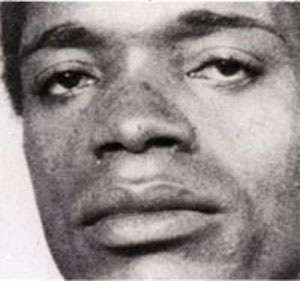
Jimmy Moni Mambo |
MONIMAMBO, LOVY & MORENO:
ORCHESTRA SHIKA SHIKA
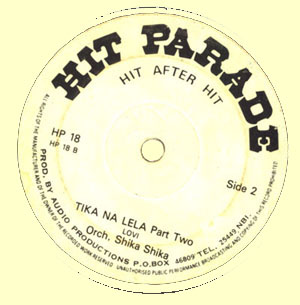
Shika Shika released an album on the Hit Parade label in 1982 and two more in 1983, and produced a slew of singles on different labels. "Tika na lela (Leave me to weep)" by Lovy is one of their greatest songs: it became their catch-phrase. They quote the lyrics often, and reprise it musically in both "Massa" and "Ma-Sofia." Among those who leave and weep in this latter version are Samba Mapangala. Their other hits included "Sisili," "Amba," & "Inyo" (according to Phil Bunce in Issue 3 of SONGA! magazine which included a cassette of "Amba").
Among the singers of Shika Shika were Monimambo Jim (born 15 Nov 1949; died circa 2002 in Dar-es-Salaam), Vicky "Lovy" Longomba (1957-96) and Moreno Batamba (1955-October 1994).
Monimambo was also known as Jimmy Monimambo Mfumu Ntoto, the honorific means "King of the Earth" in the Ki-Kongo language (Maquis du Zaire did a song called "Mtukwao" with the lyric "Monimambo ooooh!"). He has most songwriting credits. Monimambo is a surname in Angola; it is also the name of a pan-Kongo trickster spirit! Jimmy was born in Barumbu, Kinshasa of Angolan parents. Many Angolans migrated to the Congo basin in search of work. Sam Mangwana and Ricardo Lemvo also have Angolan roots. In addition to Shika Shika, Monimambo (who started out with orchestras Los Angel and Cercul Jazz, among others) wrote and performed with Boma Liwanza, Special Liwanza, and Viva Makale of Kalombo Mwanza George. Once Monimambo married a Kenyan woman it was logical for him to settle in Kenya. According to (Simba Wanyika guitarist) Abbu Omar, "Jimmy Moni Mambo married a sister of the Meru tribe, her name was Mercy. At the time, she was the girlfriend of Joseph Just, a member of Simba Wanyika, Jimmy decided to pursue her. She was family to us, but Jimmy, he grabbed her and disappeared with her."
Boma Liwanza seems to be the precursor of Shika Shika. In two of their songs the phrase "Shika Shika" or "Shika Yeye" (Caress her) comes up. After Boma Liwanza and Special Liwanza came Viva Makale, then Shika Shika, as the musicians worked through new line-ups. Other bandmates in Shika Shika included Bwami Walumona & Kasongo Kanema formerly of Baba Nationale, and later of Les Mangelepa, Lawi Somona, plus Sammy Mansita (later of Virunga, who also fronted Orch Mokano), guitarist Mwalimu Siama Matuzungidi, and drummer Lava Machine, who were together in Virunga. Monimambo and Longomba also recorded with studio bands Orchestra Mos Mos and Orchestra Pole Pole. Guitarist Thierry "Chery" Matumona Kikaya (like Siama Matuzungidi, a member of Orchestre Cavacha in 1976) left in 1981 to go to Uganda & Zambia; he now lives in Canada.
Siama Matuzungidi was guitarist with the Cavacha band in Kinshasa in the 70's (The Cavacha was a dance later popularized by Zaiko Langa Langa). Cavacha was formed by Dona Mobeti (tenor voice) and Mopero (baritone). It also featured Mambo Ley (ex-African Fiesta Nationale vocalist) and Nanga Nella. Melodica in Nairobi sold their 45s on the Editions Diabim and ASL labels, including "O Mimita" which was written by guitarist "Chery" Matumona, "Bakota Bakota" by Dona Mobeti and "Nene Malakasi" by Nanga Nella. Their 1976 hit "Luciana" can be found on the Ngoyarto CD Les plus grands succès de l'orchestre Shama Shama de Mopero. Siama's first composition for them was called "Bomoto mabasi." As Siama says, "Mopero split and formed Orchestre Cavacha de Mopero which led to a conflict. Finally Franco intervened and told Mopero to get a new name. Vicky Shama Shama was Mopero's girlfriend so he chose that as the name of the band (and it was also a hit song title by Cavacha de Mopero). Shama Shama was formed from Cavacha members as Mopero Wa Maloba was the Cavacha singer." Siama recalls: "Now I can see all the sin we lived with at that time, it was fun! Mopero died in West Africa in 2008, very sad. Shama Shama band got divided just before the Uganda trip; Mopero got new musicians and went to Uganda and then the band broke up again -- that's why KoKo Zigo convinced me to fly to Uganda and form Kombe Kombe in 1978 with Koko Zigo as the singer. We moved to Kenya as Kombe Kombe and we were given a contract at Garden Square in Nairobi to form a new band by the name Viva Makale, but Koko Zigo kept the name Kombe Kombe for our private recordings."
Siama recalls: "At the beginning of Viva Makale the band was:
George Kalombo Mwanza/saxophone and vocal
Buami Walumona/lead guitar
Thierry "Chery" Matumona/lead guitar
Siama Matuzungidi/rhythm guitar
Tabu Frantal/guitar
Thomy Kabeya Lomboto/bass guitar
Coco Zigo Mike/vocal
Moreno Batamba/vocal
Jimmy Monimambo/vocal
Tambwe Mandola/vocal
Tshamusoke/trumpet
Lava Machine/drums
|
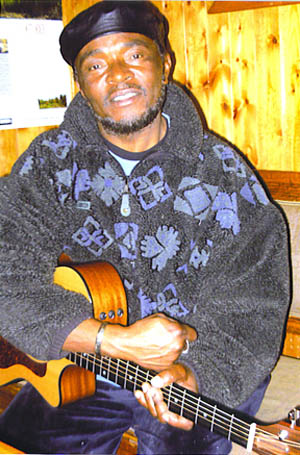
Siama Matuzungidi |
Then the line-up of Shika Shika was:
Jimmy Monimambo/vocal
Siama Matuzungidi/guitar
Thierry "Chery" Matumona/lead guitar
Tabu Frantal/lead guitar
Johnny Ekombo/guitar
Lovy Longomba/vocal
Dago Mayombe/vocal
Lokombe/vocal
Wabansilu Daid "Manysho"/bass
Lava Machine/drums
Lawi Somana/sax (sometimes Atey or Tabu Ngongo)
Almost the same musicians used to record in Moja One of Moreno Batamba: it depended who Moreno wanted to use because in the old days Moja One and Shika Shika were not performing just studio recording."
|
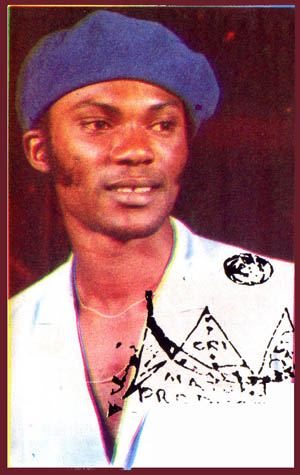
Moreno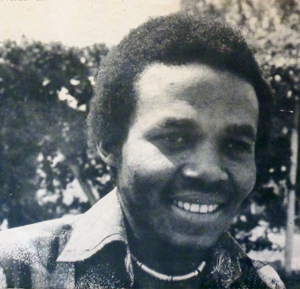
Jojo Ikomo in Nairobi
|
Moreno (Batamba Wenda Morris), of the deep bass voice, was born in Kisangani, Haut-Zaire province, Congo, in 1955. He quit school in 1971 to join Orchestre Maquis Sasa Bata. He moved to Uganda & in 1974 joined Orchestra Bana Ngenge of singer Jojo Ikomo. Ethan Bloomberg writes: "During a discussion of Orchestre Veve with Samba Mapangala, Bana Ngenge came up. He told me a story of Veve in Uganda (they were wildly popular), and a club owner who later went to Kinshasa and poached some Veve musicians, to perform in Kampala. Bana Ngenge was the group that emerged from this undertaking." Bana Moja or Bana Ngenge (the name depended on who was in charge) moved to Nairobi in the mid-70s and featured, in addition to Jojo Ikomo, Fataki Lokassa, Nsilu Wabansilu Manitcho (ex-Veve bass-player), Lawison Somana (ex-Veve saxophonist), Ochudis, Mandala Otis Muissa, Nzengele Saida (guitar), Beya Maduma (a.k.a. Moro Maurice, sax player from orch Veve, later a solo artist in Abidjan), & guitar soloist Roxy Tshimpaka (later of Choc Stars, then Zaiko Langa Langa).
Peter Toll adds: the formation which arrived in Kampala in 1974 was fronted by singers Djodjo Ikomo and Fataki Lokassa, both former members of Orch. Tabou National, a band that was founded by Tony Dee Bokito in 1970. After Tony Dee moved to Mbandaka in 1972, several musicians left the band and Ikomo started working with Orch. Veve with whom he recorded his 1973 song "Maina" (Veve 159). Ikomo was also one of the founders of Orch. Bana Modja with whom he released his compostion "Mayatu" (1974).
Other members of Bana Moja were bass player Manitcho and guitarist Roxy Tshimpaka (ex-Thu Zaina). During their stay in Uganda the group produced a few records that were later released as 45 RPMs on the African label:
African 90853 - Mayatu (Ed. Bana Moja, later redone for the LP "Maya Tu", KR 1007).
African 90984 - Azonga / Koyoka koyoka (Ed. Bana-Moja 02)
African 90985 - Okei kolakate nika / Na bangi makambo (Ed. Bana-Moja 03)
African 90986 - Mabaku (Ed. Bana-Moja 04)
In 1975, Bana Moja moved to Nairobi, where a number of musicians regrouped under the name Bana Ngenge. Unfortunately, the band split the following year, with Ikomo and Moreno leaving to join Les Noirs. Meanwhile, Fataki "Los Los" Lokassa ("Masumbuko ya Dunia") travelled with a remnant of Bana Ngenge to Tanzania where the band finally collapsed.
The music Bana Ngenge recorded was released in Kenya on a label called Bana Moja. So, although Bana Moja didn't exist as a band from 1975 on (that is, until Ikomo's return to Zaire in 1985), the name still continued as a record label. Apparently, in the old days quite a number of musicians were selling and licensing recordings and running their own label. For example see the many 45 RPMs on Editions Ntimbo by Orch. Sentima, Top Forum & Festival du Zaire. And also Coco Zigo had his own label, Editions Zigo, that released Orch. Bangambo, Shama Shama & Bansomi Lay Lay. Bangambo seems to have been an earlier band, in Kinshasa with Rigo Star on guitar.
In 1976 when Bana Ngenge broke up, Moreno & Jojo (or Djo Djo) joined Les Noirs and scored a hit with "Tshiku" (on AFRICAN STARS COLLECTION Vol 3). Jojo also recorded with Orch. Bassanga on the ASL label. Other members of Les Noirs included Mukaputu Kalemby Kajos, William Tambwe Lokassa (bass), Mankwazi Duki Dieudos & Chuza Kabaselleh. Dieudos left Kenya and returned to Zaire in the early 80s where he played with Tiers Monde, later he moved to Belgium and hooked up with Dalienst. Kuka & Les Noirs scored a hit with "Mungu iko Helena," and Chuza and les Noirs hit with "Sikiya sauce," (composed by Dieudos Makwanzi) both on ANCIENT SUCCES (ASLP 426), dated 1973. (Jojo was later in Empire Bakuba.) Kuka was Mathieu Kuka composer of the classic "BB69" a hit for African Jazz in the 1960s. He was in Kenya with Les Noirs in the 70s but returned to Kinshasa where today he leads Afric'Ambiance.
After the split up of Bana Ngenge in 1976, Fataki Lokassa moved to Tanzania and carried on with other members of the group for a short while. In 1978 Fataki returned to Nairobi where he joined Pepelepe, Les Kinois (later Virunga). He died on Dec 11, 2006 in Dar-Es-Salaam. Peter Toll adds: "As for Ikomo, he left Kenya in 1985 and moved back to Zaire. With a new Orch. Bana Modja he made some recordings for the Kinerama label (LP Maya Tu, KR 1007 (1982)) but by the mid 1980s, he had joined Franco's OK Jazz. He later ended up in Empire Bakuba."
"As for the name change Bana Moja / Bana Ngenge -- I think this really had to do with the person in charge. With Fataki the band was called Bana Ngenge, with Ikomo it was Bana Moja."
As a postscript to this, in December 2017, Djo Djo Ikomo published a notice in the Kenyan paper saying: "Veteran Congolese musician Djo Djo Ikomo, formerly of TPOK Jazz and Orchestra Veve, through his Kenyan acquaintance Njoroge Kibe, is seeking to be reunited with his daughter. He first came to Kenya in 1980 and returned to Kinshasa in 1985 for a relative's funeral but stayed on. In Kenya, the now-aging musician had a daughter, Brigitte, to whom he wishes to bequeath his property in DR Congo."
|
|
From 1978-80 Moreno was based in Dar-es-Salaam where he sang with Safari Sound before returning to Kenya. Back in Nairobi in 1980 he started Moja One where he teamed with tenor Coco Zigo Mike, guitarist Siama Matuzungidi and drummer Lava Machine (with other musicians from Shika Shika). Their biggest hits were "Pili Mswahili," "Dunia ni duara," (in 1981), & "Urembo si hoja." For some time in 1983, Moreno briefly joined Samba Mapangala's Orchestra Virunga in what was perhaps the group's most star-studded line-up ever. The group which turned the now defunct Starlight Club into the hottest live-music nightspot in town, featured Coco Zigo, Fataki Lokassa, Dago Mayombe and later Moreno on vocals, along with Ottis and Samba Mapangala; Manitcho Nsilu, Sammy Mansita, Django Nkulu Mwilambwe, Bejos, Siama Matuzungidi and Beya Mikobi Dibuba on guitars, and others, some of whom were only briefly in the band. Siama recalls Lava Machine replaced Willy on drums and the trumpeter was Diana Kodila. The outfit later split three ways to create Vundumuna, Ibeba System and Virunga. Diana Kodila the trumpeter released "Mama Koko" and "Nyako Bera" as Orch Super Diana Star on Eds Kamanyola. Moreno went solo. He mainly sang in Kiswahili and the themes of his songs varied from social commentaries like "Dunia ni Duara," "Mapenzi ya Shinda" and "Mwanamke Hatosheki," to love songs like "Angela" and "Pili Mswahili." This last was a song about his girlfriend, Pili Mikendo Kassim, a Tanzanian model he met in 1976 while with Orchestra Les Noirs in Mombasa. His 1993 chart topper was "Vidonge Sitaki," based on a Taraab song by Golden Star, but sadly he died the same year, aged only 38.
|
Lovy Longomba
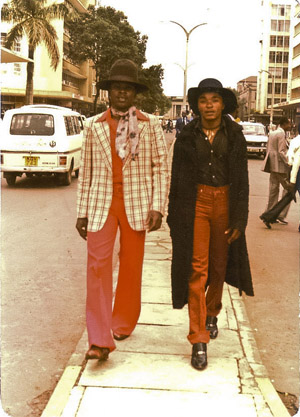
Tomy Lomboto, bassist (left), & Siama Matuzungidi, guitar, outside Garden Square, Nairobi, 1979, courtesy of Siama Matuzungidi
|
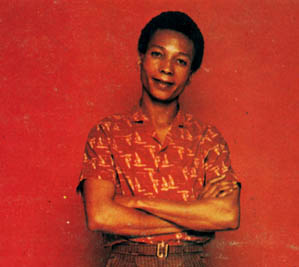
High-voiced Lovy Mokolo Longomba came in the middle of a distinguished family. He was a brother of Awilo and son of Vicky Longomba, founding member of OK Jazz who created Lovy du Zaire in 1971. His twin sons Christian and Lovy are hip-hop stars in Kenya today. Lovy started his career at 18 with Orchestre Macchi. In 1976 he and Dindo Yogo with guitarist Nseka Huit Kilos left Macchi and formed Etumba na Ngwaka with singers Lofanga, Gaby Yau-Yau and Mukolo, lead vocals (who later died in Kenya). Huit Kilos, of course, went on to star with l'Afrisa International of Rochereau and now backs Ricardo Lemvo in Makina Loca, based in Los Angeles. In August 1978 Lovy left Kinshasa and moved to Uganda where he met Siama Matuzungidi, and they both moved to Nairobi where Lovy joined Les Kinois, but three months later he quit that group for Boma Liwanza (Dindo Yogo meanwhile joined Viva la Musica, then Langa Langa Stars in 1981, and Tout Choc Anti Choc in 1983). After only 6 months with Boma Liwanza, Lovy was off again, to join Super Mazembe of Mutonkole Longwa Didos, and got the nickname "Ya Mama" because he would sing the high women's part in story songs. Band-mates included Joseph Okello Songa, Musa Olokwiso Mandala & Fataki Lokassa from Les Noirs. His hits included "Lovy," "Yo mabe," "Ndeko," "Nanga," "Mokano" and "Elena." Lovy left in 1981 & sang with Shika Shika for two years. He joined Mos Mos of Moises Fonta (with Monimambo and other members of his circle) before forming his own group Super Lovy (in May 1981) on the AIT label and, to avoid a contractual conflict, used the name Bana Likasi when he recorded for Audio Productions Ltd (Their "Mado Zaina part 1" can be found on THE NAIROBI BEAT (Rounder)). He recorded several solo albums produced by Felix Jakomo. In "Lomama," Lovy namechecks Massamba, Felix, Dialukila and Monimambo, so we can assume they remained friends. He even quotes "Tika na lela"! He was a founder of Ibeba System, along with Dhago Mayombe, but never recorded with them. In 1988 Lovy went to Dar es Salaam and performed with Orch. Afriso Ngoma. Lovy Longomba died in a car crash in Tanzania in 1996.
Tabu Frantal, Lifenya Lorri and Mandefu wa Mandefu were also band members of Shika Shika. The latter wrote five of their hits, including "Bibi moke," which were issued on the Jaca label. Tabu Frantal released "Helena" on the Hudson label with Orchestre Malekesa du Zaire. Nsilu wa Bansilu Manitcho (who was in Japan, but is now back in Kenya, doing Gospel music) of Bana Ngenge was also in the band, occasionally playing bass: he's name-checked in the song "Tina." Siama Matuzungidi was the rhythm guitarist. Born in the Congo in 1953, he grew up at a Jesuit school where he had unlimited access to the music room. Inspired by Bavon Marie Marie, he started playing guitar with Orchestre Cavacha in 1971. In 1975 he was with Orchestre Bibicha until 1978 when he quit Kinshasa for Kampala, Uganda, where he joined Kombe Kombe. He recalls: "Coco Zigo took me to Uganda and we formed Kombe Kombe band; this was in 1978. The same year Lovy Longomba joined us in Kombe Kombe; and Kanda Bongo Man came with Bella Mambo band. We played in the same club Monday to Friday. We kind of mixed the two bands together and lived in the same house -- all of us together for maybe a year. We moved to Kenya in 1979 with Coco Zigo, while others went back to Zaire. In Kenya the first band was called Viva Makale: we played at the Garden Square which was ruled by Buami Walumona and George Kalombo and then from there musical life in Nairobi began." Siama, who was given the name "Mualimu" or Teacher because of his skill on the guitar, also played with Orchestra Shika Shika until 1980 when he was a founding member of Moja One. He remembers: " I composed "Sisili" and "Rebeca" with Shika Shika band. With Moja One I contributed ideas, composed, and played rhythm guitar parts." He was also in Virunga then Ibeba System for five years (1981-85), including a three-year stint in Tokyo. After playing with Losaka in 1994 and Shangoya (1995-2004) Siama started Marimba Africa in Minneapolis, where he now lives.
Coco "Jeriko" Zigo Mike joined Shama Shama de Mopero before moving to Kenya as part of Viva Makale, Kombe Kombe, then Virunga (of Samba Mapangala), before leading his own Losako Musica in Nairobi. He also sang with Viva Stars in Kenya (probably a Viva Makale regrouping) and later formed Losaka la Musica and Bangambo Zigidia. He died in a Nairobi hospital in August 1998.
In the song "Amba," Masala, Longomba, Mutanda & Moni Mambo are name-checked. "Daina Akinyi", "Zainabu" (one of their members) and "Olivia" were other Shika Shika singles.
Guitarist Tabu Frantal (from Kisingani, Zaire where he played with Orchestre Succès Le Peuple) formed Boma Liwanza in 1972, with former members of Orchestre Revolution. They toured East & Central Africa frequently and ended up in Nairobi, touring the Indian Ocean islands and Madagascar. In 1981 Boma Liwanza dissolved and Frantal starred with Shika Shika until their dissolution two years later. In 1984 he helped form Vundumuna (out of the break-up of Virunga), which featured his pal Nsilu Wabansilu Manysho whom he met in Kampala, and who had gone from Boma Liwanza to Shika Shika with him. Sammy Kasule was another member of Vundumuna, as was keyboardist Botango Bedjil, a.k.a. B.B. Mo-Franck. Vundumuna was the top band in Kenya for two years. In 1987, B.B. Mo-Franck took Vundumuna to Japan for a six month contract, making them the first purely African band to play live in Tokyo. Drummer Lava Machine died in December 2005 while still living in Japan. Tabu Frantal also collaborated with vocalist Lessa Lessan (ex-African Fiesta Sukisa), who went on to form Orchestre Popolipo. Frantal has started a new Orchestra Vundumuna in Nairobi in 2006.
-- Alastair Johnston, with additions from Siama Matuzungidi, Cheeku Bidani, Ethan Bloomberg, Douglas Paterson & Peter Toll; & The World of African Music Vol 2 by Ronnie Graham.
Update February 2023: I have deleted the text reading "parts 1 & 2" after titles as it is self-evident.
Baba Gaston & Baba National
(For biography see above)
|
 |
LPs:
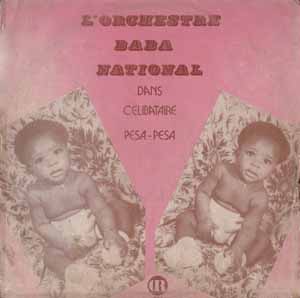
L'Orchestre Baba National dans Celibataire / Pesa Pesa
(AIT (Kenya) LP101 Licensed from Ogoua Int'l Records, Abidjan)
A1: Kanga Motema Kianda (Baba Gaston)
2: Celibataire (Baba Gaston)
B1: Epuka Tabia Mbaya
2: Pesa-Pesa
(Courtesy Alan Wheeler; Tim Clifford adds: "The B-side of the album seems to include two songs originally issued as singles on the Super Matatu label. Epuka Tabia Mbata, MTU 3, by Juwata Jazz and Pesa, MTU 4, by V.M. Malaika Weusi, who recorded for Simba wa Taita as Vuria Mwangeka Malaika Weusi.")
|
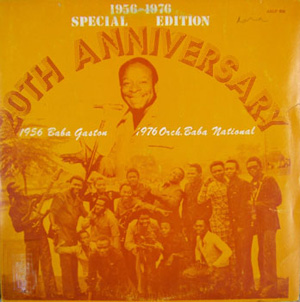 |
20th ANNIVERSARY (ASLP 906)
Side A:
Sous Ordre Ya Mwasi
Molukano
Side B:
Ilunga Na Mombasas
Baba Gaston Numero 3
Baba National
|
courtesy: East African Music |
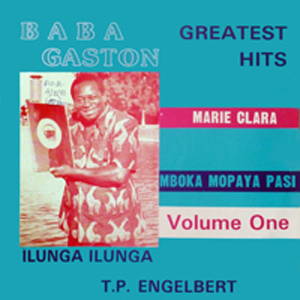
GREATEST HITS VOL 1 (ASLP935 ca 1981)
A1. Marie Clara
A2. Caesar ya Maobi (sic) i.e. Caesar Moyibi
A3. Ngai mwana nazongi (vocals by Starzo ya Estha)
A4. Lolo Twisonge
B1. T.P. Engelbert
B2. Lofundu ya pamba
B3. Mboka mopaya pasi
B4. Wa Ngoya
*Reissued on CD by Tamasha with muddy sound. See my review on Music of Congo page 4
(Not to be confused with next disc!)
|
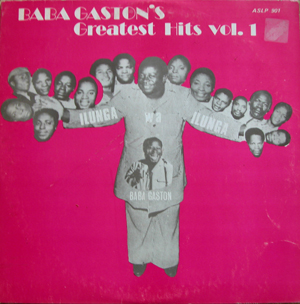
|
GREATEST HITS VOL 1 (POLP 901; ASLP 901)
Side A:
Ilunga-Ilunga1 &2
Mapenzi ya Peremende (Pipi)
Mangelepa
Side B:
Mei1 &2
Ain Souci
Ngai Nayo Dialoguete
Liner notes (courtesy of Alan Wheeler): At last PHONOGRAM (KENYA) Ltd has come out with Something Special -----something which has long been awaited. This Long Play by Orchestre Baba National should have been as ordinary as any other LP released in this country, but it is not.
This LP is special for obvious reasons: the music is of high quality and in the tradition of Baba Ilunga wa Ilunga "Gaston" himself who is noted for his tremendous sense of perfection: This LP has been made more special in the sense that most of the tracks have never been released before. You will enjoy the super hits like Mbula ya basi, Mapenzi ya Peremende, Mama Bana & Magenlepa and many more.
Besides the high quality of music -- not forgetting the best quality of recording -- there are other important factors which make this LP to be even more Special.
It does also commemorate the 20th Anniversary of Orchestre Baba National and 40th Anniversary of Baba Ilunga himself. And it is also the first LP by Baba Ilunga wa Ilunga in East Africa....
He was born 5th July 1936 at Likasi -- about 100 kilometers east of Lumbumbashi, the capital of Shaba Province in the Republic of Zaire. His main interest in music was prompted by the church choir.
When he was nine years old, Baba Ilunga wa Ilunga was a member of the Roman Catholic Church Choir at Likasi and Lumbumbashi and he attributes his initial success in music to his first teacher -- Joseph Kiwele -- who composed so many religious songs in Shaba Province in the early fifties.
Baba Ilunga wa Ilunga became a professional musician between 1951 and 1952 when he joined an all-white group -- the Orchestre de la Sabene -- in Lumbumbashi.
It is while in this orchestra when he composed what was to become his famous hit -- Baba Gaston. Baba Ilunga wa Ilunga owes his success in the field of profession music to his late Greek teacher -- Leonidas Rapitis -- who was a noted composer and pianist in the Republic of Zaire.
Rama Athumani, Taifa Weekly, Nairobi, 10th January, 1976.
GREATEST HITS VOL 2 (POLP 933) info needed
|
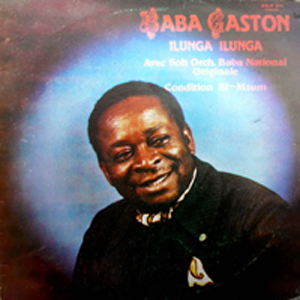
Courtesy: Doug Paterson |
CONDITION BI-MSUM ASLP 971 (1983)
A.1. Ekelekele
2. Hello Hello
B.1. Rudi Nyumbani Africa
2. Condition Bi-Msum
This LP was recorded at Studio Minzoto (Zaire) with singer Stazo Ya Esta (= Starzo ya Esta, Stazo Ya Estha). I assume Baba Gaston recorded this album with Kinshasa musicians during a trip to Zaire. (Peter Toll)
|
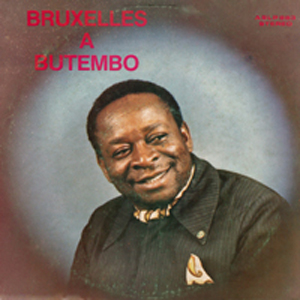
Courtesy: Doug Paterson |
BRUXELLES A BUTEMBO ASLP 983 (1983)
A.1. Bruxelles a Butembo
2. Okozua Nini
B.1. Lengema Big Manager
2. Vituko Vya Harusi
|
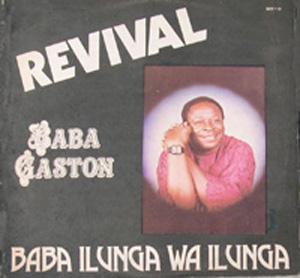 |
REVIVAL (ASLP 1004 1985)
A1: Adios chou chou
Vichwa viwili
B1: You love my friend
Kosa gani omeer
|
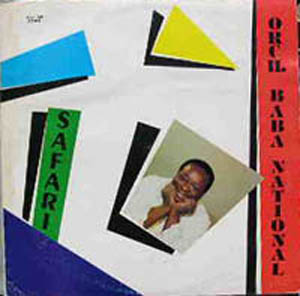 |
SAFARI (ASLP 1006 1985)
A: Nazonga mboka
Safari ya Tanzania
B: Nyongo mpenda watu
Que sera sera
Baba National
Baba National 45s:
Affaire Zua b/w Piele Boniko? (Kabila Kabanza/Baba Ilunga) ASL 7-1515 1973
Assana-Nela (Ilunga wa Ilunga) ASL 2254
Baba Gaston (bis) b/w Mubenga Abondela (Starzo Ya Estha) Eds Tshondo TSH17 ("Rythme Sekesa")
Batela-Bana b/w Noel Nakalemi ASL 7-1516 1973
Bembeleza Bolingo (ASL2241?)
Bombanda Jamais (Vangu-Aloni) ASL 7-2181
Bonne Annee New Year (Baba Ilunga wa Ilunga) ASL 7-2212N
Bruxelles a Butembo (Baba Gaston) ASL 7-003 1983
Caesar Moyibi (on CD; see below)
Celibataire (Editions Ba-Ba Kenya single IWI-5)
Cherie Mbambi (Baba Ilunga wa Ilunga) A.I. music
Elongi ya Petolo (Kaniki/Maki) KMG5201 (1976)
Fungula Matoli toli B. N. (Lutulu Kaniki) ASL 7-2165 1977
Guanzo (Baba Gaston) Ed Ba-Ba IWI-7
Heshimu mtoto wa shule (Baba Ilunga wa Ilunga) ASL 2294 1982
Idd Mubarak (Baba Ilunga wa Ilunga) ASL 7-2208
Ilunga Ilunga (ASL 2086) 1975
"Ilunga Ilunga" is on ANCIENT SUCCESS VOLUME ONE (ASLP426) & the CD listed below
Kai Kai (collected on the CD below)
Kakolele Viva Xmas (Baba Ilunga; featuring Moreno) ASL 7-2164 1976
Kiolela (Nana) ASL 2249 1979
Kula Keba (Baba Ilunga wa Ilunga) ASL 7-2200N
Kwa mutu malela (Baba Ilunga Ilunga) ASL 2287 1981
Lolo Twisonge
Lulu Masamba (IWI 6)
Madaraka kwa yaya (Ilunga wa Ilunga) Edition Kamanyola KAM14
Maja aba Mpamba No 2 (Tshikuna) ASL 7-2119 1976
Mapenzi ya peremende b/w Mke Mwenzangu (Baba Ilunga wa Ilunga) ASL 7-2179
Maria Clara
Mboka Mopaya [Note: also a Johnny Bokelo title]
Mbongo Mobomi Mpe Mobongisi (Baba Gaston) Eds Tshondo TSHK2
Mtoto wa munyonge (Baba Ilunga wa Ilunga) ASL 7-2235 (AS 4575)
Mubenga Abondela b/w Baba Gaston (bis) Eds Tshondo TSH17
Munga 1 & 2 (Baba Ilunga wa Ilunga) ASL 7-2223 (Mapocho Pocho)
Musao Iyambi (Lutula) b/w Lukengo Kiwelewele (Baba Ilunga) Sindimba SIN 14
Nakuomba (unreleased recording from Jojo Records, issued on Nairobi Calling LP, 2017)
Nakupenda (Baba Gaston) sung by Lovy, performed by Baba Ilunga wa Ilunga (DoromyDM80 "Yakisaka")
Naleli Big Manager Lengema (Ilunga wa Ilunga) ASL2260N (AS4711)
Nazonga Mboka (ASL2347)
Ndoto ya mpaka (Baba Ilunga) b/w Au de Pourvu (Lutulu Kaniki) ASL 7-1517 [waya-waya] 1973
Ngai Baba Nakosambwa (Baba Ilunga wa Ilunga) Eds BaBa IWI 7-2
Ngai Muana nazongi (Stazo ya Estha) b/w Lofundu ya Pamba (Tshondo 11: reissue African 90.505 1971)
Ngai Nabeleli (collected on CD; see below)
One Way Traffic Edition (Baba Ilunga wa Ilunga) Kamanyola KAM 15
Pembeni ya mbanda (Lutulu) b/w Separation na mutawa (Baba Ilunga/Sangwa Ngulli) ASL 7-1523 1973
Pembeleza bolingo (Nana Akumu wa Kudu) ASL 7-2244
Pourquoi Fifi? IWI 7/1
Relaxing/Yarroo (on ZAMBIA 64 soundtrack album) (EMI JCLP10044)
Rosi (Baba Gaston Ilunga/Kalenge) b/w Kiswahili lugha ya Africa (Baba Ilunga) Sindimba SIN3
Saadi Malingaka (Baba Ilunga wa Ilunga) A.I. music
Sakina mama b/w Mamango bokata Kikambo (Sangwe; Baba Ilunga) Sindimba SIN13
Seli Tutu (ASL2247)
Soul Safari (Wangoya No 2) b/w Mama bea nakokate (Ilunga wa Ilunga) ASL 1536 1974
Sweet sweet mbombo (Baba Gaston) Polydor 7-382 1977 (included on Soundway KENYA compilation)
Tanu-Afro Yajenga Nchi b/w Zabibu Kalemi (Baba Gaston) SINDIMBA SIN7-001 (Tanzania 1974)
Tokosamba b/w Baba Gaston No 3 (ASL 2123)
Toli ya mwasi (Lutula Kaniki) ASL 7-2189N
Unyumba sio lela b/w Tokisana tata Kabassele ASL EP001
Vituko Vya Mama Mkwe (Baba Gaston) Eds Ba-Ba IWI-8
Wangoya
Winnie
You Love my Friend (Baba Ilunga Wa Ilunga) ASL2344
Zala Reconnaissant Fa Fan b/w FC Lupopo Bana ya tembe (ASL 1520)
Celebration (Cassette):
[more info needed]
Amisi Omonelinga (Lovy)
track 2: Manena (Lovy)
track 3: Zaidi (Lovy)
related bands:
Baba Gaston & Orch Tchondo National "Kalai"s YAHOOS YS001
Orch Tchondo Nationale "Mwambusa" (Evanika) YAHOOS YS002
CDs:
Baba Gaston: Baba Ilunga Ilunga & Ngai Nabeleli (Tamasha)
1. Kai Kai 4'40
2. Ngai Nabeleli 8'38
3. Winnie 9'01
4. Ilunga wa Ilunga 8'36
5. Baba Gaston 3'39
6. Rudi Shambani a.k.a. Safari ya Tanzania 8'27
7. Qui Sera Sera 9'12
8. Africa au Zaire 8'47
* Note: Beware of a mislabelled version of this CD available from various download sites such as Amazon and Limewire. It is actually a Negro Sucèss album. I have listed the track times above to help in identification.
|
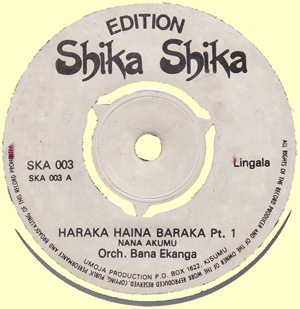
courtesy Alan Wheeler
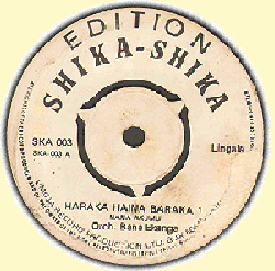
courtesy Afro7 net |
Bana Ekanga
An offshoot of Baba Nationale, featuring Yassa Bijou Ley, later in Bana Ngenge and Pepelepe, and female vocalist Nana Akumu wa Kudu, also of Pepelepe & later OK Jazz. Nana's lovely song "Haraka Haina Baraka" uses a well-known Swahili catchphrase meaning "Hurrying is bad for your health" or "Haste makes waste." "Auma" tells the story of the band's travels from Zaire to Uganda to Nairobi, Kenya, "gentille pays (a lovely country)." Bana Ekanga's songs also exhort Jim (i.e. Jacques Akomo?), Kasule Mopepe, "Santana" Mongoley (ex-lead guitar of Lipua Lipua), Dago Mayombe (singer), Ochudis (singer), Adey, Tobina (label owner?), Tabou (Frantal? guitar), "Mwalimu" (i.e. Siama, rhythm guitarist), Juma, and (drummer) Lava Machine.
45s:
Amboko (Yassa Bijou-Ley) Safari SAF18
Amemiki (Lisasi Ebala) Ed Dokan ENO 001*
Auma (Bijou Ley) Eds Shika Shika SKA 004
Bana Ekanga (Bijou-Ley) Bolingo DD10
Basala kala (Nana Akumu) Eds JACA JRP27 1981?
Haraka Haina Baraka (Nanu Akumu) Eds Shika-Shika SKA003
Hodi Hodi (Tabu Nkotela) Safari SAF 15
Liwa ya mama Tabu (Tabu Nkotela Kiombwe) ASL 3392 1981
Mitelengano (Nana Akumu) Tobina TON36
Mokili (Dhago Mayombe) Safari SAF 14
Mwana Marehemu (Rey Seme) MALI MOTO RICH01 (Seko-Seko)
Nziki-Nziki (Yassa Baita Bijou) CBS Linga 12 ca. 1980-81
Sukuma-Wiki (Yassa Bijou-Ley) Tobina TON 30 ca. 1981
Santa (Bijou-Ley) Edition Dokan ENO002
Wasi wasi ya nini? (ASL 3396) 1981
On LP:
*Amemiki part II included on Nairobi Calling!, No Wahala Sounds NWS5, 2017
Super Ekanga 45s:
Maluki Papa (Bijou Ley) Ed Tingiza TING 1
Mokolo na kokufa (Bolingo Sitho, but a cover of Tabu Ley?) Eds Tingiza TING 005
Bana Moja (a.k.a. Bana Modja)
(Bana Modja were DjoDjo Ikomo's group whom he left behind in Kinshasa when he went to Uganda. In Kampala he teamed up with some Veve musicians and they moved to Nairobi in 1975 but soon disbanded. When DjoDjo returned to Zaire he regrouped with his old bandmates)
Note from Mbokamosika blog:
On the origins of Bana Modja: The group was formed by Thomas & Felly Ndjoku, the sons of N'Djoku Ey'Obaba, former governor of Kinshasa, and their cousins Jojo & Alexis Ikomo. Bana means offspring and they were literally from the same family. Thomas Ndjoku was also owner of the Bana Modja label and produced many bands such as Yoka Lokole, the breakout band from which Papa Wemba and many members of Zaiko and Viva La Musica emerged. They were called "Belgicains," because they studied abroad, when they returned they were shunned by their parents for taking to music so moved to N'Djili, Zaire on their return. Because of family pressure they did not tour and perform but rather concentrated on recording and issuing 45s. Felly went on to be the arranger for Lita Bembo. Thomas became a Christian minister and continues as a gospel artist. Jojo went on to work with Pepe Kallé and plays the occasional gig with old pals.
Personnel:
Jojo Ikomo, singer
Moreno, singer
Fataki "Los Los" Lokassa, singer/guitar
Alexis Ikomo
Roxy Tshimpaka, guitar solo
Nsilu Wabansilu "Manitcho," bass
Lawison Somana, sax
"Ochudis" Mandala Otis Muissa, singer
Nzengele Saida, guitar
Beya Maduma (a.k.a. Moro Maurice), sax
The Kin-based band, known as the Belgicains because they all studied in Belgium, formed in the early 80s included:
Boutié (tenor)
Dada Akoma (bass; later with Langa Langa Stars)
Gérard (harmony singer)
Thomas Ndjoku
Felly Ndjoku
Petit Mando (drums)
Elvis Kunku (2nd guitar; later with Empire Bakuba)
|
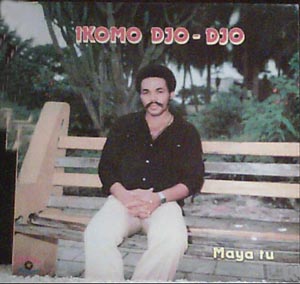 |
LP:
Ikomo Djo-Djo & Orch. Bana Modja: Maya Tu
(Kina-Rama LP KR1007)
(Recorded by Mayaka Esongama, Kinshasa, distributed by Sonodisc, Paris)
1. Amour Go
2. Kaiba
3. Maya Tu
4. Souvenir Go
45s:
Note the publisher is Bana Modja, not Bana Moja!
Bona (eds. Bana Modja)
Maya tu (Ed. Bana Moja, later redone for the LP "Maya Tu", KR 1007; reissued African 90853)
Azonga (Eloko Djo Felly) / Koyoka koyoka (Engange Djo Djo Ikomo) Eds. Bana-Modja 02; reissued African 90.984
Okei kolakate nika (Nono Tamango) / Na bangi makambo (Ey'osuka Djana) Edi. Bana-Modja 03; reissued African 90.985 1975
Mabaku (Eds. Bana-Modja 04; reissued African 90986)
Mayatu (Ikomo Djo-Djo) African (Paris) 90.853 1974
Miseminga
Londia (Kina Rama 2)
Munsi b/w Manz (Ikomo Djo Djo) ASL 7-33080, re: EMI/Pathé PEA215
Bana-Mike
This appears to be a one-shot band, with Thoms Lomboto on bass
Masikini b/w Hatuna Chuki (Tommy, arr: Yakub) MOTO MOTO Moto 7 - 2 [Lingala]
|
 |
Bana Ngenge
"The new Bana Moja was formed out of members of Orch Veve, led by Jojo Ikomo and Fataki Lokassa, on tour in Uganda. The band disbanded in 1975 with several members moving to Kenya where they regrouped as Bana Ngenge but only lasted a year before splitting again. Bana Moja the label, seems to have been created to release Bana Ngenge records and its name outlasted the band." -Tim Clifford. The song "Bana ya Ngenge" tells the story of their formation.
Line-up:
Djo-Djo Ikomo, Fataki Lokassa, Moreno, "Ochudi (or Ochudis)" Mandala Otis Musa, Yassa Bijou Ley, Kavabuha Augustin - vocals
Roxy Tshimpika - solo guitar
Nzengele Saida - guitar
Thierry "Chery" Matumona Kikaya - guitar
Apollo (?) - guitar
Nsilu Wabansilu "Manitcho" - bass
William Tambwe Lokassa - bass
Maurice "Moro" Beya Maduma - sax
Lawison Somana - sax
Lava Machine / Alexi / Augiga - drums
|
|
 |
BANA NGENGE 45s:
Bana ya Ngenge (Nsilu Wabansilu) Bana Moja BANA10
Belinda (Fataki Lokassa) Bana Moja 11
Bo moto Manytsho (Nsilu Waba Nsilu) Musiki du Zaire MZ 102 (P) 1976
Cherie Flora (Ingange Ikomo Jojo) or Cherie Fleur
Cherie Peter
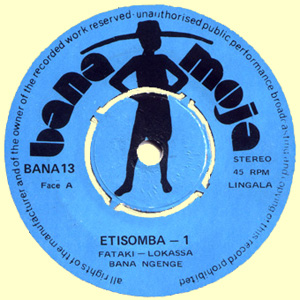
Etisomba (Fataki Lokassa) Bana Moja BANA 13
Kayumba (Ingange Ikomo Jojo)
Note: This and the version on the Melodica CD Vol 1 are identical to the single ASL 7-2124 issued by Jojo Ikomo under his own name
Koliya ya mpesa (found on Grand Piza CD)
Kolokota (Fataki Lokassa) Eds BABU 012 (a "Shika Yeye")
Kombe Kombe (Ingange Ikomo Jojo)
Note: This and the version on the Melodica CD Vol 2 are identical to the single ASL 7-2128 issued by Jojo Ikomo under his own name
Lobe Lobe (Fataki Lokassa) Bana Moja BANA 9
Malanda (Fataki Lokassa) Bana Moja BANA 14
Msema Kweli Baba (Fataki Lokassa) Eds JACA JRP12
Mwajuma (Nzengele Saida)
Nairobi() Eds Tobina?
Nira (Mandala Mwisa) Tanzanian Film Corp TRS008 P1977
Nzela ya Mombasa Wakuze (Mandala Muissa) (Musiki du Zaire MZ100) (p)1975 Bokuku
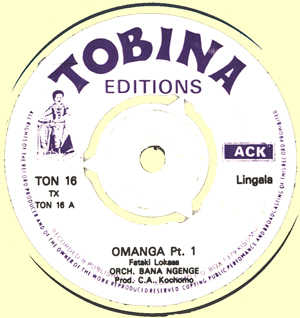
Omanga (Fataki Lokassa) Tobina Editions TON16
Selina (Fataki Lokassa) BABU 11
Zainabu (Mandala Musa) Kung Fu TON17 ca 1981
|
|
 |
Bana Ngenge CDs:
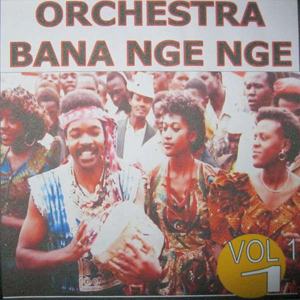
orch BANA NGE NGE "Vol 1" Melodica (Kenya)
1. Kayumba (taken from a scratched record with "double dolby" & too much bass; on top of that the record sticks at one point!) (by Jojo Ikomo) orig: ASL 7-2124 1976
2. Belinda (Fataki Lokassa) orig: Bana Moja BANA 11
3. Malanda (also from a record with surface pops) (Fataki Lokassa) orig: Bana Moja BANA 14
4. Etisomba (Fataki Lokassa) orig: Bana Moja BANA 13
5. Lobe Lobe (Fataki Lokassa) orig: Bana Moja BANA 9
6. Omanga (Fataki Lokassa) orig: Eds Tobina TON 16
|
|
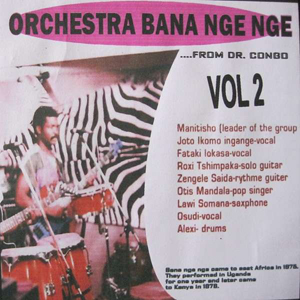 |
orch BANA NGE NGE "Vol 2" Melodica (Kenya)
1. Bana ya Ngenge
2. Cheri Peter
3. Kombe Kombe
4. Cheri Clara (i.e. "Cherie Fleur," presumably the song also known as "Cherie Flower" published as Jojo Ikomo & His Orchestra ASL 2122)
5. Seline (i.e. Selina)
Mostly taken from badly dubbed cassettes. Budget in every sense of the word, reprocessed sound with the classic Melodica "rinse" to remove the sonic brightness & render it as auditory mush. All of these tracks on the 2 CDs have been posted on YouTube where you can judge the sound quality.
Bana Ngenge Stars Popote
Dunia Imelaniwa (Fataki Lokassa) Universal Sounds USD005
Luna (Fataki Lokassa) Shameji SEM 02
|
|
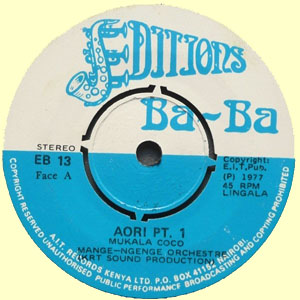
Mange-Ngenge Orchestre
(Yet another formation with Coco Zigo, and presumably some remnants of Bana Ngenge)
45s:
Sugar Mami (Coco Mukala) Editions Ba-Ba EB12 (1977)
Aori (Coco Mukala) Editions Ba-Ba EB13 (1977)
|
 |
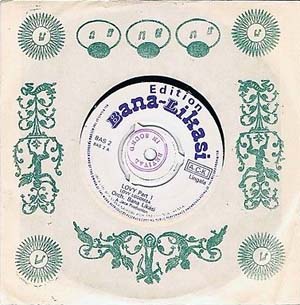
Bana Likasi
See also under Lovy
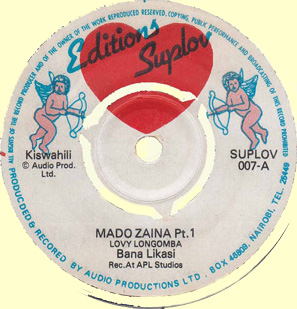
Likasi, Congo, was Baba Gaston's hometown, and presumably Lovy Longomba's as well. Bana Likasi the band was a side project of Lovy in 1985 when he wanted to avoid contractual obligations for his group Super Lovy. According to Julian Thorpe's website the Bana Likasi musicians were members of Super Mazembe: Katele Aley (vocals), Kalombo Mwanza George (sax), Miketo Rapok Kayembe (vocals), Atia Jo (bass), Lovy Longomba (vocals), Didos Mutonkole Longwa (singer), Kasongo Kanema/Madjo (vocals) and Roddy Mapako Lobe. They recorded on AIT's subsidiary which was Lovy's own Suplov label, and Editions Chris Tetemeko. We can add Kalala Mbwebwe, who wrote "Imbe," to the line-up.
45s:
Auma (orch Bana Likasi) Eds Bana-Likasi BAS1
Bilangwela (Lovy) SUPLOV 5 (P) 1985
Fatuma (Lovy Longomba) SUPLOV 10
Imbe (Kalala Mbwebwe) Eds Suplov 008 (Kiswahili; recorded at APL Studio) ca 1985
Jose
Keba-yo (eds LOVY 07)
Lena (Kanema) Eds Chris Tetemeko CHRIS7 -- mislabeled should be "Leah"
Lovy (Lovy Longomba) Eds Bana-Likasi BAS2
Mado Zaina (Lovy Longomba) Eds Suplov 007
Part one of "Mado Zaina" can be heard on the Rounder LP The Nairobi Beat, and also on Kenya-Congo Connection from No Wahala Sound (NWS3 2016)
Mayopa (Alley) Eds Chris CHRIS05 (also on Best of Editions CHRIS cassette/CD)
Monni CHRIS06
Bana Nzadi
See under Moreno
|
courtesy Alan Wheeler |
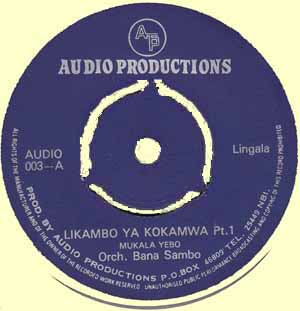
Orch. Bana Sambo
Rocky Musumbo is guitar soloist. Mukala Yebo is presumably the same as Mukala wa Mulumba, percussionist and vocalist who paid his dues alongside Nico, Mangwana and Papa Noel in bands like Vox Africa & Cercul Jazz before joining Virunga and then Les Mangelepa in Nairobi in 1977. That fits with the known date, 1980, of Bana Sambo's release on Polydor. Bassist Manitcho, now based in London, was also a member. It was a nzonzing band, in the A.I.T. studios.
45s:
Bolingo ya Lokuta (Salute) Audio Prods AUDIO 002
Esther (Bana Sambo) Audio Prods AUDIO 013
Likambo ya Kokamwa (Mukala Yebo) Audio Prods AUDIO 003
Solongo (Bana Sambo) Audio Prods AUDIO 001
Uwongo Haufai (Rocky Musumbo) Polygram POL467 1980
"Bolingo ya Lokuta" and "Salongo" are included on the Hit Parade LP Hit After Hit (HPLP003) compiled by Babu Shah, along with a track from Kilimambogo Bros, and one from Shika Shika. Rochereau and Bwambe Bwambe also had songs called "Solongo."
|
|
Orch Bassanga
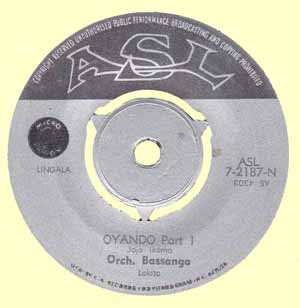
Orch. Bassanga, led by saxophonist and vocalist, George Kalombo Mwanza, also featured Jojo Ikomo, guitarist Loboko Pasi (later of Boma Liwanza and Super Mazembe), Batchalinge Tabu Ogollah (of Boma Liwanza, Special Liwanza, Shika Shika, Les Jaca, before he moved to Japan), William Tambwe Lokassa (bass) and the Ethiopian Tamrat Tommy. They split up on arrival in Tanzania in 1975. Drummer was Kavabuha Augustin, alias Augiga, from Burundi who began singing in a church choir at age 9. He studied music before joining Nairobi Bassanga, Bana Ngenge, then Bwambe Bwambe; among his other bands were Afripal and Superflies. In Tanzania he joined Masantula Ngoma and Orch Makassy before returning to Burundi where he founded orchestra Imboneza. He returned to Tanzania to join Lake Tanganyika Club Band, made up of veterans. (The Bassanga are cave-dwelling people in Southern Katanga province, Congo.)45:
Oyando (Jojo Ikomo) ASL 7-2187N
Wild Guy (Mike Tilasi) b/w Sweet & Soul Time (Mike Tilasi & Lawrence) English / Polydor POL7-373
|
|
Orchestre Batcha Lokito Band
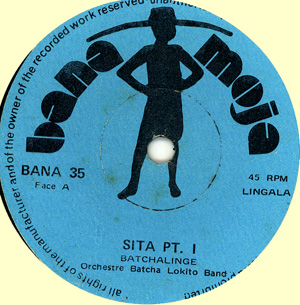
I found one single from this band on the Bana Moja label, written by Batchalinge, aka, Tabu Frantal. Probably done at the same time as Jojo Ikomo's album with Orchestre Lokito.
Sita (Batchalinge) Bana Moja BANA 35
|
courtesy Samy ben Redjeb |
Orchestre Bella Succès
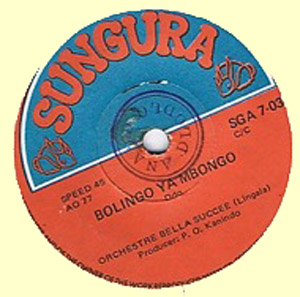
No info on this band, who may have come from Southern Congo via Zambia. I don't think there's a connection to Vercky's band Bella Bella that was one of the giants of the era, but there may be with Bella Mambo, an offshoot formed by Kanda Bongo Man.45s:
Balobi no somba pupe b/w Muleke no 1 (E T Sango) AIT122
Bolingo ya Mbongo b/w Mobutu apiki nda lapo (Ddo; Eva-Sango) Sungara SGA7-036 (AO75/AO77) prod: Oluoch Kanindo
Grace Isa Kunotupane b/w Kaunda na Zambia (Moto Moto MOTO 7-3)
Muleke no 2 b/w Rukia amuuza mwanangu (Moto Moto MOTO 7-19)
|
 |
Boma Liwanza
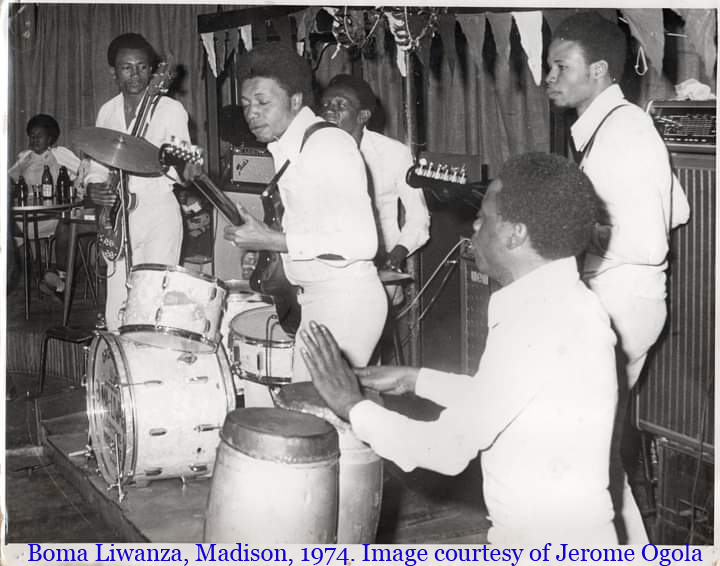
L to R: Babel on bass guitar, Tabu Frantal on lead guitar, Mitchoum on drums, Malou on congas, Roger on rhythm guitar
Personnel (1972-81):
Lola Shango, leader
Tabu Frantal (a.k.a. Tabu Batchalinge Ogolla), guitar, founder (who also formed a group called Batcha Lokito, who recorded "Sita" on the Bana Moja label)
Roy Mosanda, guitar (also in Shika Shika)
Bibiley Kabaka, guitar
Christopher Eshu, founder
Daid Nsilu Wabansilu, bass
Etchou Ndjadi Mitchoum, drums
Monimambo Jim, vocals
Lovy Longomba, vocals (for 6 months in 1979, during a stand at the Starlight Club)
Moreno, vocals
Lokombe, vocals
Kikuni "Mbongo Pasi" Bercky (singer, sax player, named after Verckys)
Loboko Pasi, rhythm guitar
Boli
Malou, congas
Roger, rhythm guitar
Siama recalls: "After Boma Liwanza broke up initially, I became the guitarist for a short time and we played in Mombasa, but at the end of 1981 I went back to Nairobi and in 1982 we started Virunga and played at Starlight Club until 1986."
|
 |
LPs:
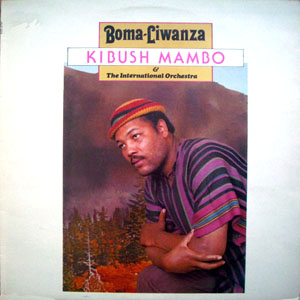
Boma Liwanza: Kibush Mambo (CBS Africa JSLP003)
A:
Back to Africa
Mono (Mbongo Pasi - Bercy)
Sina Mambo 1 (Kikuni "Bercky" Mbongo Pasi)
B:
Boma Liwanza Special (Instrumental)
Sina Mambo 2 (Kikuni "Bercky" Mbongo Pasi)
Bilobela (Kikuni Mbongo Pasi)
(Note: In "Bilobela" the band yells out "Shika yele," possibly the origin of the catch phrase.)
|
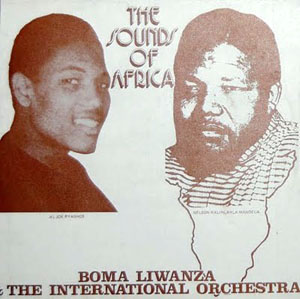 |
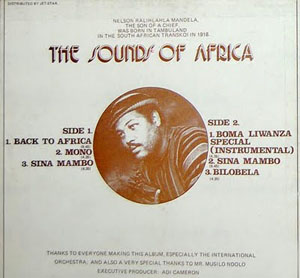
Boma Liwanza, the International Orchestra: The Sounds of Africa (JET STAR jslp...)
A:
Mono (Mbongo Pasi "Bercy")
Sina Mambo (Kikuni "Bercky" Mbongo Pasi)
B:
Bilobela (Kikuni Mbongo Pasi)
Masua Mabe (Kikuni Mbongo Pasi) also on 45
(In "Masua mabe" they sing "Shika Shika" -- caress caress -- possibly the origin of the later band's name)
|
 |
CD:
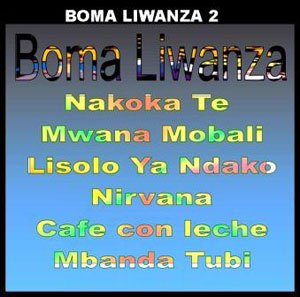
Boma Liwanza 2 (Melodica, Nairobi)
Nakoka te
Mwana Mobali
Lisolo ya Ndako
Nirvana
Cafe con Leche
Mbanda Tubi
There are six tracks on here, credited to Boma Liwanza, but don't get your hopes up. First of all the whole thing is less than half an hour, and secondly it was recorded, it seems to me, at the wrong speed, so all the tracks sound too fast. Plus the last one sounds like it was recorded on a cheap tape deck off the radio! I doubt that was the band's intention. The whole thing is also overmodulated, to really ruin your enjoyment of this band, but then again I am not sure it IS Boma Liwanza. The best track on here is "Cafe con Leche," the most amazing take off of OK Jazz ever achieved by another band. The guitarist goes off on one of those demonic two-fingered leads between choruses and is egged on by people yelling "Juba," one of whom sounds like Sam Mangwana. According to kentanzavinyl.com, "Café con Leche b/w Nirvana" is a single on the Pathé label (PEA 217) by Mundemba & His Underground, so two of the tracks credited to Boma Liwanza are actually by Mundemba, about whom there is no information on line. The other four tracks are almost certainly by them, having appeared on two 1973 SOMO 45s as A-side and B-side.
|
 |
Boma Liwanza 45s:
In 1975 Monimambo left to create Special Liwanza (see below), but they continued and in 1976 they cut 8 sides for Pathé
Atosha Na Furaha b/w Tumba Mado (Wawa Litanda Babel) Somo SM 7-8010 (1973) "Sakumuna"
Bambanda ya Batchi () Pathé 101
Baruti (Magalano Ligbutu Lady's) Somo SM7-8001 1973 re: ASL 7-1500
Bolingo Happy (Magalana Ligbutu) Pathé 105 (1976)
Bridgita (Magalano Batshi) ASL 3386 (1980)
Brother Man () Pathé 107
Catharine Obebisi b/w Omeka Tembe - Somo SM7-8011 (1973)
Diabaza (Jimmy Monimambo) Bana Moja BANA34 -- N.B. A different song from "Diabanza" by Shika Shika; I believe it's the name of a band member
Easter () Pathé 103
Elengene (a.k.a. Café con Leche?)
Fauzia () Pathé 106
Jera Inn (Kikuni Mbongo Pasi) Jera Inn GOO 001
Josephine (Wawa Babel) ASL3391N (P)1981 (c)Polygram
Lisolo Ya Ndako b/w Mbanda Tubi - Somo SM7-8002 (1973)
Ma Bibi b/w Mary Akinyi (AFRICA AFR7-47 1973)
Masua Mabe (Kikuni Mbongo Pasi) Sango SAN22 1979; re: ASL 7-3362
Mbanda na Mbanda (Kikuni Mbongo Pasi Berky) ASL7-3368
Milimani (Monimambo Jim) ASL 3376 (March 1979)
Miwela wela (Mawa Litanda Babel) ASL 3378 (Nov. 1979); included on ASLP920 The Very Best of Zairean Music
Nakoka Te (Boli) b/w Mwana Mobali - Somo SM7-8006 (1973)
Ngai Bebe b/w Wilermina (AFRICA AFR50 1973/4)
Sina Mambo (Kikuni "Bercky" Mbongo Pasi) Super Musiki du Zaire (1978?)
Siza () Pathé 100
Sofia () Pathé 104
Wema pyame () Pathé 105
Zala serieux (AFRICA AFR 7-48 1973)
Zawadi ya mwaka () Pathé 102
(Note: Thanks to Alan Wheeler & Kentanzavinyl.com for most of the info)
|
courtesy KenTanza |
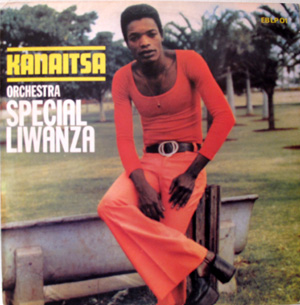
Special Liwanza
Personnel (1975-81):
Jimy Monimambo, vocals
Sammy Kasule*, singer/bass guitarist
Nsilu Wabansilu, bass
Lifenya Lorry, vocals?
Tabu Saidi Ogolla "Frantal," lead guitar
Ali? sax
Jim Masala
& undoubtedly some of the above band, Boma Liwanza, including Lovy Longomba (vocals)
(*According to KenTunes, Sammy Kasule was born in Uganda. He fled to Kenya and joined Les Noirs. He also played with Vundumuna and recorded two solo albums: Kasule and Muziki. Since 1991 he has lived in Sweden and has a band named Makonde, with whom he sings & plays bass.) Special Liwanza had a single "Kanai" released in Ivory Coast, they also backed Laba Sosseh on a Lassissi release, so it is very likely they made a West coast tour.
LP:
Kanaitsa (AIT records, EBLP 01, 1977)
Side 1
Kanaitsas (Monimambo Jim)
Mays (Sammy Kasule)
Side 2
Ayoma Wa Bunyores (Lifenya Lorry)
Basi Ya Dumbas (Monimambo Jim)
|
 courtesy Alan Wheeler |
Produced by Daudi Kabaka
Sleevenotes (courtesy of Tim Clifford):
Ntshimba Monimambo - better known as "JIMY" was born in 1949, November 15th at Kinshasa Zone Barumbu.
Went to St. Paul School, Barumbu for six years, left in Standard Six and proceeded to College to study mechanics for two years during which he developed a love of music, becoming a musician as a singer. He left the college in 1967 and joined Orchestra TAMPALA in 1968 as a Vocalist. He did only one year in TAMPALA and in 1969 he joined Orchestra LOS ANGEL of Reuben Mawa.
In 1970 he left Los Angel and joined Orchestra VIPER NOIRS. In 1971 he left Viper Noirs to join Orchestra CERCUL JAZZ in Congo Brazzaville. In the same year he left Cercul Jazz after six months to join Orchestra Super Vox in Isiro Province of Zaire then lead by the famous Bijos Bikasi. In 1973 he joined Orchestra Success Mwachana in Kendu Town of Kivu Province. From there is when he joined the Boma Liwanza of Mzee Shango Lola with which he came to East Africa in 1974. As he puts it in his own words, "This is the man who really taught me real music. I mean Mzee Shango Lola. This made me realise that all that I had been doing was just not good enough".
In 1975 he left Boma Liwanza and formed his own Band Orchestra SPECIAL LIWANZA which he leads until today.
This is his first album and he hopes it is going to be worth the whole lot of trouble he took to DO-IT-UP for the sake of his good and faithful FANS.
|
 courtesy Alan Wheeler |
Special Liwanza 45s:
Achachambala (Ogolla Tabu Saidi) Eds Chris Tetemeko CHRIS-31
Ayoma (Lifenya Lorri) Editions Ba-Ba EB9 1976
Cherie Mbala (Moni Jim) Bolingo DD5
Chris Uniponye (Dr Tabu ATC-Ogollah) Editions Les: TREMOR 3
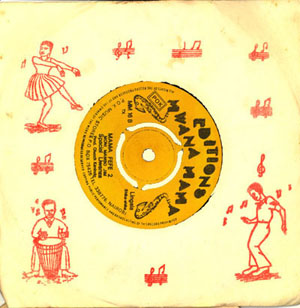
Elisa (Monimambo Jim) editions Mwana Mama MM22
Elisa Warimo (Tshimba Monimambo) Editions Ba-Ba EB10 1977
Henriette (Lifenya) Wasi Wasi WW7 (P)1976
Kanai (Tshimba Monimambo) Eds Ba-Ba 8 (Nbo) 1977 + Societée Ivoiriènne du Disque
Kanaitsa (Editions Ba-Ba EB8) 1977
Lily (Sam Kasule) Wasi Wasi WW7
Liwa ya Mama (Dr Tabu Saidi) Eds Chris Tetemeko CHRIS-4
Mama Emily (Tabu Saidi Batchalinge) Eds Babu BABU 009
Mama Fefe (Moni Mambo Jim) Editions Mwana Mama MM 16
Maria Chantale (Tshimba Monimambo) Editions Ba-Ba EB 11 (p)1977
Masasu (Monimambo Jim) Editions Mwana Mama MM17
Mbanda Mineur (Batchalinge Tabu & Franthal's) ASL 7-2093 1975
Mpenzi Wangu (Marie Wandaka) Doromy DM26
Mwale (Tabu Saidi "Ogalah") Golden Toddy; also City Boom CB1 1979
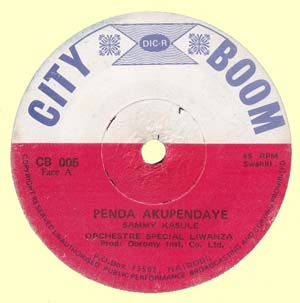
Penda Akupendaye b/w Mungu Ni Samee (Sammy Kasule) City Boom CB005
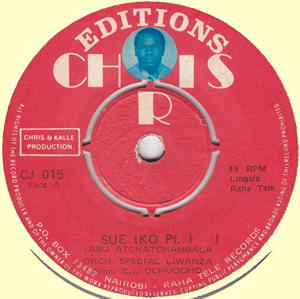
Sue Iko (Tabu Atchatchambala) Editions Chris CJ 015
Towumelite (Tule Wa Lupini) Editions Ba-Ba EB7-2 1976
Vicky (Monimambo) recorded 25/1/75 Africana (AIT); Editions Ba-Ba EB1 1976; re: RCA Victor PB 9159 1977 (included on Stern's Urgent Jumping 2016)
Zumba (Moni Mambo Jim) Editions Mwana Mama WEM5
Special Liwanza & Shika Shika
Presumably a transitional band. Alan Wheeler discovered two singles which are credited to them jointly:
Salula (Jim Masala) Musiciana MUSA 001
Sala (Jim Masala) Musiciana MUSA 05
|
 courtesy Afro7 |
Liwanza Komecha
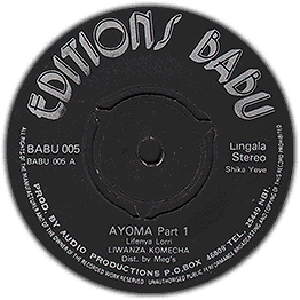
Ayoma wa Bunyore (Lifenya Lorri) Eds BABU 005 (Also on the Special Liwanza LP)
Juliana (Lifenya Lorri & Liwanza Komecha) Eds BABU 006
Liongela (Lifenya Lorri) Eds BABU 008
|
|
Bwambe Bwambe and Super Bwambe
Personnel: George Kalombo Mwanza, sax; John Ngereza, guitar; Tchou Tchou Batenga, vocals; Kayembe Nyonga, vocals; Luboya wa Tshiteyai; Matabu Kunyanga. With Thomy Lomboto, a.k.a. Kabeya Ilombo, bass, from Viva Makale. George Kalombo had started in a band called Bakoka (also the name of a town in the heart of the Congo, and a label in Kenya) and then gone East to Northwestern Tanzania, to Mwanza (my conjecture, since he added that to his name), where he formed Orch Bassanga (with Monimambo Jim). His most successful band was Viva Makale. John Ngereza was a Tanzanian who left Bwambe Bwambe to form Les Wanyika with Issa Juma in 1978 (Tchou Tchou Batenga followed), where he also swapped rhythm for lead guitar. Bosho (or "Beauchaud") Kayembe Nyonga later led Festival Libaku in Nairobi.
Siama Matuzungidi recalls: "There were a few recordings: some of them I and Lomboto played and the guitarist Jacques (he went back to Zaire in the 80s -- I forget his other name) was still using the name Bwambe Bwambe in recordings. But the actual band was broken up already before we arrived. Later Omari Shabani guitarist and John Ngereza formed Les Wanyika -- this was before we arrived in Nairobi. Then George Kinyonga and Peter Kinyonga formed Simba Wanyika with John Ngereza. I believe all these used to be in Bwambe Bwambe."
A profile of Kayembe appeared in the Kenyan Daily Standard, 4 March 1980:
"Kayembe Beauchad was born in Lubumbashi 1945; moved to Tanzania in 1965 and formed Kite Jazz. Facing difficulties he left and joined Okessa. Then joined Bantou Succes in Mombasa. In 1973 he formed his own band Super Bella at the Sport View, Mombasa. In 1976 he moved to Nairobi to join Baba Gaston's band. When Gaston left Kenya he joined Super Bwambe at the Garden Square. Their hits include 'Kayembe Ngonga,' 'Dovin' and 'Kayumana Frankay.' "-- Tom Magero (courtesy KenTanza Vinyl. com)
LP:
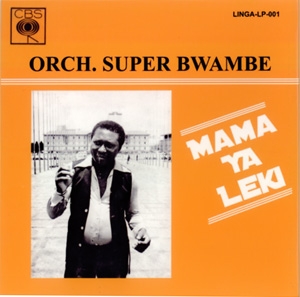
MAMA YA LEKI (CBS LINGA LP 001 1980)
A1: Nya Siaya (Terry) (Kayembe Nyonga)
2: Fatia (Kayembe Nyonga)
B1: Mama ya lekis (Kayembe Nyonga)
B2: Maria-Fellia (Luboya wa Tshiteyai)
Liner notes: Orchestre Super Bwambe was formed in February 1977 by (singer) Kayembe Nyonga and Luboya wa Tshiteyai. Kayembe Nyonga was born on 19 January 1945 in Lubumbashi, Zaire. He has been a member of several bands such as VILE KITE JAZZ, SUPER BELLA and BABA ILUNGA WA ILUNGA. He is pleased to present his new LP which is titled "Mama ya Leki" on CBS Records. Kayembe with his group SUPER BWAMBE BWAMBE signed with CBS Records in January 1980. (Doug Paterson)
|
courtesy discogs |
Orch Bwambe Bwambe 45s:
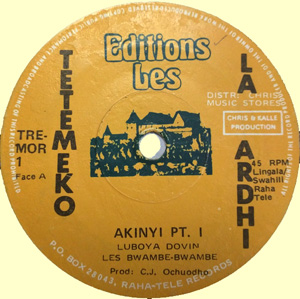
Akinyi (Luboya Dovin) Editions Les (Tetemeko la Ardhi) TREMOR 1
Akinyi wa Homa Bay (?) Eds CHRIS 24
Bwambe (Ludo) Diploma DCC 008
Bwambe Mabina (Luboya Davvin) ASL7-2203
Halleluyah (Bitanga Chuchu) Cavacha Meru Super Sounds HKM 001
Kifo Cha Baba (Luboya Dovin) ASL7-2182N
Lisanga (Matabu Kunyanga) ASL 7-2213N
Maggy Awino (Kayembe-Nyonga) Eds Chris CJ 004
Massa (Kayembe-Nyonga) Eds Chris CJ023
Mwana Mawa (Kayemba-Nyonga) Raha Tele RT 007 1978
Mwana Muluhya (Kasongo wa Kanema) ASL 7-2186N
Nitajaribu (Aloni-Vangu) Raha Tele RT 008
Nzambe (Kayembe Beauchaud) ASL 7-2210/AS4352
Salome (Kasongo wa Kanema) ASL 7-2198-N
Tumba (played on John Peel Show July 1995) ASL 7----N
|
|
Super Bwambe 45s:
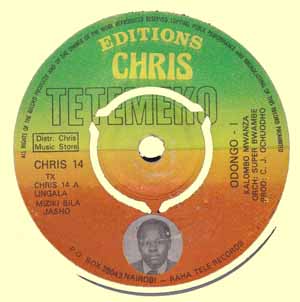
Atikapo (Kalombo Mwanza) Editions Chris CHRIS 15
Bibi-Maa (Kayembe-Nyonga) Edition Dokan ENO 005
Councillor (single on Editions Chris; but mislabelled on Best of Vol 3 where it does not appear)
Kayembe Tata (Kayembe-Nyonga) Edition Dokan ENO 006
Maria Fellia (Luboya wa Tshiteya) CBS (K) 012-B 1980
Marie (Kayembe-Nyonga) Edition Dokan ENO 004
Nya Siaya (Terry) (Kayembe-Nyonga) CBS Linga (LNG 001) LA666 1980-81
Odongo (Kalombo Mwanza) Eds Chris CHRIS14
Salongo
Toboyi Konyokwama (Luboya and Kayembe) CBS (K) 013 1980
Tufurayi (Kayembe-Nyonga) CBS Linga LNG 011 1980
Les Raha Tele
(Possibly Bwambe Bwambe or Bana Likasi recording under another name)
Fitina (Tetemeko) Editions Chris CHRIS 11
Orchestre Fuka Fuka
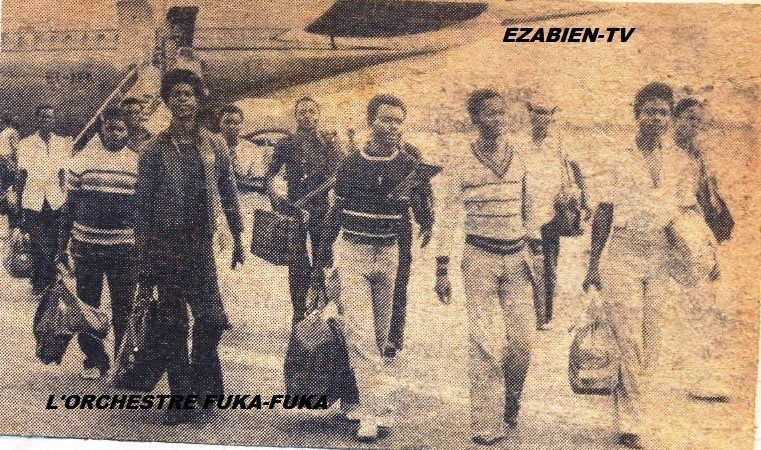
Kinzunga Ricos, founder and guitarist, was a Veve studio musician (as the double-barreled name Fuka Fuka suggests) who had played with Les Kamale and Lipua Lipua and wrote "Niki Bue" which was a hit for Lipua Lipua. Les Kamale also recorded on the Fuka Fuka label in 1975-6 so it follows ex-members would choose this name. Fuka-Fuka is a neighborhood of downtown Matadi, a city on the Congo river on the Angolan border. Tshibau Mulembu and Tshimanga Assosa (both also ex-Lipua Lipua) were the vocalists. Their earliest single I have found was recorded in Zaire in December 1976. Tshimanga Assosa had sung with Negro Succès of Bavon Marie Marie, but after Bavon's tragic death had left Kinshasa to look for work in Tanzania with a new group called Maquis du Zaire. In 1980 Assosa moved to Nairobi and joined Orchestre Makassy for the session that included his hit "Mambo Bado," released in UK on Virgin. And, inevitably, after a split, Fuka Fuka reincarnated as Super Fuka Fuka on the Audio Productions label, APL. Richard Kasongo posted a picture of the band on facebook, getting off a plane in Tanzania, and tagged Micka Jagajaga as the drummer. He quotes Jagajaga as saying he started playing drums in Kinshasa age 12 and played with Zabantu, Londa-Londa, Fuka Fuka, Le Kinzunga, Tonto Ricos, as well as alongside Mulembu, Etuma-Nangwaka, Dindo Yogo & Nseka Huit Kilos, Bisengo Madiata ("Madiata le President"), and in G.O. Malebo with Vieux Armando, etc. "In 1978 I left on an East African tour with Fuka Fuka to Dar-es-Salaam, Nairobi and Kampala. 1981 returned to Dar-es-Salaam for seven months and teamed up again with Orch Makassy to record the Mambo Bado album, which sold in Europe. After a stint in Abbey Hotel Nairobi the band went to Kampala for three months and then back to Kinshasa where Fuka Fuka broke up. In 1983 Jagajaga moved to Nairobi and joined les Mangelepa. After that he joined Vundumuna and went with them to Asia in 1987 and recorded Nakata Mikili in Japan. He toured the Middle East with Vundumuna in 1988. In 1989 toured Belgium and Holland with Simba Wanyika and recorded an album. In 1990 returned to Tokyo with Jambo Jambo band. Decided to stay in Japan, and toured Thailand. 2005 joined Le groupe Tanzanites with Abbu Omar (also ex-Simba Wanyika) and also played with l'Afrique Band Expresse." He recorded an album Mambo in Japan.
|
 |
45s:
Baba Isaya (Tshimanga Assosa) ASL 3374N Swahili
Beto ba Yai (Mulembu) Almayi ALM-09 20/12/76 Soneca Zaire
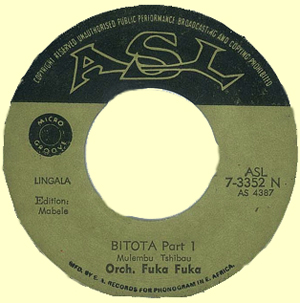
Bitota (Mulembu Tshibau) ASL 7-3352 (Eds Mabele)
Babokilo (Mulembu Tshibau) ASL 7-3356N
Lomeka (Tshimanga Assosa) ASL 7-3359 (Eds Mabele)
Mbiya (Tshimanga Assosa) ASL 7-3367 (Eds Mabele)
Papy (Mulembu Tshibau) ASL 7-3370N
Super Fuka Fuka
Kapi Kapinga (Tshimanga Kalala Assosa) APL 005
Yoyce Bolingo (Nduka Masingu) APL 006
|
courtesy: afrodisc.com
|
Grand Piza
Band associated with the Bana Moja and Diabim labels, and a popular rival to the Veve groups in Kenya and Uganda. Makengo Roy was leader and songwriter, also associated with Orch Mandalala (as this was one of their hits, it likely became the name of a splinter group). Other members were Emmanuel "Aimé Kiwakana" Kiala on vocals, Mbo Mayau and Mongongo Mpia dit Porthos, ex Conga Succes, younger brothers of Johnny Bokelo, as rhythm guitar. (It is possible he could also be known as Mongo Santa Maria.) Kiala sang with OK Jazz. Mongongo also played with OK Jazz and Bana OK and ended up in Abidjan in the 21st century. In "Linda Toli" there's a shout-out to Johnny Bokelo who published their records and also wrote "Bana Kenya." On "Keba na zuwa" there are shout-outs to Roy Makongo, Mambiza (?), and also Nyboma and Pepe of Lipua Lipua, as well as Maquis, so perhaps some of the members had been in those bands. Kebam and Massikini are credited as songwriters and could be other musicians. Another member of Mandalala was Chumu Lay Lay who went on to form L'orch. Tout Mopia. In 1975 Mbo made a recording as Grand Piza Ezanga.
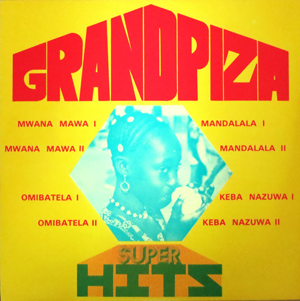
LP: SUPER HITS VOLUME ONE (ASLP910 Nairobi) 1977?
A1-2: Mwana mawa (Makengo Roy) also a 45 on Bana Moja BANA 6
A3-4: Omibatela (Makengo Roy) also a 45 on Diabim
B1-2: Mandalala (Makengo Roy) also a 45 on Bana Moja BANA 12
B3-4: Keba Nazuwa (Mokengo Parthos) also a 45 on Diabim
Liner notes:
Grand Piza ni kikundi ambacho kilizuka miaka mitatu iliyopita na kimekuwa na mafanikio makubwa tangu mwanzo. Kwani tangu kibuniwe kime bahatika sana kimuziki kwa kuweza kuto rekodi ambazo ziliweza kuu tetemi sha ulimwengu mzima. Rekodi hizi ni "Mwana mawa," ikifa tiwa na "Mandalala" na pia "Bilanga" ambazo zimeweza kuwapatia ushindi mkubwa Orch. Grand Piza. Huu ni ushindi ambao kweli bendi nyingi zina tamani sana kuupata.
Haikuwa shida kwa hawa vijana, kama alivyosema kiongozi "Makengo Roy". Tume shinda na sifa kubwa tumepata lakini sisha tuja tosheka kwani bado tunakuja hatujafika. Juhudi zake Makengo Roy na mwenzake, Mokengo Parthos zimeweza kuwaangazia maisha hawa vijana wa Grand Piza. Hata hivyo hii ni rekodi ya kwanza ya mfululizo wao wa Super Hits na ina Mojawapo ya vibao vyao vipya "Keba Nazuwa" moto kweli. Hivyo Makengo anasema "Mambo Bado Mtatuchoka"
-- Justus Musyoka Kasoya, Phonogram Limited
(Translated by Google):
Grand Piza is a group that broke out three years ago and has been a huge success since the beginning. It had since are designed as musically very fortunate to be able to inactivity main tetemi records that could be fed whole world. These recordings are "Mother Son," "Mandalala" and also "Bilanga" that have been handing a major victory to orch. Grand Piza. This is a true victory that many bands have a strong desire to win.
It was not a problem for these young people, so said the leader "Makengo Roy". Commission won a great reputation we have but we do not already satisfied since we still come we arrived. His efforts Makengo Roy and his colleague, Mokengo Parthos these young lives have been enlightens the Grand Pizza. However this is the first record of their series Super Hits and has One of their new hits "Keba Nazuwa" hot indeed. So Makengo says "Mambo Bado Mtatuchoka."
|
|
Grand Piza 45s:
Bana Kenya (Jonnie Bokelo Isenge) Eds Bokelo EB9 reiisued by Pathé (also EB9)
Bilanga (-) reissue: African 91.289 P1976
Bokila (Mbo-Mayau) Bana Moja BANA 27
Djoku Apazi Makita (Kebam) ASL 3364E
Fouati (Aime) Bana Moja BANA 28
Keba na zuwa (Diabim 12) re: African 91.010 1975
Kisangani (Diabim 8) by Grand Piza Ekonda (reissued: African 90.937) 1975
Mandalala (Makengo Roy) Bana Moja BANA 12
Mayindombe (Mpia Mongongo "Porthos") Bana Moja BANA 7* possibly the same as "Keba na zuwa"
Mbila (Makengo Roy) Diabim 16 (reissued: African 91.117; attributed to Grand Pinza, due to sloppy typesetting)
Mandalala
Mosolo suka te (Mbo Mayau) Editions Bokelo EB7 1977
Muana Mawa (Mbo) (Mbo) Bana Moja BANA 6
Naleli Mama (Massikini) Bana Moja BANA 29
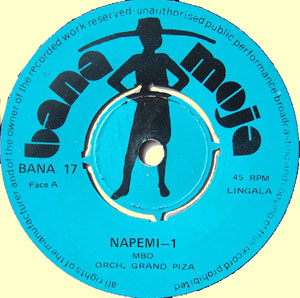
Napemi (Mbo) Bana Moja BANA 17 (1973)
Nzotu ya moto b/w Nazongi Libala (Mbomayou) Editions Bokelo EB2
Oboti Kolisa (Mbo mayau) AIT (included on Urgent Jumping [Stern's 2016])
Ombatela (Mongongo Mpia) Diabim 13
Yo Zairois ngai Zairoise (Mbo Mayau) Diabim DIA17
Zambia New Year (Mbo Mayau) Eds Shaba SH023 [Dance Ekonda]
CD:
Muana Mawa
(Melodica, Nairobi: A CD made from a cassette?)
1. Mwana mawa 1
2. Mwana mawa 2
3. Koliya mpesa*
4. Bana Moja
5. Bona*
6. Mama alobi na bala
7. Mbomoko Mobayi
8. Makuela
9. Etisomba*
(*Bona is by Bana Moja, Koli ya mpesa and Etisomba are by Bana Ngenge, don't know what they're doing on here.)
|
|
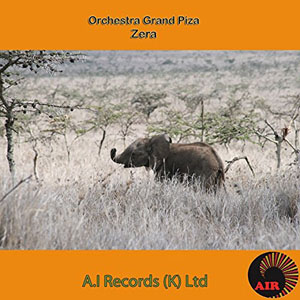
DIGITAL REISSUE: ZERA
(A.I.Records Nairobi 1980/2016)
Zera
Vie ya moto
Linda Toli
|
|
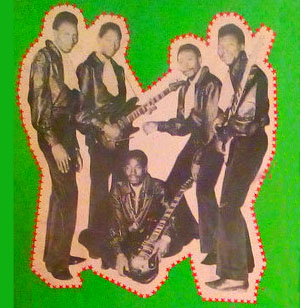
Hi Fives
Orchestre Les Hi-Fives, originators of the popular Kibushi sound, were one of many Congolese dance bands who, fleeing political turmoil, made their way east to Tanzania and Kenya. They were founded as Bana Kibushi Batano by Vicky Numbi in Lubumbashi, Congo. In 1965 they moved to Dar Es Salaam, Tanzania, and two years later to Mombasa to join the burgeoning Congolese exile music scene in Kenya. Here, like much of this cohort, they became as much a "Kenyan" group as a Congolese one. Various problems, notably with residency permits, forced the band to break up some time in the late '70s or early '80s, and the members scattered to the four winds. -- John Beadle, Likembe
|
|
LPs:
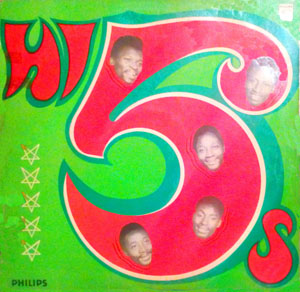
VOLUME 1 (Philips PKLP 100, 1971)
A1 Mpete Wa Kibushi
A2 Nalingi Josephine (Tshibanda Joachim)
A3 Siku Gani Tutaonana
A4 Chene Muswa Mabaka
B1 Chulu Inshile Inpite No. 1 (Vicky)
B2 Chulu Inshile Inpute No. 2 (Vicky)
B3 Zonga Zonga Maman
B4 Napasi Bolingo (Tshibanda Joachim)
|
Courtesy: Likembe
|
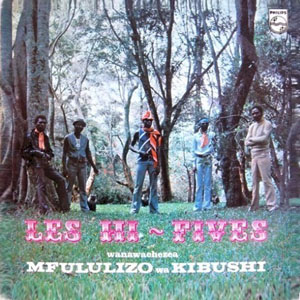
WANAWACHEZEA MFULULIZO WA KIBUSHI (Philips PKLP 105, 1972)
A: Wami Mukaji Kisenga
Chibila Chibe
Nako lela
B: Maba ya makasi
Zuwa ya pamba
Sonya Mwana Likas
|
|
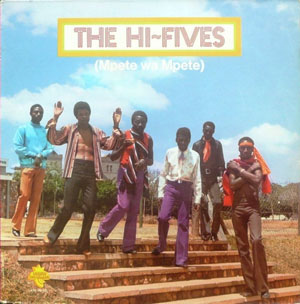
MPETE WA MPETE (Disques Esperance ESP 155 502)
A1 Anna
A2 Joyce - Take One
A3 Mokili Eko Baluka (Part 1)
A4 Mokili Eko Baluka (Part 2)
B1 Coup Direct
B2 Babotoli Mobali
B3 M. P. R.
B4 Olukala Makambo
|
|
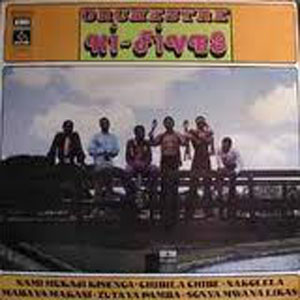
ORCHESTRE HI-FIVES (Pathé 2C 054-81.595 1974)
A1 Nami Mukaji Kisenga (Mutonkole M. K.)
A2 Chibila Chibe (Nawezi K. Y.)
A3 Nakolela (Numbi M. K.)
B1 Mabaya Makasi (Tschibanda)
B2 Zutaya Pamba (Tschibanda)
B3 Sonya Mwana Likas (Tschibanda)
|
|
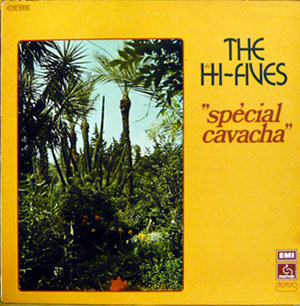
SPECIAL CAVACHA (Pathé 2C 062 - 81.930 1975)
Mpete Wa Mpete
Betty
Nuambila Mese
Katsotshe
Somele 1
Somele 2
Sweet Sweety
Mpempe Club
EP:
Side A: L'Orchestre Mambo Jazz: Ozali Mama Bana - Tika Namona Mpasi
Side B: Hi-Fives: Joseph Zambe Ayebi Nyonso - Nasengi Pardon (Philips PAS 1 7-EP 1969)
|
|
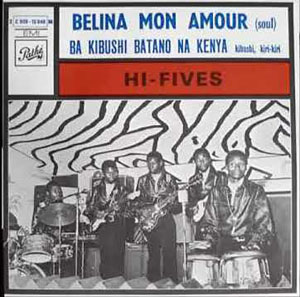
45s:
Agy "I Love You" b/w Yo! Yo! Yo! Ndaya (ASL 7-1095 1973) *A side on Hit Parade Africain vol 3
L'Amour est aveugle b/w Nalalaki mwazi ngai (Pathé 2C006 15015)*A side on Hit Parade Africain vol 1
Azalaki Mwasi Ya Libala b/w Makosa (Pathé PEA 192)
Belina Mon Amour (Vicky) b/w Ba Kibushi Batano Na Kenya (Vicky) Pathé 2C 006 15046 1970*A side on Hit Parade Africain vol 4; B side on Hit Parade Africain vol 1
Betty (Pathé PEA 190)
Chulu Inshile Inpite No. 1 (Philips [West African] Records Ltd. / ASL 7 - 1028 1974)
Emny Mon Chou Chou b/w Wanbayo Fuile Lubanga (Pathé 2C 006 15095)
Faux promesse b/w Liwa ya Catherine (Pathé 2C 006 15081 1971)
Jeannine ngai nabalaki b/w Mwana wa mraka (Pathé 2C 006 15086 1971) *B side on Hit Parade Africain vol 1
Ma Cherie (Vicky) b/w Namoni pasi na mokili (Pathé 2C 006 15047 1970)
Mariam nirudie b/w Unipe nauli (Pathé 2C 006 15087 1971)
Mokili Ya Makambo / Moyi Sambo Mpe Butu Sambo (Pathé 2C 006-15.094)
Mwazi ndoki b/w Mama tika babala ngai (Pathé 2C 006 15042 1970)
Mwazi nzoba (Vicky) b/w Zamba salisa ngai (Pathé 2C 006 15016 1970)
Na Kovanda Nangaaki Monzemba b/w Longola Ngai Nsoni (Pathé PEA 219)
Nakupenda Mado (Soul Posters SP 10508)
Nichukuwe Twende Kwako b/w Nakokufa lokala nyama (Pathé 2C 006-15088 1971) *A side on Hit Parade Africain vol 1
Njane Part 1& 2 (Pathé PEA 193)
Safari Tabu (Pathé 2 C 006 - 81561 1973)
Salongo b/w Chiyamb (Pathé 2C 006 81560 M 1973)
Wacha Ukatili (Tshyco) b/w Lamore Studio (LAM 7-040)
Wake Wengi Sawa Ma Jani b/w Moly Mon Ligalot (Pathé 2C 006 15118)
Ye nde mobali na ngai (Tshyco) b/w Vive Loua (Pathé 2C 006 15043)
|
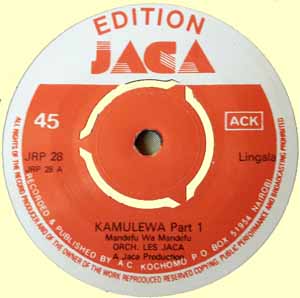 |
Les Jaca
Les Jaca was created by Lovy when he decided to leave Super Mazembe in 1981. He went into the studio with many of the Shika Shika stars, including Siama, Tabu Frantal, Mandefu, Roy Mosanda, Lawi Somana, Moreno and Monimambo, and the "Sly & Robbie" of East Africa: Lava Machine on drums and Manitcho Nsilu Wabansilu on bass, but the attempt bore little fruit, so Lovy remained with Super Mazembe. Editions JACA was created to publish Shika Shika and Viva Stars. A. C. Kochomo was the producer and he issued at least 40 singles. Another offshoot was Editions Tobina, who published Bana Ngenge, Jaca and Pepelepe. See kentanzavinyl.
45s:
Adija Adisi (Lovy)
Christmas (Mandefu wa Mandefu) Eds Tobina TON 31
Hadija Hadis (Roy Mosanda) Eds Jaca JRP 15
Jangu (Mandefu wa Mandefu) Edition Jaca JRP29 1983
Kamulewa (Mandefu wa Mandefu) Edition Jaca JRP28 1983
Manguta ya Daddy (Sam) Master T Franthals & L'orch Les Jaca / Edition Jaca JRP37
Marylene (Master T. Franthal's) Eds Jaca JRP36
Mayeye Julieta (Roy Mosanda) Eds Tobina TON 22 (Lingala)
Mokolo ya Suka (Mandefu wa Mandefu) Safari SAF 16 [Lingala]
Osiepna Seda (Roy Mosanda) Edition JACA JRP 17
Papi Guicain (Editions Tobina TON 7-02)
Sakii (Frantal Tabu) Tobina TON21
Senene (Frantal) TOBINA TON37
Shemeji (Eds Bana-Likasi BAS 5)
Sikia (Ligbutu) Tobina TON29
Wivu (Frantal Tabu) Safari SAF 7
Ya yo nini? (Etchou Ndjadi Mitchoum) Eds Jaca JRP14 ca 1980
Zebola Tex (Ligbutu) Safari SAF13
|
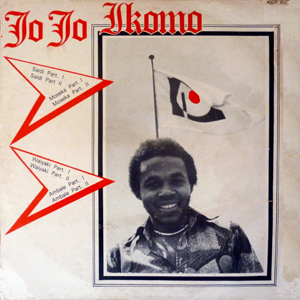 | Jojo IkomoLPs:
JOJO IKOMO & HIS ORCHESTRE LOKITO
(ASLP 912)
A : Saidi (Tabu Ogollah)
A 3 & 4: Moseka (JoJo Ikomo)
B : Waiyaki (Willy)
B 3 & 4: Ambale (Coco)
Liner notes: Born in Mbandaka on the 12th March, 1952 in the Republic of Zaire, Jojo Ikomo presents a life heavily involved in the artistic field. In 1970 the star of Jojo Ikomo appears on the musical firmament of Zaire with his first song "Sema Sema" accompanied by the Orchestre Tabou National, drawing everybody's attention to him. From that moment onwards his career steadily developed and he and his Orchestre Tabou National became one of the best recognised Orchestres in the country.
In 1973 he joins Orchestre VeVe of Kiamuangana Mateta with whom he enjoyed a lot of success, particularly with songs like "Maina" and "Kaniuka."
In 1975 Jojo Ikomo leaves VeVe to form his own Orchestre -- Bana Moja with his cousin Djama.
He left Zaire and travelled towards the East of Africa and played for some time in Uganda. Finally he reached Kenya, meanwhile with Orchestre Bana Ngenge. During this time he created some of his top sellers like Kayumba, Kombe Kombe etc. which secured him a large followership.
His singular talents to touch the deepest sentiments of the people, to make them laugh and cry and to reach their hearts through his expressive voice are at its best in this present recording which is Jojo Ikomo's first LP and which will satisfy all his followers, and gain many more. [courtesy: Zim Bida]
Note: Personnel on this album, recorded in Nairobi (in 1977?) post-Bana Ngenge, but before Jojo's return to Zaire and the reformation of Bana Moja, must include Tabu Frantal, lead guitar, Coco Zigo, Ochudis & Jojo Ikomo on vocals. Willy is Willy Tambwe Lokassa on bass guitar. Shout out to "Samba" might be Samba Mapangala, vocalist.
|
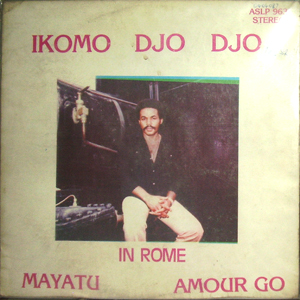 |
IKOMO DJO DJO
IN ROME 1982 (ASLP 963 licensed from Kina Rama)
A1. Amour Go
A2. Londia
B1. Mayatu
B2. unknown track
(unknown personnel)
|
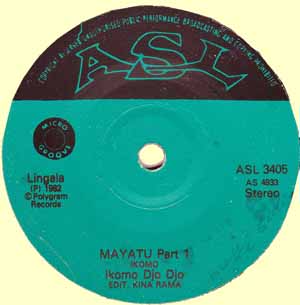
courtesy Alan Wheeler |
For more Jojo Ikomo, see also Bana Moja, Bana Ngenge. For more from this band see Batcha Lokito.
45s:
Jojo Ikomo & His Orchestra
Cherie Flower (Jojo Ikomo) ASL 7-2127 1976 AS3949
Kayumba (Jojo Ikomo) ASL 7-2124 1976
Kingo Muambe (Jojo Ikomo) ASL 7-2173N 1977
Note: Not the same as Super Mazembe's song "Kingo Mwambe"
Kombe Kombe (Jojo Ikomo) ASL 7-2128 1976
Maleso (Jojo Ikomo) by Orch Londele Eds Chris Tetemeko CJO 003
Note: This is the only appearance of Orch Londele, presumably another name for Ikomo's band
Mayatu (Ikomo) ASL 3405 1982 Eds Kina Rama (reissued with Bana Modja; diff. from Shika Shika song)
Satonge (Jojo Ikomo) ASL 7-2176 1977
|
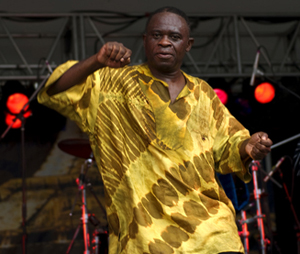
SAMBA MAPANGALA
Photo: copyright David Gaar, Madison WI 2007 |
Les Kinois
Samba Mapangala, born Matadi, Congo, moved to Kinshasa in early 1977. After secondary school he sang with Super Tukina who recorded his first hit, "Satonge," then he joined Super Bella Bella alongside Jean Bosco and Mongoley (ex-Lipua Lipua guitarist). In 1975 he went on tour to Eastern Zaire with l'orchestre Saka Saka of Bikassi Mandeko. On January 19, 1976, they arrived in Kampala, Uganda, and formed Les Kinois (The Kinshasans) after a split with Bikassi. The newly formed Kinois were hired to play at Economic Night-club where Shama Shama de Mopero were also playing. Soon Les Kinois had a gig at the Hotel Kampala International. A year later they relocated to Nairobi where Bedjo joined their ranks on lead guitar. Soon Fataki Lokassa, Lovy Longomba and other Congolese joined. They scored hits with "Sunday" and "Malako." The played frequently at Garden Square, Alliance Club, Uhuru Park & the Starlight Club. They were among the most popular of the expatriate bands of the time, alongside Les Mangelepa, Baba National, Boma Liwanza, Bwambe Bwambe and Shika Shika. When asked about the popularity of Congolese music in Nairobi, Mapangala replied, "Music has no borders. Everyone enjoys the rhythm." But, pressed about the economic hardship of making a living as a musician, he replied, "I had a very good life and great career in Kenya, but music piracy was making it impossible to make money." Les Kinois broke up in 1980, when Mapangala formed Orchestre Virunga. For more see Doug Paterson's Samba Mapangala page.
Personnel:
Samba Mapangala - Band Leader and lead vocalist;
Pele Ondindia - Assistant Band Leader, Bass Guitarist and vocalist;
(Iliko) Madjo Maduley - Assistant Band Leader and vocalist (a.k.a. Madjo Abdallah of Orch. Emagi?);
Bedjo Mikombi - lead (Soloist);
Bibiley Kabakaba - Assistant Lead (Soloist);
Joseph Okelo "Josse" - rhythmnist;
Niki Djo - Bass and (lead-solo) Pop Music;
Faustao Temopele Waroma, the dynamic (Drummer) boy;
Kasule Mopepe, Tumba (Kongas).
"All members of Les Kinois come from Kinshasa (Zaire) besides Kasule Mopepe from Uganda and Okelo Josse from Kenya." (DP)
|
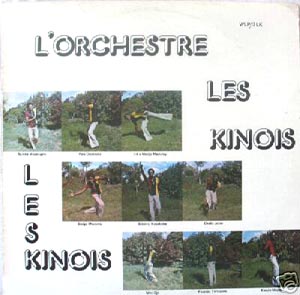
|
LP:
LES KINOIS (A.I.T. WLP/3LK)
1978; produced by Felix G. Jakomo Jr.
A: Coco
Asha
B: Mukungukilua
Les Kinois
BONANE (A.I.T.)
No info; the title is obviously a transliteration of "Bonne année")
Bonane
Kilindo
Lokoki
Mbede
Reissued digitally by emusic in 2016
|
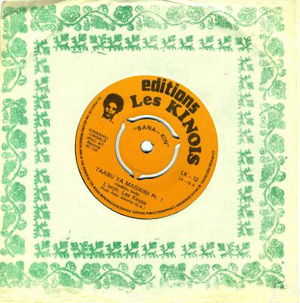
|
Les Kinois 45s:
Achieng (Pele Ondindia) Editions les Kinois LK008
Ah Vonvon (Samson Francky) b/w Naboyi Bombanda Marie(Moghe) ASL 7-3205 (PAX9; FOL)
Ami Abouma (Linga 13)
Ba-Boka (Iloko) Lake Victoria LAS 3046; also Super Musiki du Zaire SMZ001 1978
Biwewe Pathé 114
Blanche (Pele Ondindia) Eds Les Kinois LK10
Chebule ASL 2292 1982
Cherie Nata (Eds. Les Kinois LK009)
East Africa (Pele Ondindia) Musiki du Zaire MZ21 1977; also RCA (Paris) PB 9151
Furaha ya Christmas (Diabanza; Niki; Djo) Eds. Les Kinois LK006
Fwaya (Samba Mapangala) Editions Chris 16; appears as the second track, misidentified, on Best of Eds Chris vol 3 CD)
Ilolo Viviana (Mikobi Mwalimo Bedjo) Eds Chris Tetemeko CHRIS 20 (Miziki Bila Jasho)
Juma (Madjo Maduley) Eds Chris Tetemeko CHRIS 19
Kaka Ramadhani Eds Les Kinois LK11
Kawendo Tuta Tuta (Bibiley Mwana Malela) Hit Parade HP 107
Kilindo (AIT?)
Kirie-Kirie (Kasule) Super Musiki du Zaire SMZ002 (P) 1978
La Vie Musiki du Zaire MZ18
Lisano (Musiki du Zaire MZ22)
Mabuidi (Samba Mapangala) Eds Les Kinois LK002
Malako (Samba Mapangala) Eds Les Kinois LK001
Marte (Bibi Kaba Kaba) Muziki du Zaire MZ19 1977
Mopaya Zoba (Monganza Gina Dewolo) by Bana Kin O.R.C. ORC3020
Mother-Father (ASL 3387 1980)
Mpenzi Rudi Super Musiki du Zaire SMZ004 1978
Pola (Bibi Kaba Kaba) Musiki du Zaire MZ20 1977
Safari (Samba Mapangala) Bana Moja BANA 33
Sawa Pathé 125
Semeki-Siama (Eds. Les Kinois LK005)
Sunday (Madjo; Madule) Eds Les Kinois LK004
Susana (Samba Mapangala) SAM001
Taabu ya Masikini (Mwalimu Bedis?) Editions les Kinois LK12
Tikana Nake Njeri (Amewachana Nami) (comp: Bibiley Kaba Kaba) by Les Kinois Bana Kin label: Kheri-N'Jema l'Kinois 1001
Toweli nini (City Boom CB11)
Yena oboyi libala (Diongo Oporte) Editions Chris 21
CD:
MALAKO DISCO ORIGINAL (CD from Melodica in Nairobi, which has applause grafted on):
Malako
Mwana Mboko
Blanche Christmas
Sunday
Sigana Maronyango
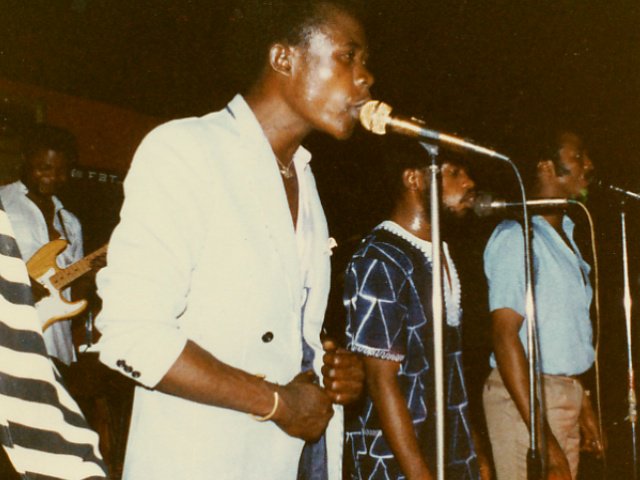
Coco Zigo on the mike, with Samba Mapangala (?) & Kasongo wa Kanema, plus Siama Matuzungidi (background, on guitar). Starlight Club, Nairobi, March 1984, photo by Rio Nakagawa
|
courtesy Alan Wheeler
|
L'orchestre Kombe Kombe
Later incarnation of Shama Shama de Mopero. Mopero had toured from Gabon to Kenya with L'orchestre Shama Shama, whose members included Nanga Nella and Mambo Ley. Mopero returned to Congo and joined Victoria Eleison. Kombe Kombe was founded in Uganda by Coco Zigo (singer) & Siama (guitar), who decided to stay behind. Siama Matuzungidi recalls: "Me, Thomy Lomboto, Coco Zigo Mike, "Chery" Matumona, Jollet and TeTe Le Beau (two more members of orchestre Shama Shama, I forget their real names) left Uganda due to Idi Amin war; we came to Nairobi as Kombe Kombe Band in 1979." They were also known as Kombe Kombe "Buskas" on their first release. Since DjoDjo Ikomo was in the band and the name seems to have come from a song by Bana Ngenge, it's likely the band was a blend of Bana Moja/Bana Ngenge, as well as Mopero's musicians. With Lava Machine on drums. Most were drafted into Viva Makale by George Kalombo.
Kombe Kombe 45:
Adios Edna Somi (Tomy Lomboto) VRP 005 1970
Agie Koko (Coco Zigo) Edition Kombe-Kombe BEG1
Balozi (Coco M) Eds Sapato CCE2
Driver (Coco) Lake Victoria VC 002 [Lingala "heat"]
Fozi (Koko Zigo) Eds Matunda ANA 002
George Otieno (Koko Mike) VMS006
Gor Mahia Champion 1980 (Koko Mike) VMS-4 [Kiswahili "Catch up"]
Hamza (C0c0 Ley) Eds Mwana Mama MM20
Kanindo (Kalombo) Eds Bakoka BAK 8802 [credited to orch. Bakoka]
Kumi Kumi (Coco) Safari SAF11
Lili (Mkokolo) Lake Victoria Special VC003
Makambo Mingi (Coco Zigo) Edition Kombe-Kombe [U.R.P.] BEG 2 [Lingala]
(presumably differs from the Lovy Longomba song recorded with Mos-Mos)
Mimi (Koko) Eds Matunda ANA 003
Nyako-Nzanzi (Koko Mike "M") Victoria Music Stores VMS-1
Osiepe (Coco Zigo) Tobina TON35 Jaca production
Ruwenzori (Coco Zigo Mike) Eds Mwana Mama MM30 [Lingala "Chafua-Chafua"]
(Group is called "Combe Combe Band" on this release)
Saba Saba (Koko Mike "M") Victoria Music Stores VMS-2
Santana (Coco Zigo Mike) Judo CAK 3 1980
Sau-Sauda (Coco Zigo Mike) AIT EIT-03
Shanti (Coco Zigo) Safari SAF17 (A Jaca Production)* 1970
Souzi Body (Eds Sapato/CBS CCE-1)
Sugar Daddy (Coco) Eds Tobina TON 27 [Lingala]
Super Christmas (Koko Mike "M") Victoria Music Stores VMS-3
Tisa Tisa (Orch Kombe Kombe) Eds Matunda ANA001
Victoria Music Store Nairobi (Mkokolo) Lake Victoria VC001
Yo Venika (Coco Zigo Mike) attributed to Combe Combe, Eds Ogaden DET 3
* "Tshanti" also credited to Coco Zigo and Viva Makale
Lifenya Lorri & Liwanza Komecha
See under Special Liwanza
|
 |
Orch Lemba Lemba (Mwenyenyo)
Yet another Monimambo outfit with mostly the Shika Shika crew. (Lemba is a district of Kinshasa, the Lingala verb kolemba means to wear you out!) Featured Bibiley Kabakaba on rhythm guitar & Tabu Frantal on lead. Reportedly Lessa Lassan was also a singer with them. Their first single was released on Molende in 1976, so that would have been recorded in Zaire, before they moved East. On the Sound Masters singles they are called Orch Lemba Lemba (Mwenyenyo); the Mwenyenyo was a dance.
45s:
Ezanga (Jimmy Moni Mambo) Hit Parade HP 026 1982
Family (Jimmy Moni Mambo) Soni Sounds SONYA 03
Harmaguendo (Mongo Ley) Molende 11 1976
Kamulette (Tabu Frantal) Makonge MEN102
Lemba Lemba* (Moni Mambo) Sound Masters SOMA2
La Vie (Frantal Tabu) Makonge MEN 101
Nakupenda Lakini (Moni Mambo) Eds Mau-Mau Afrique CEGE02
Ngombele () LEM02 re: African 91.450
Wangare (Moni) Sound Masters SOMA 3
*orchestre Lipua-Lipua also had a hit called "Lemba Lemba"
Lovy Longomba
Journeyman vocalist with Shika Shika, Super Mazembe, Bana Likasi and his own band Super Lovy. See above for more biographical info. He sang in Kenya with Les Kinois, 1978, Special Liwanza, Kombe Kombe, 1978, Boma Liwanza, 1979, Mos Mos, Shika Shika, Super Mazembe (1980-84), Bana Liksasi (mid-80s), before forming his own Super Lovy. Shamallah Wa Shamallah writes: "His last hit under his own band, "Maisha yangu Lovy" is believed to be a premonition of his death. He folded up Super Lovy and went to Tanzania where he joined Vijana Jazz and was on lead vocals when they released their super selling hit "Ogopa Matapeli." He died in Tanzania and his body was brought to Kenya where it was buried. He used to live somewhere in Nairobi West near Nyayo Stadium."
LPs:
|
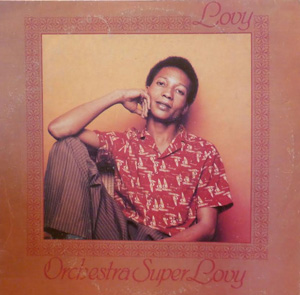 |
Orch. Super Lovy: FIRST ALBUM LVLP 01 (1981)
A.1. Pitie
A.2. Dada
B.1. Bibi
B.2. Elee (also released as a single)
(All songs composed by Lovy)
From the liner notes:
"When I left school I joined L'Orchestre Macchi of Kinshasa. This is where I learnt music. I participated in composing records like LOLA, MAYUNA and SOLE which I personally composed.
Before long Dindo Yogo and myself split and formed L'Orchestre Etumba na Ngwaka together with Huit-Kilo. In August 1978 I left Kinshasa for Nairobi to join Les Kinois. I stayed with Les Kinois for three months and later joined L'Orchestre Boma Liwanza, where I stayed for nine months.
In May 1979 I left Boma Liwanza and joined Super Mazembe. While at Mazembe I composed ATIA-JO, KAYEMBE, LONGWA, OUMA, MADO ZAINA, LOBOKO, YO MABE, NDEKO, BIWELE CHRISTMAS, LOVY, ELENA, NANGA, MOKANO GINA and MBANDA YA MOBANGE. Nearly all my compositions at Mazembe were hits.
I left Mazembe in May 1981 and formed my own "Super Lovy." My first record which is almost in every shop EELE is already a hit. The second one is MOKILI.
I now bring you this album called LOVY."
The songs he lists at Mazembe are mostly praise songs for band members and some of them have writing credits to other band members, so maybe he just recalls singing them. Here there are shout-outs to Dialu Kila, Lava Machine on drums and guitarist "Pierrot," who may be Petit Pierre a.k.a. Twikala wa Twikale of Les Mangelepa. Whoever it is, he is smoking hot on this album. |
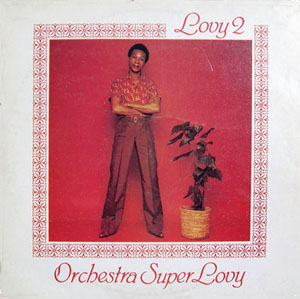 |
LOVY 2 (LVLP411)
Mete (Lovy)
Lomama (Lovy)
B: Annie
Eli
(In "Lomama," sung in Lingala, we hear a namecheck for Felix (Jacomo, the producer of Super Lovy and Super Mazembe), then Boka, Massamba Maquis & Dialu Kila (who were the consular staff and Ambassador of Zaire at the time), Misele, Monimambo, Pierrot, Eddy, Lava Machine, & Lovy. They also quote the songs "Mado Zaina" & "Tika na lela." Sammy & Manitcho get a shout-out in "Annie.") Other band members were Thierry "Chery" Matumona Kikaya (lead guitar), Bibiley Kabakaba (guitar acc), Siama (guitar acc), Lawi Somana (sax), Manitcho (bass guitar), Jackino or Jacky (singer) and Shabani on drums.
|
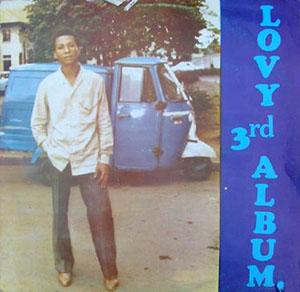 |
LOVY 3rd ALBUM (AIT LV LP03) "Nelly"
Nelly
Lela
2: Pital
Keba-yo
Liner notes: Produced by Felix Jacomo (G.A.)
LOVY MOKOLO LONGOMBA
Since the early days with Super Mazembe, LOVY has always been a fantastic and prolific composer -- remember "Lovy," "Yo mabe," "Ndeko," "Nanga," Mokano" and "Elena."
The Lovy voice too is something special and has an unmistakeable sound that just cannot be copied by any other Lingala artist, no matter how hard they may try. This has given LOVY a special fan club, and for those fans, here are more of the HOT AND HIGH SOUNDS OF LOVY.
|
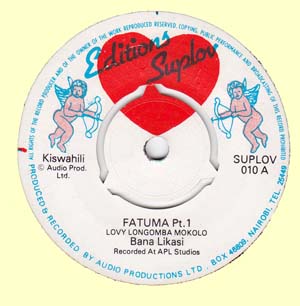
(courtesy Alan Wheeler) |
Super Lovy & Bana Likasi
45s:
(From Muttu Mondiya Mama on Julian Thorpe's page; and big thanks to Alan, Rufus, Doug, Tim, and the gang)
Apayi b/w Mondonga by Lovy du Zaire ASL 3296
Aya (Lovy) eds LOVY 06 (P)1982 AIT Records
Bilangwela (Lovy) Eds SUPLOV 5 (1984)
Bondoki (Lovy) SUPLOV 001
Coco (Lovy) SUPLOV 002
Elee (Lovy) eds LOVY 01
Eli (Lov) Eds LOVY 05
Etali Yomoko (12" UK single on Swahili Records 12 SWAH 001 1983)
Fatuma (Lovy Longomba Mokolo) SUPLOV 10
Izolele (Lovy) Soni Sounds SONYA 01
Jose
Keba-yo (Lovy) eds LOVY 07
Kialula (Lovy Longomba) SUPLOV 06 (P)1984
Lolo (Lovy) SUPLOV 03
Longomba (Lovy) Hudson Production HUDP003
Mali Ya Baba
Mokili (Lovy) Eds LOVY 02 (AIT Records)
Mwana Kisumu
Nairobi (Lovy Mokolo Longomba) Sony/Columbia CR (k) 002 (p) 1991
Obaye Ngai / Emeda (ASL 3259 1972)
Rudy Nyumbani (Lovy) Soni Sounds SONYA5
Salima
Talaka
Umasikini sio kilema (Lovy) eds LOVY 03
Ye Ye Ye (Lovy) eds LOVY 04
EDITIONS CHRIS compilation VOL 3
A compilation album from the Chris Music Store in Nairobi with five complete (but misidentified) 7' singles:
Bana Likasi: Mayopa
Super Bwambe: Councillor (Not on this comp: the second track is actually "Fwaya" by Les Kinois)
Super Mazembe: Rossy Marrie
Super Lovy: Mwana Kisumu
Massima la Musica: Viva Christmas
Early recordings of Lovy & Dindo Yogo with L'Orchestre Macchi and Etumba na Ngwaka are heard on SUCCES DES ANNEES 70 vol 1 (NgoYarto EPP19)
"Yoka toli" and "Mokano" on JEUNES VEDETTES DES ANNEES 70 (Sonodisc CDS36546)
"Lola Mwana" on l'AFRIQUE DANSE (Sono 360 061)
Orchestra Makassy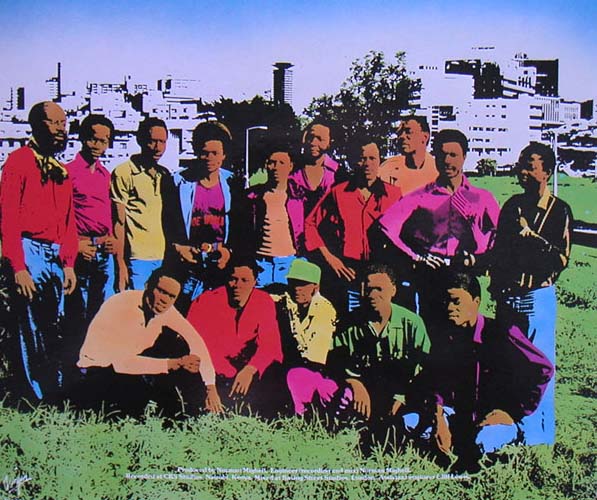
For the history and discography of Makassy see the Congo in Tanzania page.
Orch Malekesa du Zaire
Malekesa 45s:
Asali (Frantal Tabu) Edition de Hudson EDH01
Helena (Frantal Tabu) Edition de Hudson EDH04
Mapenzi ni Tabi (Aloni Vangu) Eds Ya Babeti EBB 7-12 Kiswahili
Tosa Baboti (Aloni Vangu) Eds Boyoma AV001 Lingala
Orchestra Malembe, Super Malembe & Malembe Stars
This group was formed by Kabakaba Bibiley, after orchestres Popolipo, Les Kinois and Virunga. Bibiley was the guitarist for Samba Mapangala's bands and later played for Lovy's Orch Super Lovy and Moreno's Moja One. Bibiley was later associated with Bana Motindo in Nairobi in 2000. (Info from Muttu Mondiya Mama, posted online July 15, 1998) There is another Orchestre Malembe with an album Mbi Salasioni on the Badmos label, I believe they are from Ivory Coast. There was also an Editions Malembe-Malembe label in Kenya. Tim Clifford suggests the name Super Malembe may be an attempt to imitate Super Mazembe. According to a 2002 guide book to Kenya Orch Malembe Stars were a cover band playing in the Ngong Hills Hotel in Nairobi.
45:
Orch Malembe: Selina Eds Matunda ANA 11
Orch Super Malembe: Elangwela MMM Panther Sounds Panther 003
Orchestre Mandalala
Splinter group from Grand Piza, led by Makengo Roy. They had one track, "Kita Kotongo part 1," included on an album called Kenya Hit-Parade from Soul Posters (SP 2137) in France. Soul Posters also distributed Afro-Disc and Playa Sound in Europe. "Kita Kitongo" is a remake of their hit "Zuwa te."
Orchestre Mandalala 45s:
Konda () Soul Posters SP 10589 1977
Nawalela Te (Chumu Lala) Soul Posters SP 10590 1977
Les Mangelepa
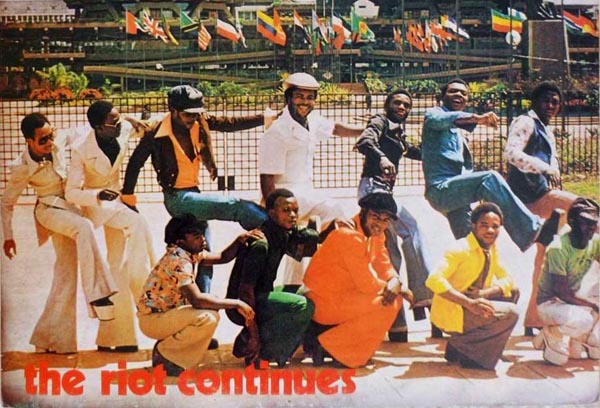
Personnel:
Bwamy Walumona (Simon) "Le capitaine" - lead guitar, chief of the orchestra
Kabila Kabanze "Evani" - lead vocal
Kelenga Nzaazi "ViVi" - vocal
Babibanga Wa Tshilumba "Kai Kai" - vocal, trumpet, trombone
Lutulu Kaniki "Macky" - vocal
Kasongo Fundi "Petit Jean" - drums, bass
Lukangika Maindusa "Moustang" - lead guitar, rhythm
Mwepe Mutshi "Cavalou" - trumpet
Lumwanga Mayombo "Ambassadeur" - rhythm, bass
Mukala Wa Mulumba "Bebe" - drums*
Tabu Ngongo Ildephonse "Supersax" - saxophone
Tshimanga Zadios - saxophone
Twikala Wa Twikale "Petit Pierre" - organ, lead guitar
Kabe Kimambe "Elombe" - organ, lead guitar
Kabebe Mukangwa "Picolo" - bass
additional personnel:
Tambwe Lokasa (William) bass
*i.e. Mukala Kanyinda (CoCo) tumba
Paddi (Ma Wau-Wau) saxophone
For a biography of the group see the liner notes to the ENDURANCE CD.
|
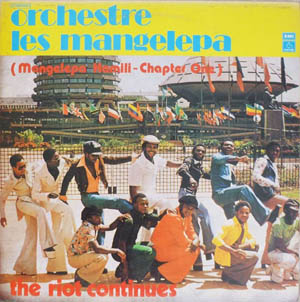
 |
MANGELEPA / THE RIOT CONTINUES (Pathé EMI 2C064 82413 (P)1977)
Mangalepa Kamili 1& 2
Sakina 1& 2
Nganga-Kimetu 1& 2
Ekubuku 1& 2
About the Band:
The group came into existence one fine morning--it was 1.7.76, to be exact. But the decision to adopt the now famous name (Mangelepa) was taken on 22.3.76, though the idea to form the group dates back to 1974. By then, as most people already know, the boys were musicians in Orchestre Baba National, led by Baba Gaston. Unfortunately limited space makes it impossible to give a full account of the problems they had to face while working for Baba Gaston; anyway, the boys, led by Bwami Walumona, decided that they had taken enough, and so on the morning of 1.7.76 it came to pass that the world of entertainment witnessed the birth of a new child and it was baptized Mangelepa.
...They are a knock out group and they have just begun ... the riot continues! Get up and boogie! Get up and RIOT!!! {thanks to Zim Bida}
"Mangelepa" was the title of a song by Baba Gaston's band, but also, according to Dona Mobeti, the name of a dance created him him and his orchestre Cavacha.
Musicians
Bwami Walumona (Simon) Lead guitar, bandleader
Kabila Ka Banzi (Evani) vocalist
Kalenga Nzaazi (Vivi) vocalist
Badibanga Tshilumba (Kai Kai) vocalist, percussion, trombone
Lumwanga Mayombe (Ambassadeur) rhythm
Lukangika Maindus (Petit Moustang) rhythm
Kasongo Fundi (Petit Jean) bass, drums
Tambwe Lokasa (William) bass
Mukala Wa Mulumba (BeBe) drums
Mukala Kanyinda (CoCo) tumba
Mayepu Mutshi (Cavalou) trumpet
Tabu Ngongo (Supersax) saxophone
Paddi (Ma Wau-Wau) saxophone
Jerome Ogola writes: "Kakai Badibanga was the only civilian trombonist in East Africa. He sang, danced, did choreography and played percussion, he was like a band with a band."
|
 |
FIRST ANNIVERSARY (ASLP 913 1978; on CD from Tamasha TAM0032)
"The Riot Continues . . . a year later"
Embakasi (Kalenga Nzaadi "Vivi")
Maindusa (Lukangika Maindusa "Petit Mustang")
Mimba (Kabila Kabanze "Evani")
Nyako-Konya (Babibanga wa Tshilumba "Kai-Kai")
Personnel:
Bass, guitar = Twikale wa Twikale
Drums = Mukala wa Mulumba
Rhythm guitar, bass = Lumwanga Mayombo
Lead vocal = Kabila Kabanze
Band leader, guitar, manager = Bwamy Walumona
Percussion = Lukangika Maindus
Saxophone = Tabu Ngongo
Tenor trumpet = Mwepu Mutshi
Trumpet, vocals = Babibanga Tshilumba
Vocals = Kalenga Nzaazi
Vocals, Drums, bass = Kasongo Fundi
Recorded and mastered at Phonogram Ltd, Nairobi, in collaboration with JoJo Productions
Tour of Zambia (ZMPL EPA 001, original pressing from Zambia)
A: Djala
Tshibola
Mankwanzi
Tour of Zambia
Instrumental
|
 |
ACTION ALL THE WAY a.k.a. "Walter" (Phonogram 1978 ASLP 919)
Walter
Halleluya
Maboko Pamba
Pambana Pambana
Reissued as SECOND ANNIVERSARY (ASL LP2016 1978)
also by Tamasha
|  |
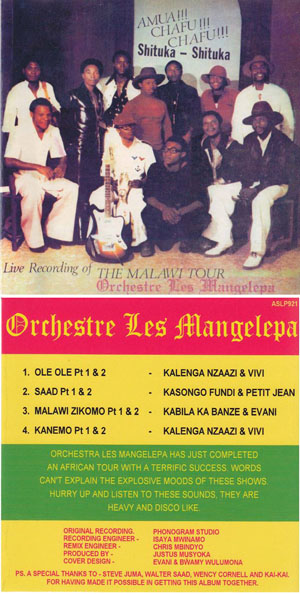
courtesy: Alan Wheeler |
LIVE RECORDING OF THE MALAWI TOUR ASLP 921 1979-80
a.k.a. Amua, Chafua Chafua, Shituka Shituka
Liner Notes:
Orchestra Les Mangelepa has just completed an African tour with a terrific success. Words can't explain the explosive moods of these shows. Hurry up and listen to these sounds, they are heavy and disco like. Track list:
A1-2 Ole Ole (Kalenga Nzaazi & Vivi)
A3-4 Saad (Kasongo Fundi & Petit Jean)
B1-2 Malawi Zikomo (Kabila Ka Banzi & Evani)
B3-4 Kanemo (Kalenga Nzaazi & Vivi)
|
courtesy: Alan Wheeler |
THE VERY BEST OF LES MANGELEPA:
The Golden Disc Award Winners, a.k.a. LISAPO ASLP928 1980
Amua
Lisapo
Maindusa
Kanemo
|
 courtesy East African Music |
GOLDEN HITS of Mangelepa ASLP2017 1982 (also Tamasha reissue as ASLP 2017)
A: Mangelepa Kamili (William)
Kizunguzungu (Kai Kai)
B: Trouble (Bwamy)
Sakina (Coco)
|
 courtesy East African Music |
SAFARI YA MANGELEPA ASLP988 (also Tamasha reissue as ASLP 2027)
A: Safari ya Mangelepa (Kabila Kabanze Evani)
Zoao (Kalenga Nzaazi Vivi)
B: Harare (Tabu Ngongo - Super Sax)
Odesia (Kalenga Nzaazi Vivi)
Kabila Kabanze Evani - vocals lead
Kalenga Nzaazi "Vivi" - vocals
Lutulu Kaniki "Macky" - vocals
Kawele - solo guitar
Bambu - rhythm guitar/second solo
William Tambwe - bass guitar
Tabu Ngongo - sax
Micky - drums
Belly Kanku - trumpet
|
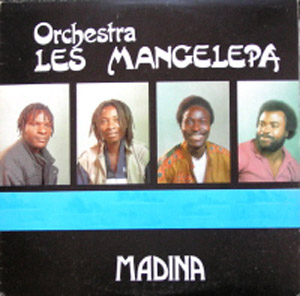 |
MADINA ASLP 413 1985
A1. Madina
2. N'Kimba
B1. Lolo Mukena
2. Kamwala
|
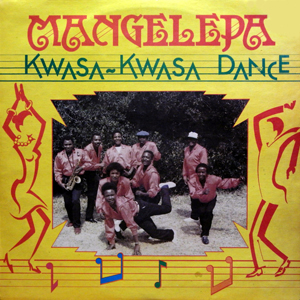
courtesy: Global Groovers |
KWASA KWASA DANCE (Gramma Records 1989)
Cherie Tracy
Tosambela nzambe
Kamulabi
Mokili
MBUNGU (Digital download from Jojo Records)
01. Mbungu (Mukala Coco) Wasi Wasi WW6
02. Mbuya (Kalenge-Nzaazi "Vivi") Eds Tobina TON 7-9
03. Lande Lande - unknown
04. Ekubuku from Pathe 2 C064 82413
05. Arthur Mariga - unknown
(Unknown provenance, maybe not an album, but stray singles compiled in 2012)
|
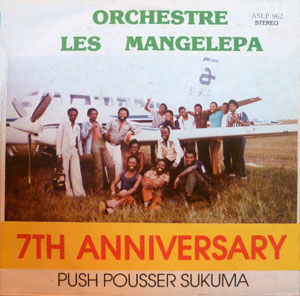
courtesy: Alan Wheeler |
7th ANNIVERSARY: PUSH POUSSER SUKUMA ASLP962 1982
Push Pousser Sukuma
Zarina
Nseya (Katako "Rocky" Lubula)*
Ni Mimi Tu
* included on Kenya Special Vol 2 (Soundway CD) 2016
|
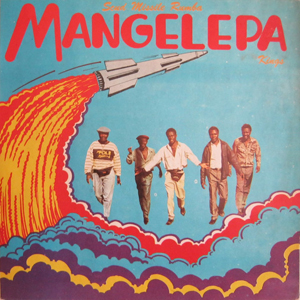 |
SCUD MISSILE RUMBA (R.T.P. 30 1991)
Recorded at Mosi-oa-Tunya Studios, and issued in Zimbabwe
A1 Peter Mutema
A2 Sandra
B1 Nakei Koluka
B2 Baba Namama
|
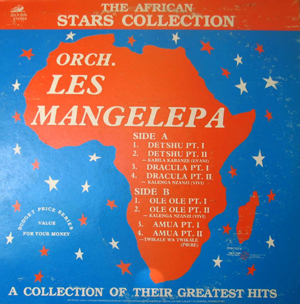 |
THE AFRICAN STARS COLLECTION VOL 5 (Jumbo Jet JJLP005) ca. 1990, see Natari website
A 1-2. Detshu (Kabila Kabanzi "Evani")
A 3-4. Dracula (Kalenga Nzazi "Vivi")
B 1-2. Ole Ole (Kalenga Nzazi "Vivi")
B 3-4. Amua (Twikale wa Twikale "Pierre")
(Also released on cassette as "Les Mangelepa with Hits like Amua, Dracular" - CASLP 2023 (P)1990)
|
 |
CDs: ENDURANCE (RETROAFRIC RETRO21CD 2006)
Embakasi (Kalenga Nzaza Vivi)
Maindusa (Inkangika Maindusa)
Mimba (Kabila ka banze Evany)
Nyako Konya (Badi Banga wa Thsilumba)
Walter (Badi Banga wa Thsilumba)
Malawi Zikama (Kabila ka banze Evany)
Kanemo (Kalenga Nzaza Vivi)
|
 |
GOLDEN VOICES (SOUND AFRICA, KENYA, 2007)
31st Anniversary release on 2CD
Vocals: Evanny Kabila Kabanze, Lutula Kaniki, Kalenga Nzazi
Guitars: Twikale Kalonda (solo, rhythm, bass)
Munga John (solo, rhythm)
Campron (bass), Lady (rhythm, solo)
Kazadi Mbambu (solo, rhythm)
Drums: Toto Ilunga, Ley Juse
Tumba: Ley Juse
Keys: Makaya
Sax: Kalle
CD 1:
1 Nairobi (Twikale Kalonda)
2 Omari (Kabila Kabanze)
3 Kijana (Mukala Kanyinda Coco)
4 Bebe De Londre (Monga John)
5 Kona Kona (Kalenga Nzazi Vivi)
6 Janine (Lutula Kaniki Macky)
7 Mbungu (Mukala Kanyinda Coco)
8 Mathias K'Oyoo (Kabila Kabanze)
9 Badilisha Tabia (Kabila Kabanze)
10 Mangelepa (Kabila Kabanze)
CD 2:
1 Mangelepa Millennium (Kabila Kabanze)
2 La Congolaise (Twikale Kalonda)
3 Suzanna (Kalenga Nzazi Vivi)
4 Tosambela Nzambe (Twikale Kalonda)
5 Jafar (Kabila Kabanze)
6 Mokale (Kabila Kabanze)
7 Zoke (Lutula Kaniki Macky)
8 Amigo(Lutula Kaniki Macky)
9 Mama Mia (Twikale Kalonda)
10 James Osogo (Kalenga Nzazi Vivi)
|
 |
LAST BAND STANDING (Strut 159CD 2017)
remakes of some of their famous songs:
1. Kaneno
2. Malawi Zikono
3. Mbungu
4. Maindusa
5. Nyako konya
6. Suzanna
7. Mimba
8. Ma Lilly
|
(courtesy of Kentanzavinyl.com) |
Les Mangelepa 45:
Amua (Pierre) ASL 2252/ AS 4670; included on ASLP920 The Very Best of Zairean Music
Aoko (Mukola Kanyindo "Coco") Eds Jojo 3203 1976
Auto stop (Lutulu Kaniki Macky) ASL 2295 1982
Beyande
Cherie Makisa
Conseil Gratuit
Desespoir
Djalaa (Petty Jean) Eds Mangelepa EPA 7-3
Dracula (Lutulu Kanicky, Macky) Sango ASL 2250 1980
Embakasi ASL22114 1973?; also on ASLP 425 Yester Decade (1987)
Hayansa (Kabila ka Banze "Evani") ASL 2282 1981
Kadjera (Lumwanga Mayombo) ASL 2277 1981
Kanemo (ASL 2281 1981)
Kasuku (Kabila ka Banze "Evani") ASL 2222N
Kijana (Mukula Coco) Wasi Wasi WW5 1976
Kimbele Mbele (Mandefu wa Mandefu) Eds Tobina TON 7-7
Kizungu Zungu (Badibanga Kai-Kai) Eds Mangelepa EPA 7-2
Lisapo (Tshimanga) ASL 2270 (1980)
Malawi Zikomo
Mangelepa Kamili Eds Jojo3205 1976
Mangelepa Kanini (Sakina; Nganga-Kimetu; Ekubuku) EMI JJP 999
Mangelepa Ni Yako (ASL 2353 1986)
Mankwazi (Kabila ka Banze "Evani") Eds Mangelepa EPA 7-5
Manyeto (Les Mangelepa) ASL 2336
Masanga Olele
Massanga (Kabila Kabanze Evani) ASL 2342 1985
Mbungu (Mukala Coco) Wasi Wasi WW6
Mbuya (Kalenge-Nzaazi "Vivi") Eds Tobina TON 7-9
Mimba (Kabila Ka Banze "Evani") ASL 2251
Mtukufu Rais D. Arap Moi - ASL 2241
Naleli Papa (Badibanga Kai Kai) Eds Jojo 3205 1976
Ni Mimi Tu (Lutulu Kaniki "Macky"; Soloist National: Captain Bwamy) ASL2320
N'Kimba (Kabila Ka Banze "Evani") ASL 2348
Nyako Konya (Badibanga wa Tshilumba "Kai-Kai") ASL 7-2238 1979
Nsense (Kabila Kabanze "Evani") Eds Tobina TON 7-8
Ole Ole (ASL 2257N /AS4697)
Sakina Eds Jojo 3207 1976
Suki Pembe (ASL 2334 1984)
Trouble (Bwamy Walumona) Eds Mangelepa EPA 7-1
Tshibola (Badibanga Kai-Kai) Eds Mangelepa EPA 7-4
Walter ASL2237 1981
Wasai
Zeba
|
courtesy Afro7.net |
Orchestre Matonge
Named for a neighborhood in Kinshasa; the label also released Baba National and other Congolese bands. Leader Jean-Claude Kasongo is Kasongo wa Kanema of Baba Gaston, Les Mangelepa and Super Mazembe & Virunga fame. There is also another band called Bana Matonge, most likely based in Congo. (Thanks to the Honorable Jerome Ogola for info)
45s:
Cherie More Eds Kamanyola KAM2
Na Koloba nini (Jean Claude Kasongo) Eds Kamanyola KAM6
Pesa Moselebende (Jean Claude Kasongo) Eds Kamanyola KAM3
|
courtesy Doug Paterson |
Orch Mbuta Mbuta
A project of percussionist Mukula wa Mulumba (a.k.a. Koko Kanyinda, formerly of Vox Africa, later of Les Mangelepa), with Coco Zigo vocalist. Tchoutshou (ex-Baba Gaston) also a member. Shout-outs to Bella Bella suggest members may have come from there too.
Doug Paterson found four tracks in the A.I.T. archives from an (unreleased?) LP. Two other singles appeared on Musiki du Zaire in 1977.
LP:
AIT (AITY 7010)
A 1-2 Ida
A 3-4 Acha
B 1-2 Nakokamua
B 3-4 Christmas
45s:
Ewawa Na Mapendo (Mukula wa Mulumba) Musiki du Zaire MZ 23 (P) 1977
Bolingo (Mukula wa Mulumba) Musiki du Zaire MZ 24 (P) 1977
|
|
Orchestre Mokano
The first appearance of "Mokano" as a song title I have found is one by Lofongo Ea Bengolo & Etumba na Nguaka (Eds Cavacha Wondele, 1977, with Huit Kilos, Bibiley and Lokassa on guitars and Dindo Yogo on vocals), though about the same time Lovy recorded a different song with the same title in Nairobi. The group L'Orchestre Mokano comprised Congolese musicians recording in Nairobi around 1980. In true form the band was named after a hit by one of the members. "Mokano" was a hit song for Lovy before 1980, but was rerecorded by him with Super Mazembe later. L'Orchestre Mokano recorded on the Hit Parade label, which was dedicated to Orchestre Shika Shika for its first 30 issues, but then allowed other bands into their catalogue. There are also singles on Eds Bakoka and a Kenyan label called BIEM (for this confusing name for a label see Tim Clifford's website). Personnel include Lovy (vocal), Dago Mayombe (vocal), Sammy Mansita (guitar), Siama Matuzungidi (guitar), Kizunga Rico (guitar), and presumably others who were around Lovy at the time. Interestingly they have electric piano on "Sala Zuwa."
45s:
Mosolo (Mayombe Dhago) Eds Bakoka BAK8804
Nekese (Rico) BIEM (Kenyan label) BMA001
Sala Zuwa (Sammy Mansita) Hit Parade HP103 ca 1982
|
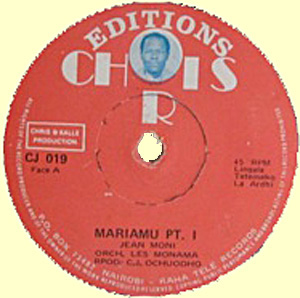 courtesy KenTanzaVinyl.com |
Orchestra Les Monama
Band led by Jimmy Monimambo in one of his many incarnations. With Mbongo Pasi on sax and Moreno on vocals. There was also a label, Editions Monama, produced by Felix Jakomo Jr that issued "Maya" by Mtsimba Monimambo as its first release in 1978. (See below)
45:
Mariamu (Jean Moni) Editions Chris CJ019
Marie Chantale (Jean Moni) Eds Chris CJ021 (remake of Shika Shika song?)
Nakokate
Nabokola Mwana nkoi (Jean Monimambo) Editions Chris CJ020
Nzola (Monimambo Jim) City Boom 008
|
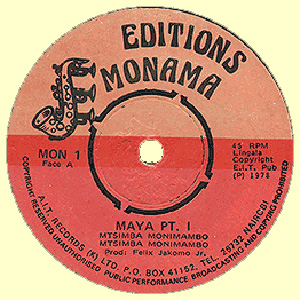
courtesy afro7.net
|
Moni Mambo
Jean - or Jimmy - Monimambo is a key figure in all these groups. As well as recording with many of them he issued singles under his own name.
45s by Moni Mambo:
Getride (Siama) S-CBS (K) 004 (P) 1979
Maya (Mtsimba Monimambo) Eds Monama MON1 (P) 1978 see also Monama
Ndaya (Mtsimba Monimambo) Eds Monama MON2
|
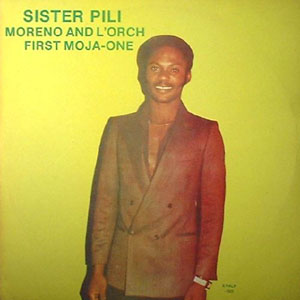
|
Moreno & Moja One
LP:
Moreno and l'Orch First Moja-One (AIT Records EFALP020) Sister Pili
A1. Adidja
2. Kaka Punguza wivu
B1. Aoko (Danger girl)
2. Sister Pili
Personnel:
Guitar-solo: Mokili Sesti
Rhythm: Siama & Bibiley
Bass: Lomboto (Toms)
Saxophone: Kayumba (Frankai)
Drums: Lava & Kaster & Hasani
Vocals: Coco Zigo & Dewolo
Solo vocals: Moreno
Music arranger: Moreno
Produced by: Felix Jacomo (G.A.)
Recording engineer: Steve Ndesandjo
Recorded at: CBS Studios (Nairobi/Kenya)
(Note: There is some irony in adding the epithet "First" to the band name as "Moja" also means "One"!)
N.B. Reissued in 2012 by Stern's as Sister Pili + 2, next.
CDs:
|
 |
Moreno & L'Orch First Moja One : Sister Pili + 2
(STERN'S)
1. Adidja
2. Kaka Punguza wivu
3. Aoko (Danger girl)
4. Sister Pili
5. Rehama Piri (POPE16) by Bana Nzadi
6. Teresia (POPE17) by Bana Nzadi
Reissue of Sister Pili plus 2 from Sterns 2012, compiled by Doug Paterson. (My review of it appears on the Kenya part two page.) The two additional tracks, 'Rehema-Piri' (POPE16) & 'Teresia' (POPE17), were singles recorded a couple of years before "Sister Pili" with a group called Bana Nzadi, seemingly incorporating members of Bana Ekanga, along with Tabu Ngongo (later of Mangelepa & then Vundumuna) on sax, and Sammy Kasule (of Special Liwanza and Les Kinois) on bass. Along with Siama on rhythm guitar and Madjo Maduley on harmony vocals.
|
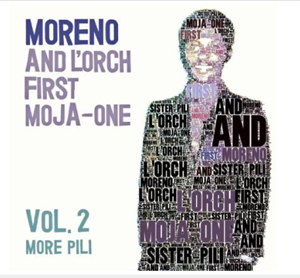 |
Moreno & L'Orch First Moja One Vol 2: More Pili
(STERN'S digital release only)
1. Tusijuane 09:01 (1982 NYIKA 02)
2. Matanga 09:20 (1984 AIT/MOJA 06)
3. Pili Mungwana 05:09 (AIT/MOJA 04B)
4. Dunia Ni Duara 09:34 (AIT/MOJA 01)
5. Sisili 09:02 (recorded 1981, unreleased)
6. Sitaki Mambo 04:52 (1983 AIT/MOJA 04A)
7. Mariana 09:02 (recorded 1981, unreleased)
8. Bokila 09:18 (1983 AIT/MOJA 05)
More great material including two unreleased songs, taken from the master tapes at A.I.T. and restored by Doug Paterson in 2014. From Siama comes this additional information on the line-up:
Recorded at High Fidelity Studios in Nairobi
Moreno Batamba (singer, composer of all songs)
Coco Zigo (singer)
Dago Mayombe (singer)
Gina Monganza (singer)
Jacques Akomo (lead guitar)
Mokili Sesti (lead guitar)
Roy (lead guitar)
Siama Matuzungidi, given name Rivancliff (rhythm guitar)
Joniko Walengo (bass)
Tommy Lomboto (bass)
Lava Machine (drums)
Caster (drum)
Papa Joe (keyboard)
CASSETTES:
|
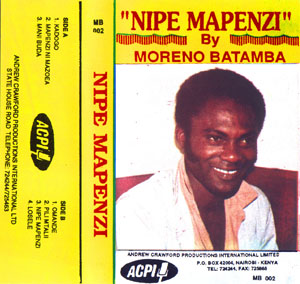
|
Moreno cassette "Nipe Mapenzi" (MB 002)
1. Kadogo - 9:19
2. Mapenzi Ni Mazoea - 9:16
3. Mani Buda - 9:20
4. Omande - 8:55
5. Pili Mtalii - 9:29
6. Nipe Mapenzi - 4:48 (Oddly, this hit song in English starts out as Afrobeat)
7. Losele - 7:19
|
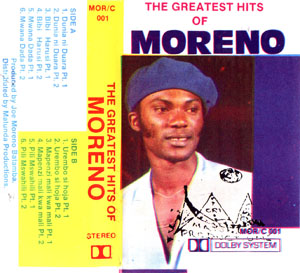
|
Moreno cassette "Greatest Hits" (MOR/C 001)
1. Dunia Ni Duara - 8:13 (original version, with horns) 1981
2. Bibi Harusi - 8:13
3. Mwana Dada - 8:45 (also released as a 45 rpm single)
4. Urembo Si Hoja - 8:31 (also released as a 45 rpm single)
5. Mali Kwa Mali - 7:50 (also released as a 45 rpm single)
6. Pili Mswahili - 13:31 (also released as a 45 rpm single) 1981
|
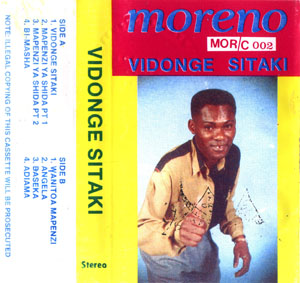
|
Moreno cassette "Vidonge Sitaki" (MOR/C 002)
Vidonge Sitaki - 7:08 (remake of a Taraab hit; also released as a 45 rpm single) 1993
Mapenzi Ya Shida - 14:08 (also released as a 45 rpm single)
Bimasha - 9:05
Wanitoa Mapenzi - 8:13 (also released as a 45 rpm single)
Angela - 7:44 (also released as a 45 rpm single)
Baseka - 8:29 (also released as a 45 rpm single)
Adiama - 6:12
|
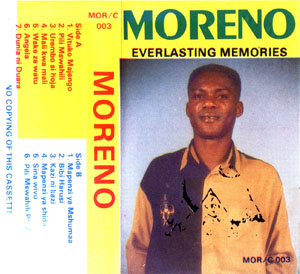
|
Moreno cassette "Everlasting Memories" (MOR/C 003)
SIDE A:
1. Vituko Majengo - 4:30
2. Pili Mswahili (possibly a remake; attributed to Baba Gaston Band on the 45)
3. Urembo si hoja (An almost reggae feel to the guitar on this; also released as a 45)
4. Mali kwa mali (also released as a 45 rpm single)
5. Wake za watu (also released as a 45 single)*
6. Angela (also released as a 45 rpm single)
7. Dunia ni duara (also released as a 45 rpm single)
SIDE B:
1. Mapenzi ya Mshumaa
2. Bibi Harusi (also on 45 as "Bibi Arusi")
3. Kazi Ni Kazi - 4:00 (also on 45 in 1982)
4. Mapenzi Ya Mshumaa - 6:07
5. Sina Wivu - 4:05 (Interesting to note the influence of Mbaqanga on this track; also released as a 45 rpm single)
6. Pili Mswahili 2 (also released as a 45 rpm single)
*Also on LP "It's My Discothek Vol 2" (POLP 547) as "Mabibi Za Watu" - 9:56 (also released as a 45 rpm single)
|
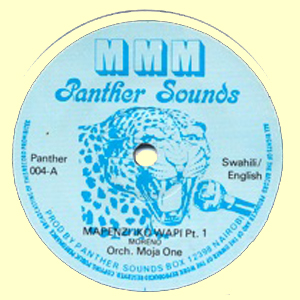
(Label courtesy of Kentanzavinyl)
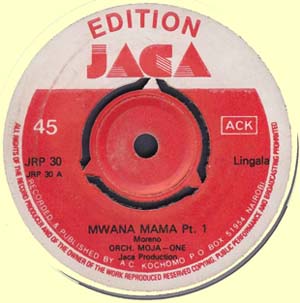
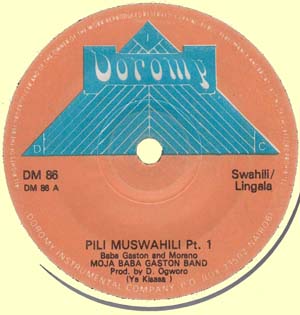
2 above courtesy Alan Wheeler |
MOJA ONE 45s:
(Info from Kentanzavinyl.com, Doug Paterson, Peter Toll, Alan Wheeler, Tim Clifford and Muttu Mondiya Mama via Julian Thorpe's page)
Aminata (AIT - Andrew Crawford Productions, also title of LP)
Angela (Moreno) Sound Masters SOMA004
Aterere
Bibi Arusi (Doromy DM88)
Bokila (Moreno) AIT/MOJA 5 P1983
Chuki ya Nini (Prince Coco Zigo) Mzalendo CLUB10 1982
Dadali (Moreno Batamba) Mlima LIMA010 Kiswahili
Dunia ni Duara (Moreno) Sound of Music Sound010; also AIT/MOJA 1: The original version
Dunia Si Yako si yangu (Moreno) CBS ACP702
Elizabetta (Moreno) Sound of Music SOUND 008
Gor Mahia (Moreno) Eds Mon-Amie Amua 3 (Prod. Hon. Kanindo Senior)
(Gor Mahia is a football club also celebrated in song by Shika Shika and George Ramogi with his benga group, CK Dombe Dombe Jazz)
Jua Lako (Moreno) Eds Jaca JPR 33 (on KWEYA compilation: POLP551)
Kazi ni Kazi (Moreno) August Gramophone Stores AUG 14 / PMS27 (P) 1982
Manimba (Moreno) Sound of Music Sound009; also AIT MOJA 2 (A "Moja Moja" sung in Swahili)
Mapenzi Mali kwa Mali (Moreno) Doromy DM92 Kiswahili
Mapenzi Iko Wapi (Moreno) MMM Panther Sounds PANTHER 004
Mapenzi ya Barua (Moreno Batamba) Disco Sounds DISCO 001 (Kiswahili)
Mapenzi ya Kisasa (Moreno) JACA JRP32
Mapenzi ya Shida (Moreno) B-side of Vidonge Sitaki (SHENG 001B)
Maria (Moreno Batamba) Doromy DM94 Kiswahili
(included on Nairobi Calling!, No Wahala Sounds NWS5, 2017)
Matanga (Moreno) AIT/MOJA 6 1984 (recorded December 1981)
Mola Ndiye Muhumba (Moreno) by Super Moja-One: Eds Jaca JRP25
Mwana Dada (Moreno) Doromy DM91
Mwana Mama (Moreno) JACA JRP30 Kiswahili
Najuta Kuponda (Moreno) Umoja Mwana Shambe UMS7
Ngalula
Nyako Marach (Moreno) Eds Mwana Mama MM31
Pili Muswahili (Baba Gaston & Moreno) performed by MOJA BABA GASTON BAND Doromy DM86
Rehama (Moreno) by Orch. Les Moja-Moja Umoja UMS6
Saad -- Krismas -- Disco (Batamba Moreno) CBS/Linga 7
Shufaa (AIT - Andrew Crawford Productions)
Sina Wivu (Moreno Batamba) Hudson Productions HUDP-002 Kiswahili
Sister Pili (Moreno) Editions FrancAfrique EFA14
Sister She
Sikutaki Tena (AIT - Andrew Crawford Productions)
Sitaki Mambo b/w Pili Mungwana (Moreno) AIT/MOJA 4
Sweet Male (Moreno Batamba) KENYATONE KTN002 Super 1981 Swahili
Tusijuane (Moreno?) Nyika 02 P1982 (recorded December 1981)
Umeshuka Bei International Musique du Afrique INTA3
Urembo si hoja (Prof Moreno) Shemeji SEM01
Utani choka (Moreno) AGS: AUG16 1982
Vidonge Sitaki (Moreno) 5'03" b/w Mapenzi ya Shida SuperPhonics SHENG 001 (Kiswahili)
Waanyika Nyika 2
Wakati Umefika (Moreno) AIT/Moto Moto MOJA 3 1982
Wake za Watu (ASL 3411), also known as "Mabibi za Watu" |
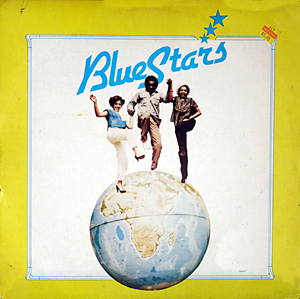
|
Moreno & Blue Stars LP (CBS /ACP 1201) BS1 1990
A1. Kalume (Margaret Safari)
A2. Losele (Moreno Batamba)
B1. African Woman (Margaret Safari)
B2. Sikutaki Tena (Margaret Safari)
B3. Shufa (Moreno Batamba) also released as a single
Note: A pretty awful album, with two bright women, Margaret & Sheila, singing harmony that doesn't fit with Moreno's growl, a terrible synthesizer and some weird musical ideas, especially on "Losele" and "African Woman." Good "Diblo-esque" soukous-style guitar, but not enough to recommended it.
Moreno & Blue Stars 45s:
Mapenzi ni mazoea by Moreno Blue Stars CBS-ACP703
Shufa by Blue Stars CBS/ACP1201
|
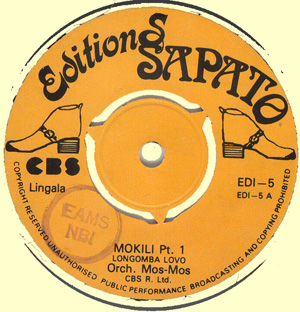
|
Orchestra Mos Mos
Band led by Moises Fonta who is now in London. With Nana Akuma as the female singer and Lovy Longomba & Monimambo also on vocals, Frantal, Siama and Chery on guitars and Lava Machine on drums. I hear the following names in shout-outs: Shabani (drummer), Manitcho (bass), Manaka, Delvida, Jackino & Bokilo (singers), "Elvis" aka Lawison Somana on sax. Possibly with Apollo on guitar, since that is one of their hits. Guitarist Mokili Sesti gets a shout out. A different "Mokili" was also a hit for Lovy, Bana Likasi & Super Lovy.
45:
Apollo (Lovy) Safari SAF10 (Lingala)
Kanindo (Kanindo) Eds Mwana Mama MM25
Mado Zaina (Lovy) Eds Tobina TON25
Note: This is a different song from "Mado Zaina" of Bana Likasi
Makambo Mingi (Longomba Lovy) Eds Mwana Mama MM28 (Chafua Chafua)
Mama Phelly (Frantals Ogollah) Eds Sapato EDI 1
Mokili (Longomba Lovi) (Editions Sapato, Kenya EDI 5)
Nyar Kano (Franthal Ogollah) Bolingo DD8 (Seke-Seke)
Pesa Oguro Janabi (Ben Maunga Sinayuera) Agweny-Wembe GEM4 (JACA distribution) Dholuo/English (Benga)
Souci (Masala) Voice of Victoria VRP 004
Vumilia Wazazi (Longomba Lovi) Bolingo DD 11
Walter Jaramogi (Franthals Ogola) Editions Sapato EDI 2
Zonga Libala (Mos Mos Group) Eds Sapato [CBS] EDI 3
Zoze (Masala) VRP (Victoria Music Store, Nbo) VRP003 Lingala
Mama ya Mwana (Editions Sapato, Kenya EDI-6)
This last single was a test pressing (& could be attributed to Shika Shika as it is unlabelled). Siama recalls, "Mama ya muana: Yes Lovy was praising Mado Zaina and also Safi Mati, who was Jimy Monimambo's wife. They were all best friend living in the same place but different apartments at that time. It could be CBS because some recordings of CBS never came out; I remember doing 4 songs for Monimambo with CBS. I can hear the voice of Monimambo, Fataki too, Nsilu waba Nsilu bass, Shabani drums, I don't know what Elvis -- Lawi Somana -- was playing, could be sax or guitar, he was a good guitarist too." Seemingly reissued as "Mboka Mosika" by Shika Shika on Eds Jaca ELJ 051.
|
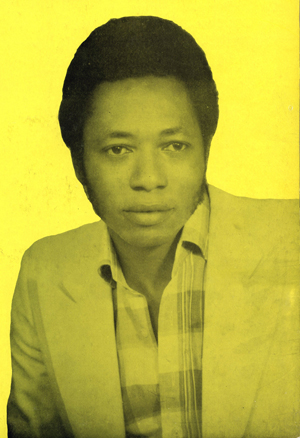 |
Nguashi Ntimbo
Nguashi N'Timbo made his debut in Lubumbashi in the Baba Gaston Band and sang with them for many years. Arriving in Kinshasa he started Orchestre Sentima and sang alongside Sam Mangwana, notably on "Tangua." By 1977 he was releasing songs in Nairobi with his Orchestre Festival du Zaire, which also featured Kadima, Zele Kabamba and Starzo ya Estha. In 1979 he joined OK Jazz for three years and may have toured to West Africa with them.
It has long been a puzzle as to whether Nguashi Ntimbo belongs in this page. The fact that Festival added "du Zaire" to their name does suggest an ex-pat band. In a series of albums called "Franco présente..." the great man issued tracks by artists associated with his band that were not necessarily recorded with OK Jazz. As noted by Jerome Ogola, in the song "Ossette muana Congo," Nguashi shouts out to Fataki Lokassa, who was in Nairobi, but also says, in Swahili, "Hii rekodi inapatikana Polygram Nairobi" which means "This record is found in Polygram Nairobi." In another song on it, "Pneu ya reserve," he calls out to the band members as Orchestre Sentima. So, for now, I will include Nguashi and Festival du Zaire, Top Forum and Sentima, and leave out the OK Jazz recordings (1979-81). However Orch Sentima's "Citoyen" was recorded in Kinshasa in 1982, and other solo work was apparently recorded in Belgium or the Congo. According to Tim Clifford's website, Ntimbo licensed singles to Melodica in Nairobi under the Eds Ntimbo label. (The checklist of Eds Ntimbo below comes mainly from Peter Toll.) Some, if not all, were recorded in Kinshasa. So for the purposes of this page we will allow a little leeway and remember my mantra, "Some came to play; some came to stay."
[update March 2018:] Composer/guitarist Abbu Omar (of Simba Wanyika and MAS System) offers first hand clarification: Nguashi Ntimbo brought master tapes from Kinshasa to deliver to PolyGram Records. He brought the master tape with original version of the popular song "Shauri yako" to Nairobi PolyGram in the same way in 1981. After "Shauri yako" he kept on bringing master tapes, some with OK Jazz. I am a witness, we met with him many times and greeted each other at PolyGram Studios, Industrial area, Nairobi from 1981 until around 85, then he disappeared. He never played live shows in Nairobi or anywhere in Kenya. He used to travel alone, kind of quiet & always worried guy, but very smart in fancy suits. I am sure some of the master tapes he used to bring were illegally brought to Kenya. His best friend was then PolyGram chief producer/manager the late Mzee Isaya Mwinamo. I am also wondering if he himself participated on singing all those songs. He knew a little Swahili. We met him in Instagram studios, twice, when he was recording (Simba Wanyika) in the studio and time to rest for lunch. We never met him city center: the rumors was that he was coming to Kenya to sell songs of his colleagues without agreement and money was also eating alone. I don't know if this was true. Many times like old man Sam Mangwana they were coming in Nairobi they will be more free than this brother. Mangwana recorded at Instagram studios in Nairobi with a big band of local people. In the solo guitar there was Sammy Mansita, on rhythm Siama Matuzungidi, bass - Johnyco Walengo, drums - Lava Machine. For those who do not know the band of Ibeba System -- it was a band comprised of musicians from the Orch. Virunga of Samba Mapangala who had a contract with the Starlight club, and a contract with JKA Resort club, this band also worked in Tokyo, Japan.
|
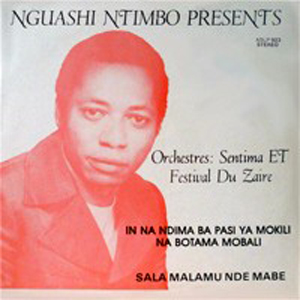 courtesy East African Music |
LPs:
Nguashi Ntimbo presents Orchestres: Sentima et Festival du Zaire (ASLP 923 1981)
A1-2: Moto Moto
A3: Lacaza
A4: Matshika
B1: Nzambe Mungu (Ntimbo et orch Sentima)
B2: Bondumba (Ntimbo et orch Sentima)
B3-4: Sava Sava (Zele Kabamba & Festival du Zaire)
|
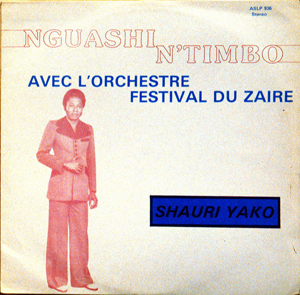
Alternate cover from Zambian pressing |
Shauri Yako (ASLP 936 1981)
A1 Shauri Yako I & II (Nguashi N'timbo)
A3 Mami I & II (Stazo ya Estha)
B1 Simakala I & II (Zele Kabamba)
B3 Kabu I & II (Zele Kabamba)
|
 courtesy East African Music |
Nguashi Ntimbo avec Orchestre Sentima "Liteya" (ASLP 944 1981)
A: Liteya
Mbonge
B: Kalanda
Basomele
Maleso
|
 |
Nguashi Ntimbo Mboyo: Vol 1 (Ntijems NT002 Nairobi/recorded in Zaire)
A1 Mboyo
A2 Original
B1 Mokolo Ekonginda
B2 Ntimbo Nazongeliyo
|
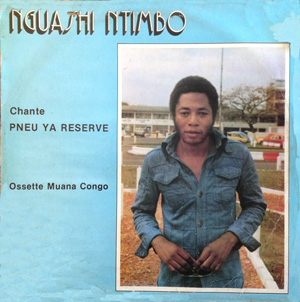 |
Nguashi Ntimbo chante "Pneu Ya Reserve" Et "Ossette Muana Congo" (JNT Music 002 ca 1983)
A1 Pneu Ya Reserve*
A2 Telephone
B1 Ossette Muana Congo
B2 Olongui Ya Mawa
* "Pneu ya reserve (Spare tire)" also appears on the 1980 Musicanova album, Musicanova présente Nguashi N'Timbo later reissued as NT001 Nguashi Ntimbo et le T.P.O.K. Jazz présente Banganga ya Moyindo
|
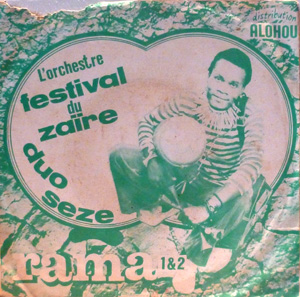 |
Festival du Zaire 45s:
Akende Bokila Eds Ntimbo ET007
Bokola nakokufa
Bondela Baboti [ET009?]
Kadioka (Zele) Bana Moja 20
Kirita
Lita ya mbongo
Madiya (Duo Seze) ASL 3351 also African 91.342 1976 (orig: J-P wa J-P)
Makana
Mbila () Aida AD007
Mokili compliqué
Mutima
Nalobaki
Nganga ya tolingani
Rama (Duo Seze) African 91.340 1976 (orig: JP wa JP)
Sava Sava (Duo Seze) African 91.341 1976 (orig: JP wa JP)
Setou ASL3401 1982
Shauri Yako (Nguashi Ntimbo) ASL 3393 1981
Other bands:
Ntimbo & L'orch. Nzube "Kobota na nse" (Ntimbo) Eds CHRIS 18
Ntimbo and Orch Mwana Mayi "Tangwa - Citoyen" Eds CHRIS 22
Ntimbo and Orch Mwana Mayi "Elongi ya Cherie" Eds CHRIS 23*
* possibly another version of "Manguta"
|
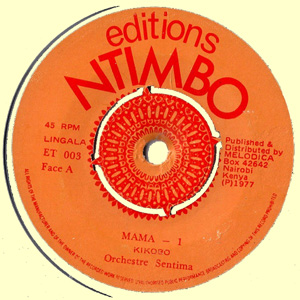 courtesy KenTanza vinyl |
Editions Ntimbo singles released in 1977:
ET 001 Orch Top Forum: Matatas (Ntimbo)
ET 002 Orch Top Forum: Liwas (Makanzu)
ET 003 Orch Sentima: Mamas (Kikobo)*
ET 005 Orch Top Forum: Tien An Miens
ET 006 Orch Sentima: Citoyens (Ntimbo)*
ET 007 Orch Festival du Zaire: Akende Bokilas (Kadima)
ET 008 Orch Sentima: Bosomeles (Kikobo)
ET 009 Orch Festival du Zaire: Fatus [I think this is an error]
ET 009 [according to discogs] Festival du Zaire :Bondela Baboti (Estazo ya Estha)
ET 010 Orch Sentima: Trop Bon, Trop Couyon*/Mati
ET 010 [I think this should be] Trop bon (Ntimbo)*
ET 12 Orch Sentima: Ntumbas (Ntimbo)
* these three tracks, along with "Dokotolo," appear on the Orch Sentima album Citoyen recorded in Kinshasa, released by ASL in Kenya in 1982
Les Noirs


|
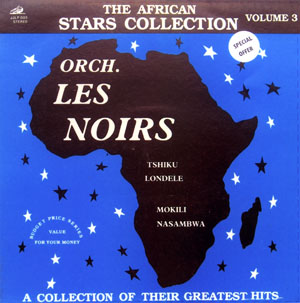 |
Long-lasting band that was among the first to visit Kenya but undoubtedly went back to Zaire. Formed in Kinshasa in 1966 they were releasing albums in East Africa in the early 70s. They may have had two branches: one based in Congo and one on tour. They also seem to have merged with an East African band called City Five, led by Chuza Kabaselle who was born in Kasai, Congo, but grew up in Uganda and Kenya. Looking at the songwriters you notice Moro Beya Maduma who was a founder along with Amba Zozo, Moreno, Deyesse (Empompo Loway), Mpudi (of OK Jazz) and other distinguished artists contributed to their repertoire. A collaboration with Tshimanga Assosa led to the formation (I conjecture) involving members of Orch Makassy for a group known as Les Noirs Agwaya, on the ASL label.
On compilation LPs:
"Mungu iko Helena" by Kuka & Les Noirs on ANCIENT SUCCES VOL 1 (ASLP 426)
"Sikiya sauce" by Chuza et les Noirs on ANCIENT SUCCES VOL 1 (ASLP 426)
"Mosasa Ndembo" by Ndala Mobangui Roger on HIT PARADE AFRICAIN vol 3 Pathé Marconi 2C 054-15240
"Sikiya sauce" by Chuza et les Noirs & "Amin no 1" on HIT PARADE AFRICAIN vol 4 Pathé Marconi 2C 054-15733
LP: The African Stars Collection vol 3 (JJLP003):
A: Tshiku
Londele
B: Mokili
Nasambwa
|
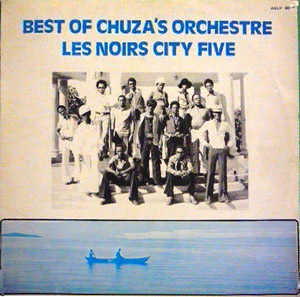 |
BEST OF CHUZA'S ORCHESTRE LES NOIRS CITY FIVE (ASLP 904 (p)1976)
(Thanks to Alan Wheeler)
A: Sikia Sauce no 2
Amin No 1
Mosasa Ndembo
Mungu Iko Helena
B: Banange jangu tugende mengo
Nakotuta yo mabe
Banga ye
Hata Ukifanya nini
Mr Chuza Kabaselleh Masters, founder leader, and owner of Orchestre Les Noirs City Five, was born in Kasai, Zaire and brought up in Uganda and Kenya.
Chuza has had a long spell in the colonial army during the last world war, posted on service to various countries abroad. It was during this period in India that he started an Army Entertainment Band Unit with George Zaake, Daniel Gatuku, Charles Renkatuka, Fundi and many others.
After the war Chuza led an ex-Servicemen's band performing so popularly all over East Africa: the very popular A.B.S. Band. So popular was this group that even the Colonial Government allowed them to entertain the Mau Mau internees all over the country.
The colonial government ensured the break-up of this group towards the end of the emergency but Chuza very much determined and popular throughout East Africa continued forming band after band. His popularity earned him success in 1970 when the Uganda government trusted him with his band to perform at the various Hotels in Uganda.
In 1972 his recording career started in Kenya. For his success he thanks all his musicians and fans, and hopes this LP will be a must in every household.
|
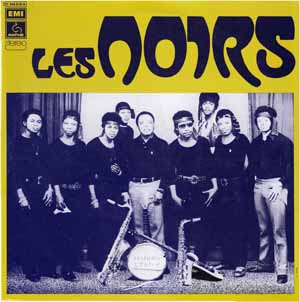
courtesy: East African Music |
LES NOIRS (Pathé Marconi C054-81818)
reissued by ASLP in Nairobi as ASLP900
A: Instrumental
Boni Okimi ngai (Makwanzi Duki)
Mama Titi (Weteto)
Osilisi ngai bisengo ya mokili (N'talu Nkatu)
B: Leontine (N'dala Mobangi)
Kumbe Bolingo (Amani)
Ntumba Monique nalinga
Possibly later than the following album, and apparently with different personnel.
|
|
Note: Les Noirs had the following personnel on their self titled Pathé-Marconi LP:
Vocals: N'Dala Mobangi
Saxophone: N'Talu Nkatu
Drums, Tumba: Mukaputu Kalembi
Band manager, drums: Teka Seke Chuza Kabaselle Mbawo Mutella
Guitar/Vocal: Makwanzi Duki
Singer: Hassan Omari
Vocalist: Kuka Mwana Bitala
Saxophone: Ndongo Amani
Band Leader: Kalonzi BrainkWhile it is classic Congolese rhumba, sung in Lingala, the album opens in English with a salute to Kenyan fans and a "Viva Mobutu" and "Viva Kenyatta." This would make them one of the first Congolese bands to hit Kenya, probably in the early 70s. By 1973 their personnel on an ASL single was listed as Alto Saxophone - N'Talu Nkatu, Ndongo Amani; Weteto (vocals?); Congas - Teke Seke Chuza Kabaselleh; Drums - Makwanzi Duki; Guitar - Makwanzi Duki; Vocals - Kuka Mwana Bitela, Makwanzi Duki, Ndongo Amani
|
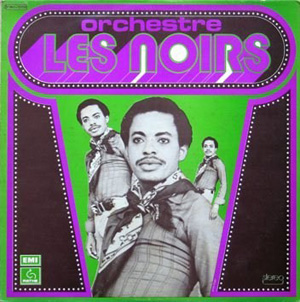 |
LES NOIRS (Pathé Marconi France 2C 062-15759 1973)
This must be where Prince got his sense of style?
liner notes: (Thanks to Alan Wheeler, translation by AJ):
Created in Kinshasa in 1966, an Orchestre bearing the name Les Noirs was made from musicians of the Republic of Zaire. During its existence the Orchestre Les Noirs has made a long voyage in East Africa -- more precisely in Uganda, Kenya and Tanzania. From this trip the band has had unparalleled success. The band comprises the following members:
Founder and band leader: Amba-Zozo (singer)
Singers: Vununu-Bovino, Bokenenge-Ngomo, Gho-Monzele
(Guitar) Soloists: Elema, Mokolo
Accompaniment: Kemimi
Saxophones: Beya-Maduma, Mozande
Trumpets: Barato, Ebule
Tumba: Weteto Koy (assistant band leader)
Side 1:
1. Bafolo 1 (Amba Zozo)
2. Mai ya tongo (Bokenenge-Ngomo)
3. S.G.A. (Kemini)
4. Longoli 1 (Amba Zozo)
Side 2:
1. Masamuna (Amba Zozo)
2. Diedo Miya (Beya Maduma)
3. Mokulu Mbembe 1 (Amba Zozo)
4. Mokulu Mbembe 2 (Amba Zozo)
5. Masunda (Amba Zozo)
|
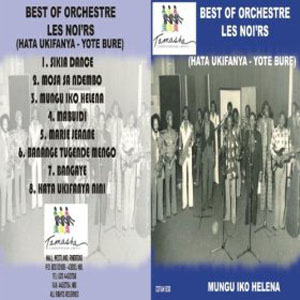 |
CD:
Best of Orchestre Les NOIRS (Tamasha CDTAM900)
*See my review on the Congo part 3 page for something of an explanation of the total hash Tamasha made with this album. As you can guess from the crudely rescaled cover it was taken from a cassette. Lots of bass rumble on here. The track names are all wrong. Here's my corrected track list:
1. Sikiya Sauce 1
2. Sikiya Sauce 2
3. Mosa se Ndembo
4. Mungu iko Helena
5. Mabuidi (Amani)
6. Marie Jeanne
7. Banange tugede mengo (?)
8. Bangaye
9. Shida
|
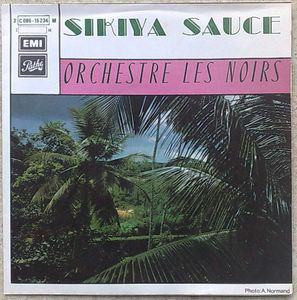
 |
Les Noirs 45s:
Au Revoir (Makwanzi Ducky "Dieudos") by Les Noirs Agwaya, ASL 2278 1981
Banda Beach Sheria Yake Castro (Chuza Kabasele) ASL 7-2190 1977
Bata / Motema Pasi ASL 1085 (1973)
Bokambro (Zozo) EMI/Pathé 2C 006-15225M
La bourgeoisie I & II (Deyesse) Ngoma DNJ5289
Dada Amin (Weteto) b/w Monoko (Chuza) BMP206 Kampala
Dieudos Namoni Pasi (Dieudos) b/w Maina Ndoki - BMP 7-203 (Rumba Lingala)
Emilie (Mathieu Kuka) b/w Marie Jeanne (Amani) EMI/Pathé 2C 006-81559M
Florence Wa Mungu b/w Nakubondela - BMP 202
Fofita (Moreno) ASL 2253; included on ASLP920 The Very Best of Zairean Music
Kitoko epai mosolo epai (Zozo) b/w Merci maman Zoani (Zozo) Ngoma DNJ5291
Kumbe bolingo () ASL1097B
Lolanga Ngunda b/w Ngai Wivinne by Zozo & Les Noirs (Zozo) ATA 1
Londele (Jojo Ikomo) ASL 7-2234 (City Five Chuza)
(Note: Remade later on same label)
Louise Bolingo b/w Mama Na Titi (Dieudos?) BMP 205
Mabuidi (Amani) b/w Nyimbo ya Dawa No 2 (Raymond Braink) ASL 7-1081 (reissued: Philips, Ghana) 1973
Mafulani b/w Kobeta Eleki Mbongo (B: Nkalu Nkatu) ASL 7-1140 1976
Major (Zozo) Ngoma DNJ 5290
Masamu-na
Masikini b/w Moselebende (Tomeka TK7-5013)
Masiya batela ngai (Zozo) b/w Ata Basali Nyoso pamba (Zozo) EMI/Pathé 2C 006-15222M
Mayaka (Tambwe) Sango SAN26; ASL2246 (March 1979) Swahili
Mbanda Kazaka (Talos) b/w Amie no 1 (Chuza) EMI/Pathé 2C 006-81562M
Mokili (Moreno) ASL 7-2184; see also under Shika Shika
Molangi ya Pembe / Basombeli Ngai Liwa Na Bolingo (Bovin / Elos) Tomeka TK – 5040
Morienzo (Chuza Kabasele) ASL 7-2152
Mosasa Ndembo (Ndala Mobangui, Roger) b/w Masenginia (Weteto) ASL 7-1100 1973 (Eds Fleure Zaire)
Mosasa Ndembo parts 2 & 3 (Ndala Mabangi Ngoy) ASL 7-1149
M'rabu (Kalemby Kajos) ASL2259N by Les Noirs Agwaya
Mungu Iko Helena (Kuka Mwana Bitala) b/w Lwaki Oyomba Awatali Nsonga (Makwanzi Duki "Dieudos") Editions Malaika 1974 (ASL 1145)
Munga Mac Odonde - ASL 2096 (1975)
Ndimbola ya polele (Makwani Dieudos) ASL 7-2166N 1977
Oboya Ngai Tina b/w Brazza Impfondo by Michel & Les Noirs (Ata Ndele ATA 2)
Otura Pierre b/w Mive Temoin - BMP 215
Peter Omwenga (Mwana Mombasa) ASL 7-2232N
Sanza ya Magie (Zozo) Tomeka TK 7-5018
Sikiya Sauce (Dieudos) - Philips (Ghana) ASL 7-1080; AS1869 (P) 1972; (EMI/Pathé 2C 006-15234M
Tata Na Mapasa b/w Suna - BMP 214
Tina Nini Bakopekisa (Chuza Kabasele) ASL 7-2201
Tubela (Mpudi) b/w Eyenga munga (Assossa/Tshimanga) Aya 3: reissued on African 90.939 p1975
Toma (Zozo) EMI/Pathé 2C 006-15221M
Tshiku (Mukaputu Kalemby Kajos) ASL 2240N/AS 4600 1980
Winni Carro Angel (Kuka Mwana Bitala) ASL 7-1152 1975
(Thanks to Alan Wheeler for images in this section)
|
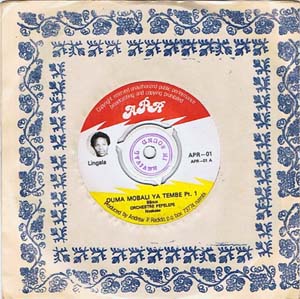 |
Pepelepe
Founded by Pepe Mato, who had started with Baba Gaston, and featuring the lovely voice of Nana Akumu wa Kudu (also of Bana Ekanga). In "Mobali ya tembe" there are shout-outs to Bijou, "Shaba Kahamba" (nickname for the bassist), Samy, Edifundu, Kasule Mopepe, "Mwalimu" (i.e. Siama Matuzungidi) & others. In "Bilanda Landa" there is a shout out to (Fataki) Lokassa, as well as to "Lembe Lembe." Johny Ekombo, drums, and Dago Mayombe, singer, were also members of Shika Shika.
45s:
Baleki Nzela (Pepe Mato) ASL 3380
Bilanda-Landa Mabe (Pepe Mato) Safari SAF9
Kwa nini? (Nana Akumu & Orch Pepelepe) ASL 2255 November 1979; included on ASLP920 The Very Best of Zairean Music
Malenga (Pepe Mato) Eds Mwana Mama WEM3
Mawazo - ASL 3383
Mitema Mabe (Pepe Mato) Eds Jaca JRP19
Mulambo (Ekombo Johny) Eds Mwana Mama MM23
Reissued by Makossa International MZ 30574 (12" b/w "Diabanza" by Shika Shika) 1981
Mwana Tabu (Nana Akumu) ASL 3265N
Ouma mobali ya tembe (Bijou) APR-01
Savana (Pepe Mato) Tobina TON23
Yangu Zamani () Polydor POL445
Orchestra Pole Pole
Another Moni Mambo outfit.
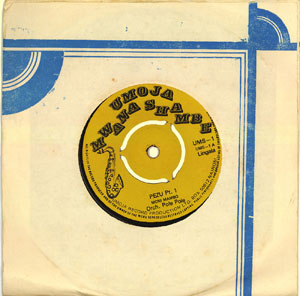 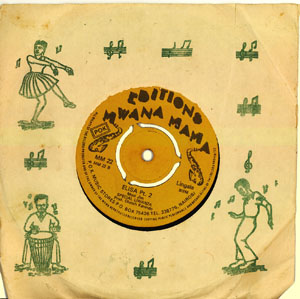
Not to be confused with the Pole Pole label which released recordings of Issa Juma & Super Wanyika. "Pole pole" means slowly slowly.
45s:
Kisombe (Jim Moni) Umoja Mwana Shambe UMS 3
Nelly (Simba Moni Mambo) Edition Shika Shika SKA 001
Pezu (Moni Mambo) Umoja Mwana Shambe UMS1
(due to the similar design of the label, I suspect the Umoja label is an offshoot of Editions Mwana Mama; two other singles on the label were by Moni Mambo's group Shika Shika).
|
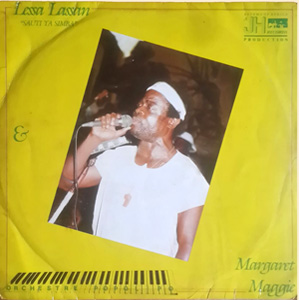
courtesy: Francis Toli
|
Orchestre Popolipo
Founded by Tabu Frantal & Lessa Lassan (ex-African Fiesta), from Congo, based in Nairobi in the 1970s. With Lava Machine on drums and Thierry "Chery" Matumona Kikaya on guitar and Zainabu and Bibiley Kabakaba on accompaniment. Lessa Lassan known as "Sauti ya Simba" sang with Dr Nico's African Fiesta, alongside Josky Kiambukuta. His hits with Nico were "Kiri Kiri-Mabina ya Sika (Kiri kiri the new dance)," "Echantillion ya Pamba," "Asala Malekoum," "Pauline," and "Limbisa Ngai." He moved to Nairobi in the 1970s and founded Popolipo, which mainly sang in Lingala. "Lassan was among the Congolese musicians who left their country to journey eastwards in search of greener pastures. He first came to Kenya alongside former TPOK Jazz solo guitarist Michelino Mavatiku Visi in the late 1970s, when they did songs like 'Masamba' with the Makfe International Band." They starred at the Cantina Club near Wilson Airport, off Langata Road, through the 1980s, and then at the Motherland Club on Ngong Road. According to an obituary in the Daily Nation (Nairobi, 14 Jan 2011) his other popular songs include "Sababu Yako (Your reason)," "Tobias Oduor," "Ujanja wa mwanamke (Woman's craftiness)," "Mwana wa Mberi (First child)" and "Zuria" (in praise of his daughter). Two tracks, "Cherie Mbambi" and "Saadi Malingaka" reissued in 2016, mistakenly attributed to Baba Ilunga wa Ilunga (who is name-checked in one of them, but only in a shout-out as a pioneer).
LP:
Margaret Maggie (Rhythms of Africa RRLP 001) copyright J.H. Records, n.d. post-1978
A1. Zuria
A2. Ujana wa wanawake
A3. Lavi
B1. ABC
B2. Margarete Maggie
B3. Mwana wa mberi
A1, B2 and 3 by Lessa Lassan "Sauti ya Simba", reissued on 45.
|
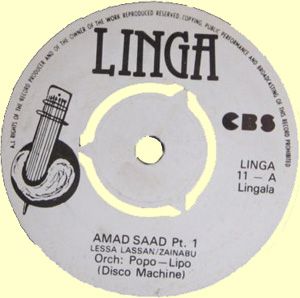
|
45s:
Amad Saad (Lessa Lassan/Zainabu) LINGA 11
Bi ya Lala (Lessa Lassan) Audio Productions Ltd ALP001
Cherie Mbambi (A.I.T.)
Massamba (Lessa Lassan)
Margaret Maggie (Lessa Lassan)
Mayemba () Zaire-Music PAR76; re: African 91.138
Mofiti b/w Yembele Yembele () Musiki du Zaire MZ6
Mofiti I & II () Musiki du Zaire MZ7-8
Mwana wa mberi (Lessa Lassan)
Saadi Malingaka (AIT)
Sima Liwa () Musiki du Zaire MZ9
Ujanja wa mwanamke (Lessa Lassan)
Shika Shika
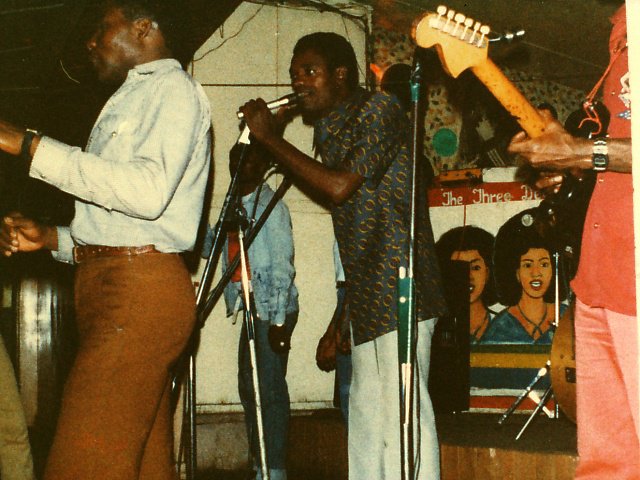
Jimmy Monimambo singing at Halliance Club, Nairobi, courtesy Siama Matuzungidi
|
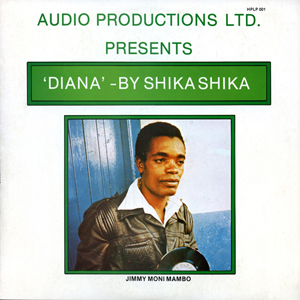 |
LPs:
DIANA
(Hit Parade HPLP001 (p) 1983)
A1. Mangenge (on 45 as HP008)
A3. Bibi Tamaa (on 45 as HP011)
B1. Diana (on 45 as HP001)
B3. Ngonde
All songs composed by Jimmy Moni Mambo; Produced by Babu Shah [-- via DP]
|
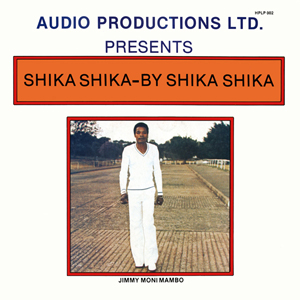 |
SHIKA SHIKA
(Hit Parade HPLP002 (p) 1983)
A1. Ivete (on 45 as HP002)
A3. Sisili (on 45 as HP010)
B1. Malily
B3. Halima (on 45 as HP012)
Recorded at Audio Productions Studio, Nairobi.
All songs composed by Jimmy Moni Mambo; Produced by Babu Shah [-- via DP]
Note: Like HPLP-001 a neat selection of three singles with one other unreleased track.
|
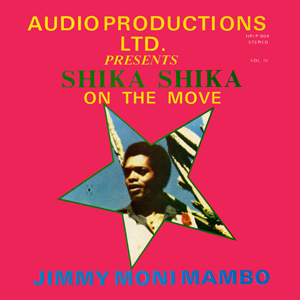 |
SHIKA SHIKA ON THE MOVE
(Hit Parade HPLP 004 1982)
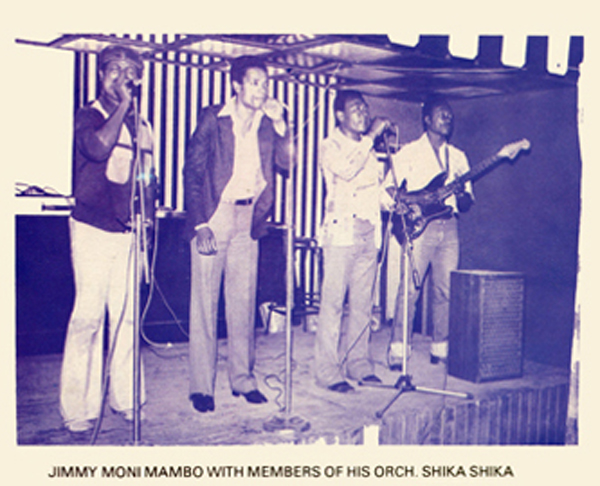
L to R: Unknown, Jimmy Moni Mambo, Lokombe, Siama Matuzungidi on guitar
Meka Meka (Ekombo)
Kabola Mikola (Jimmy Moni Mambo)
Kende Nayo (Ekombo)
Mwana Koi (Jimmy Moni Mambo)
Recorded at Audio Productions Studio, Nairobi.
Recording engineers -- Nelson O. Wamunga & Fundi Konde
Recording technician -- Nandu Shah
Compiled by Babu Shah
Cover layout & design by Babu Shah
"Loneliness is the worst thing to come in life. It is the lost smile of the elderly, the disappointment of a loser and at the same time the cry of a child. This album has been specially designed and arranged to comfort the lonely ones.
It is sincerely hoped that you would enjoy every minute of this album and would make you feel that it's a grand world to live in for ever." -- Babu Shah
[Info from D.P.]
|
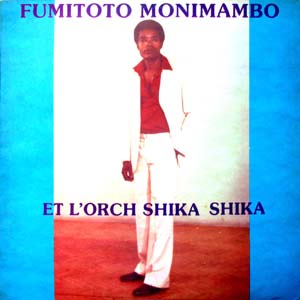 |
Fumitoto Monimambo & l'Orch. Shika Shika
MALONGA LP (SER 120; AIT release, 1984):
A 1. Malonga - 9:14
2. Kahindi - 9:06
B 1. Maze - 9:03 (also released as 45RPM)
2. Mopaya Zomba - 7:56
(All tracks composed by Mfumu Ntoto Monimambo)
|
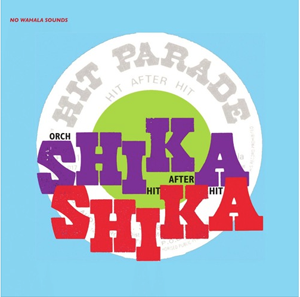 |
Orch Shika Shika "Hit after Hit" (No Wahala Sounds NWS6 2018)
A1 Mangenge (Monimambo) orig HP008 1975
A2 Tika Na Lela (Lovy) orig Hit Parade HP018 1975
A3 Cherie Safi side A (Monimambo) orig City Boom CB22A
B1 Cherie Safi side B (Monimambo) orig City Boom CB22B
B2 Bibi Tamaa (Monimambo) orig HP 011 1975
B3 Bana Nkoi (Monimambo) orig on HPLP004 1982, mislabelled as "Mwana Koi"
A compilation of 45s from the Hit Parade label, put together by your reporter and Alan Wheeler. See review on Muzikifan "Kenya/Tanzania part 2" page.
|
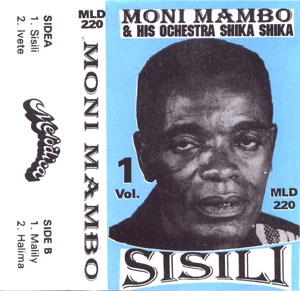 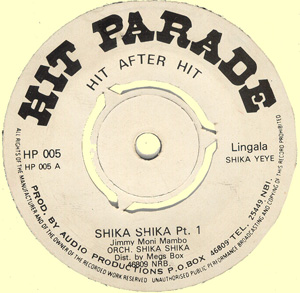
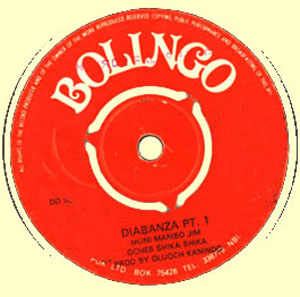
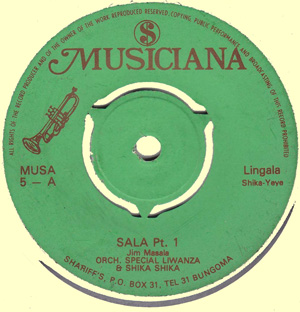
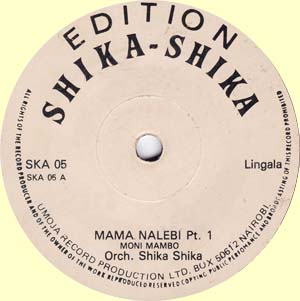
courtesy Alan Wheeler
|
Cassette:
SISILI (Melodica cassette MLD 220)
I have heard two versions of this cassette version of HPLP-002: each is appalling in a different way. The CD-rom version cuts every track off at 4'29 and has a very loud hum; the cassette issue sounds like it was recorded with dolby and loudness on then re-recorded with more loudness and more dolby. In short it's a bloody mess.
Sisili (Siama/Monimambo) 9:09 (also released as a 45 Hit Parade HP010)
Ivete (Monimambo) 9:11 (also released as a 45 Hit Parade HP002)
Malily (Monimambo) 9:17
Halima (Monimambo) 9:11 (also released as a 45 Hit Parade HP012)
Compilation album
MUZIKI MIX (Hit Parade HPLP003 1983)
A 1/2: Orch Bana Sambo "Solongo" (Orig on 45 as AIT001)
A3/4: Orch Kilimambogo Brothers "Mkamba's Day" (Orig on 45 as Kakai Kilonzo Sound KDO-013)
B 1/2: Orch Shika Shika "Massa" (Orig on 45 as HP009)
B 3/4: Orch Bana Sambo "Bolingo ya Lokuta" (Orig on 45 as AIT002) (Produced by Babu Shah)
Note: Orch. Bana Sambo "Solongo" part 1, Kilimambogo Brothers "Mkamba's Day" part 1, and Shika Shika "Massa" included on Kenya-Congo Connection, No Wahala Sound NWS3 2016, compiled by Doug Paterson
Siama Matuzungidi recalls Nderitu Munene, who was working for Babu the Indian producer. He was the one who decided if the song was good enough for Babu to produce, so he was really in charge of everything, as the "hitmaker." Also the studio engineer was Fundi Konde, an old Kenyan singer/songwriter who had hits in the 1940s and 1950s. He was first to play electric guitar in East Africa and had numerous hits including the original recording of "Malaika" with Fadhili Williams on vocal. (See RETROAFRIC CD8).
Orch Shika Shika 45s:
Amba* (Jimmy Moni Mambo) Daraja DJ005
Balingi ngai nakufa (Roy Masanda) Lake Victoria Special VC06
Belinda (Jim Moni Mambo) Eds Mwana Mama MM29
Bella (Mandefu wa Mandefu) Safari SAF 3 (JACA Production)
Bibi Moke (Mandefu wa Mandefu) Safari SAF01
Bibi Tamaa (Moni Mambo) Hit Parade H011 (Swahili "Shika Yeye") 1975
Bomoto (Siama Ntima) Hit Parade HP006
Bulula (Lovi Mokolo & Moni Mambo) Umoja Mwana Shambe UMS4/KBS411 1977
Cherie Lala (Jimmy Moni Mambo) Hit Parade HP014 1975
Cherie Safi (Moni Mambo) City Boom CB22 (Swahili "Rumba")
Chunga Bwana (Jim Moni Mambo & Ema) Comet Production COM004
Daina Akinyi (Jim Moni Mambo) Umoza Mwana Shama UMS03
Diabanza (Moni Mambo Jim) Bolingo Records DD03
(Also released as a 12" on the Makossa label MZ30574, b/w "Mulambo" by Pepelepe
Diana (Jimmy Moni Mambo) Hit Parade HP001 (1975)
Dunia Ina Mambo (Mini [sic] Mambo Jim) Tobina TON28
Epanza Mabala (Etchou Ndiadi Mitchoum) Safari SAF 5
Eunice (Jimmy Moni Mambo) Mzalendo CLUB1 copyright 1981 A.G.S. Records
Family (Jim Moni Mambo) Bolingo DD15
Feza (Jimmy Moni Mambo) Hit Parade HP016
Fifi (Siama Ntima) Hit Parade HP007 "Shika Yeye" (1975)
Fumata (Moni Mambo) Hudson Production HUDP102
Gor Mahia F.C. (Jimmy Monimambo) Eds Doromy DM79 (Swahili/Lingala rumba) see also Moja One song in praise of the team
Habari Yako (Moni Mambo) Umoja Mwana Shambe UMS02
Hadija Mama Samba (Titina) Audio Productions APL008 (Swahili) 1982
Halima (Jimmy Moni Mambo) Hit Parade 012 1975
Inyo (Moni Mambo) Daraja DJ004
Ivete (Jimmy Moni Mambo) Hit Parade HP002
Jane (Jimmy Moni Mambo) Hit Parade HP003
Kanindo (Etchou Ndjadi Mitchoum) producer: Oluoch Kanindo; Bolingo DD07; also Makossa MZ30573, B side of "Bakenda Bokila" by Kalombo and Orch. Bakoka
Koimko (Jim Moni Mambo) Savana SAVA1 (Lingala; Prod: Jaca)
Lima (Moni Mambo) Temae DJ Series (A subsidiary of Daraja) MAE001
Liwa (Jimmy Moni Mambo) Hit Parade HP021
Lolita (Moni Mambo) Linga CBS (K) 16 (P)1980
Ma-Eliza (Mandefu wa Mandefu) Jaca JRP 5
Ma Sofia (Monimambo Jim) City Boom CB23
Madaka Rosieshi (Moni Mambo) CBS(K)014 p 1980
Maisha ya mjini (Moreno) Makossa MEA716 1980
Makopa (Monimambo Jim) CBS Linga (S) 2
Male Male (Moni Mambo) Daraja DJ006
Maleba Leba () Sun Shine SALULA 1
Mama Nalebi (Moni Mambo) Edition Shika Shika SKA 005
Mangenge (Jimmy Moni Mambo) Hit Parade HP008 (P) 1975 "Shika Yeye"
Mary (Jimmy Moni Mambo) Soni Sounds SONYA 02
Mary Kalando (Roy Mosanda) Eds Tobina TON 19 (A Jaca Production)
Masala Sandra (Jim Moni Mambo) Editions Mack MACK5503 (Lingala)
Massa (Jim Moni Mambo) Hit Parade HP009 1975
reissued on Muziki Mix (Hit Parade HPLP003 1983), and Kenya-Congo Connection from No Wahala Sound (NWS3 2016)
Mati (Jimmy Moni Mambo) Hit Parade HP004
Matinda (Moni Mambo) Editions Musique Bénie EMB8111 (p) 1976
Maya (Moni Mambo Jim) Eds Mwana Mama MM19 (Lingala)
Maya (N.B. Different song) credited to Mtsimba Monimambo (no band listed) Eds Monama MON01 1978
Mayatu (Jimmy Moni Mambo) Hit Parade HP019 (1975) *diff from Jojo Ikomo's song
Maze (Monimambo) Editions Franc-Afrique (AIT subsidiary) EFA026 (also on Malonga LP)
Mboka Mosika (Lovy Longomba?) Eds Jaca ELJ 051
Mchanganyiko ya Shika Shika (Jimmy Moni Mambo) Hit Parade HP024
Migelle b/w Mboloko (Jimmy Monimambo) Mzalenda - CLUB8 1982
Milando (Jimmy Moni Mambo) Hit Parade HP020
Misere (Moni Mambo) CBS Linga (S)4
Miya-Miya (Jimmy Moni Mambo) Hit Parade HP023
Mobali na Ngai (Mandefu wa Mandefu) Tobina Editions TON26
Mobali ya bongo (Jim Moni Mambo) Eds JACA JRP23
Mokili (Moreno) Mwana Mama MM18; see also Les Noirs & next for different song
Mokili (Jim Moni Mambo) Edition JACA JRP 24
Monde (Moni Mambo) Muhitu United WAH 001
Moni (Kikuni Mbongo Pasi Berkys) Eds Mwana Mama MM7-12 (Lingala - Yiengo)
Monica Achoch (Lifenya Lorri) Hit Parade HP017 (reissued on Pluto Sounds [Zambia], credited to Moni Mambo)
Motema Ekobeta (Moni Mambo) CBS Linga (S) 3
Mulaya Moni (Simba Moni) Edition Shika Shika SKA 002
Nakobela (Mandefu wa Mandefu) Edition Jaca JRP9
Ndaya (Mtsimba Monimambo) Eds Monama MON02
Ndona a Lobi (Titina) APL Audio Productions Ltd ALP017 (P) 1983
Ngombele (Mandefu wa Mandefu) Edition Jaca JRP6
Nyako Ber (Moni Mambo Jim) Bolingo DD 01
Nyar Mzee (Jimmy Moni Mambo) Mzalendo CLUB 2 (Kiswahili 1981)
Nzumba (Monimambo) Superphonics BOY03
Obolongi ngai (Mandefu wa Mandefu) Editions Jaca JRP10
Ole Mama (Moni Mambo) Eds Mau-Mau Afrique CEGE 03
Olivia (Moni Mambo) Temae DJ Series MAE 002
Patrick ()
Rebeca (Lovy) Hit Parade HP022
Rosa Rudi (Moni Mambo) LINGA CBS(K)015 (P) 1980
Sala (Jim Masala) by Special Liwanza & Shika Shika; Musiciana MUSA 05 1977
Salula (Jim Masala) by Special Liwanza & Shika Shika; Musiciana MUSA 01 1977
Sera Mama (Jimmy Moni Mambo) Hit Parade HP027
Sherrie Katelineh (Fumu Toto i.e. Moni Mambo) Eds Mau-Mau Afrique LINGALA 01
Shika Shika (Jimmy Moni Mambo) Hit Parade HP005 "Shika Yeye"
Shika Shika Disco (Jimmi Moni Mambo) Universal Sounds USO 001
Shita (Simba Moni Mambo) Eds Malembe MLB001
Sisili (J. Moni Mambo/Siama) Hit Parade HP010
Sitaki (Moni Mambo) Daraja DJ007
Tabu ni Tabu tu (J. Moni Mambo) Hit Parade HP025
Tangawizi (Mandefu wa Mandefu) Eds Jaca
Tanya (Marie) Hit Parade HP015
Tika na lela (Lovy) Hit Parade HP018 "Kiswahili" 1975
Tina (Marie) Hit Parade HP015 1975
Wema Mado (Etchou-Ndjaji-Mitchoum) Tobina Editions TON 20
Zaina (Monimambo) CBS (S) K-003 1979
Zainabu (Moni Mambo Jim) Edition Jaca JRP 22 (1983)
*SONGA! magazine volume 3 (a brilliant, loving, hilarious, detailed and rather insane fanzine put out by Phil Bunce in Billingshurst, West Sussex, UK, 1991) included SONGA! MBELE cassette "Kenyan Classics vol 2" including "Amba" by Shika Shika licensed from Daraja Recordings.
Also includes Orch. Wela Wela: Lipa Mwenyewe (by Jonas Mwenyewe) Daraja DJ009
Francis Danger: Hesabu Gharama
Prince Njeru: Pianzo
Copies available from the Natari website.
Lawi Somona
Sax-playing member of various bands, including Shika Shika, Mos Mos, Virunga, and Afrisa of Tabu Ley, Lawi also had a solo career with two singles on an Andrew Crawford subsidiary SOA (Sounds of Africa?) and one on Musiki du Zaire (via Kentanzavinyl.com)
|
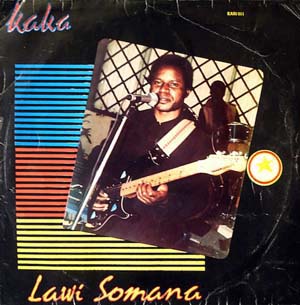 |
LP:
KAKA (Kariba KARI 001 Zambia 1986)
A1 Kaka
A2 Bibsha (Kabongo)
B1 Amour du prochain
B2 Kijana
45s:
Pesa Toli (1976) Musiki du Zaire MZ101
Safi i & II (Lawi) SOA 002
Mpenzi Bwana b/w Wewe ni wangu SOA 004
|
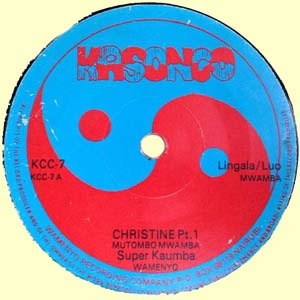
courtesy: Africa Ruge |
Super Kaumba
Tim Clifford discovered this band, as he says on KenTanza Vinyl:
"Orch Super Kaumba, meanwhile, were a Congolese band who also recorded for Editions AIT. Like many Congolese bands of the time, the group travelled widely and on a tour of Uganda recruited Sammy Kasule. He cites Super Kaumba and Orch Les Noirs as the first two bands he joined before travelling to Nairobi and making a reputation for himself under his own name. Now resident in Sweden, Kasule is still as of March 2011 an active musician playing bass and singing with Makonde."
As distinct from other bands who went East, Super Kaumba sang in Lingala and Luo. Apart from Sammy Kasule, Amico appears to be guitarist, and I hear a shout-out to drummer Dodo Doris (also of Super Mazembe)
45s:
Banoko (Mayala) Eds AIT: EIT06
Christine (Mutombo Mwamba) Kasongo KCC7
Kibila (Banza) Eds AIT: EIT08
Zena (Atibu - Amico) Eds AIT: EIT07
|
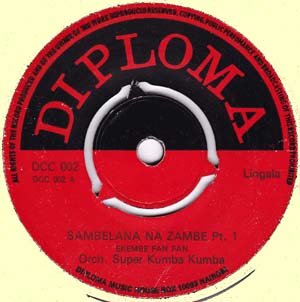
courtesy Alan Wheeler |
Super Kumba Kumba
Possibly a nzonzing band with Mose Se Fan Fan at the helm; Tim Clifford lists one single by them on the Diploma label, sung in Lingala, and released in Nairobi; Alan Wheeler found two more.
Selestine Okanisaka (Fan Fan) Diploma DCC001
Sambelana na Zambe (Ekembe Fan Fan) Diploma DCC002
Kwaheri Sana (Amos) Diploma DCC003
Tim Clifford also found two singles by Kumba Kumba National, "Kulala Bila Shuka b/w Sakina" & "Unaishi Wapi Asha b/w Kuguu Na Njia" (all by I.S. Juma) sung in Swahili on the Philips label PK7-006, and PK 7-002.
Super Mazembe
Super Mazembe are aiming high &Mdash; The Standard, Friday, May 16, 1980 by Suluvu Tuva "On the Scene" (courtesy KenTanza vinyl. com)
L'Orchestre Super Mazembe must rank as one of the most prolific recording groups on the local scene.
Currently among the top sellers in the charts of the Kenyan Record Producers Association with "Kayembe," Super Mazembe have just cut a new single they hope will be another scorcher in their attempt to consolidate their chart scoring trend.
The new disc is tagged "Lovy" which follows the band's trend of naming songs after the groups members. Kayembe is rhythm guitarist, Longwa is band leader and vocalist and Lovy is a vocalist.
The Zairean band has been associated with top sellers since their arrival in Kenya in 1975 from Zambia. March 1977 was their proudest moment recording-wise. They cut "Kasongo" named after rhythm guitarist Songoley, a song authored by the group's main lyricist Katele.
Super Mazembe was surprised when they saw the song climb the charts to perching at the top spot and stay there for three months.
After such a hit the group face the problem of following up with an equally strong song. But Katele was an inspired man -- as he stayed ever since. He wrote "Nabima Kate" which scored, followed by "Shida" which also hit, but harder, and "South view" which also knew chart success. There has been no looking back since.
Talking to Super Mazembe bandleader Mutonkole Longwa Didos, earlier this week, I was told the secret of their songwriting success lies in their having time to think, compose and record.
The band, he says, does not have a playing contract with any of the various night clubs, save for several calls and occasional fundraising affairs, the band is virtually free to dedicate all of its efforts to the recording aspects.
Parents
For Super Mazembe, music started by stealing away to the various nightclubs in their hometown of Likasi in Shaba province of Zaire where their copper mining parents slaved for a livelihood in much the same traditions as the neighboring Zambians.
"There was music everywhere," Longwa Didos said. "We would go to the various nightclubs just to watch the musicians play. Most of the current members of Super Mazembe were doing the same and it was inevitable we would meet."
"When we decided to go into music the parents were really against the idea, telling us to finish our education but our minds were made up.
"One of the guys in the band had an uncle who had instruments and we would practice. Eventually we decided to cross the border into Zambia -- this was in 1970. But the guy's uncle decided to grab his instruments at the border and we crossed into Zambia with no playing gear at all.
"However most Zambian nightclubs had in-house equipment and we ended up by playing all the same. All this time we were just playing top records of the day. We never recorded in Zambia."
Then one day Super Mazembe ran into Nashil Pichen (of the Kenyan Eagles Limpopo band) and "Pole Musa" fame in Zambia. On learning how heavy the Kenyan scene was it was back to visa chasing for the guys who eventually landed in Nairobi in 1975.
London
In Nairobi they teamed up with another Zairean vocalist Latenor Mawa, who was a local hero of sorts having scored several Swahili hits, his biggest being "Asha mtoto ma Kenya" which he had recorded with Kangee Brothers, originally Hodi Boys "B" and eventually Hi Fives. Mazembe played the Madunis nightclub (now the New Florida) before giving live playing a break to concentrate on recording.
"Our musical influences are contemporary Zairian young sounds," Longwa Didos says, "even when we started listening to the groups in Zaire we never really got over-hooked on people like Tabu Ley (Rochereau) or Franco. They and their ilk had their own crowd of older guys. It was Kiamwangana Mateta (Verckys) for us.
I do not think we have been overly influenced. I think our sound is Super Mazembe.
Crowds
Super Mazembe have also taken their Kenya residence by storm. They have already gassed out Zairean music buffs in such places as Kakamega, Kisumu, Nakuru and Mombasa.
Mazembe have one year left in their recording contract with A.I.T. and things look pretty bright for them musically. Right now another A.I.T. product scaling the charts is "Bwana Nipe Pesa" by the Lo Six's Tandi Kumalo and Super Mazembe backed the South African lady.
The men at A.I.T. continue to prove their interest in local artistes. Last year they became the first local record company to sponsor Kenyan superstar Slim Ali to the Middle East and right now they are doing great things for Super Mazembe.
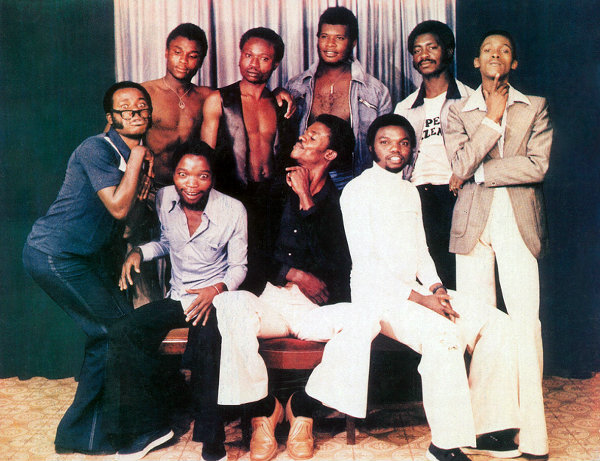
Just who are these clowns? L'Orchestre Super Mazembe of course! The guys take time to clown for the camera. Front row (left to right): Katele (vocalist, songwriter), Songolay (rhythm guitar) Atia Jo (bass guitar), Bukalos (lead guitar). Back row (left to right) Petite Musa (quit Mazembe), Rapok Kayembe (rhythm guitar), Mutonkole Longwa Didos (bandleader, vocals), and Makila (quit Mazembe). Not in picture Kasongo wa Kanema (vocalist), Loboko (rhythm guitar). Lovy and Lobe.
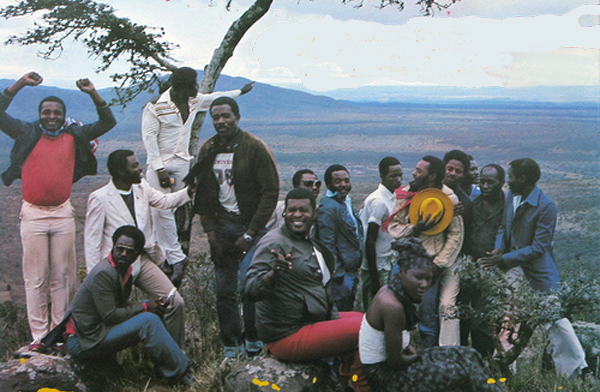
Formed out of Super Vox, a Congolese band started by Mutonkole Didos Longwa in 1967, some of whom moved to Nairobi in 1974. VOICE OF AMERICA published an obituary of Atia Jo (born Mulunguke Mwanza) on 2 January 2007: "Super Mazembe was comprised of the band leader Didos Mutonkole Longwa, Bukalos Bukassa (lead guitarist), Rapok Kayembe (rythmist), Atia Jo (bass guitarist), Katele Aley (lead composer and vocalist), Dodo Doris (drums), Kassongo Songoley (rythmist) and Charles Kagamba (vocalist)." Formed in Lubumbashi, the band moved to Zambia where Nashil Pitchen, producer of the Nairobi Eagles Band heard them and invited them to Kenya. In Nairobi their ranks were strengthened by other Congolese musicians, including Kassongo Wa Kanema, Lovy Longomba, Fataki Lokassa, Rondo Kandolo, Charles Atei, Lobe Namapako, and Loboko Pasi. "Loboko Passi was employed by Mazembe because he was the only one who knew to play guitar like orchestra Kiam...." said a Voice of Kenya broadcaster. But the band went into decline in 1986 when a businessman took their instruments away. Atia joined Virunga and later Tchakatumba. In the early 90s surviving members regrouped, but Katele died soon after leaving only Atia and Kanema.
Jerome Ogola notes: "According to Loboko Pasi, after Orchestre Basanga split up in Tanzania he came to Mombasa to join Les Noirs in 1975. He was invited to Nairobi to join Boma Liwanza and then joined Super Mazembe where he was rhythm guitarist until 1989. When Bukalos died he told Longwa to hire another rhythm guitar because he could play lead. He now performs with Ambro Musica of Mombasa."
Trevor Herman, in his liner notes to the GIANTS OF EAST AFRICA CD singles out guitarist Bukasa wa Bukasa, who died in 1989, and also mentions bandmates Loboko Bua Mangala (guitar), Mwanza wa Mwanza Mulunguluke (bass), Kitenge Ngoi Wa Kitombole (drums) & Musa Olokwiso Mangala. A lot of the songs on this compilation are stories about individual band members. Their biggest hits were "Kasongo," "Shauri Yako," and "Samba."
Doug Paterson mentions that only their Kaivaska LP (for Virgin) was conceived as an album, all the other six LPs released in Kenya were after-the-fact compilations of 45s.
LPs:
|
|
Orch. Super Mazembe
Mazembe (Editions Mazembe EMALP 0520; 1980)
A1. Loboko (Loboko)
2. Mado Zaina (Lovy)
B1. Ouma (Lovy)
2 Na bimaka te (Katele)
|
|
10th Anniversary (EMALP 0530; 1981)
A1. Mbanda Ya Mobanga (Longwa)
2. Mukala Musi (Lobe)
B1. Gina (Lovy)
2. Atia-Jo (Atia-Jo/Lovy)
|
|
Double Gold (UAMLPD1014 also EMALP 0540 1982)
Mbanda ya mobange (Longwa/Lovy)
Kasongo
Ji-ji
Nanga (Lovy)
Side 2:
Bamama
Samba
Maloba d'amour
Mokano (Lovy)
Mwana-nyiau
Side 3:
Zita
Pepe
Side 4:
Belina
Shauri Yako
|
|
L'Orch. Super Mazembe (Mushosho)
Wabe-Aba (EMALP 0550; 1984)
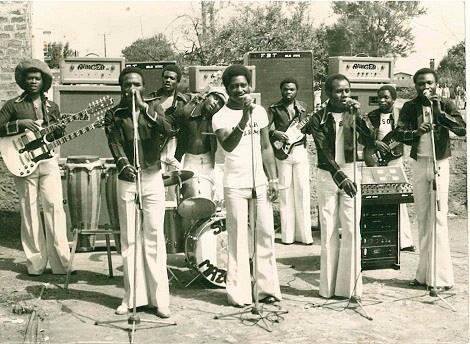
Left to Right: Longwa Didos, Kasongo wa Kanema, Lovy Longomba, Bukassa Bukalos, Athia Djo, Katele, Loboko, Dhodo Doris, Kayembe.
When we used to play at Lasco Club Mombasa hatari kubwa
(photo from Kasonga Wa Kanema)
1. Yo
2. Zulfa
3. Lukhasi
4. Rosy
5. Eyah
6. Sauda
|
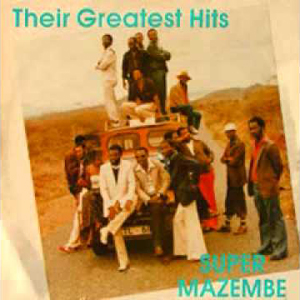
|
Their Greatest Hits (EMKLP 01; also EMALP 0560; 1986)
A.1. Kasongo (Katele)
2. Shauri Yako (Nguashi Ntimbo)
3. Kayembe (K. Rapok)
B.1 Nabimakate (Katele)
2 Salima (Kandolo Rondo)
3. Atia-Jo (Atia-Jo)
|
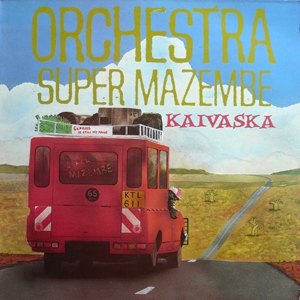 |
Orchestra Super Mazembe
Kaivaska (Virgin UK V2263; 1982)
A.1. Mbanda Ya Mobange (Longwa)
2. Kasongo (Katele)
3. Jiji (Tabu Ley)
4. Nanga (Lovy)
B.1. Bamama (Kasongo wa Kanema)
2. Samba (Katele)
3. Maloba D' Amour (Buddy Holly/Kasongo wa Kanema)
4. Mokano (Lovy)
5. Mwana Nyau (Lobe)
|
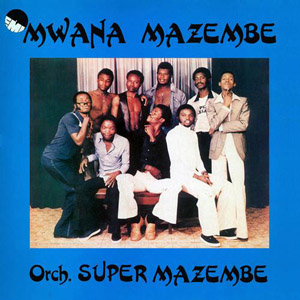 |
Orch. Super Mazembe
MWANA MAZEMBE (EMI, ca 1977, no info; also KLP 0514; available for download on 7digital com)
A.1. Kassongo (Katele) (also on Giants of East Africa)
2. Shida (Katele)
3. Samba (Katele) (also on Giants of East Africa)
4. Mwana Mazembe (Katele) (also on Mazembe @45)
MALOBA D' AMOR (AFRILP 007 1990)
UK compilation released on the DiscAfrique label
A.1. Kasongo (Katele)
2 Nabimakate (Katele)
3. Shauri Yako (Nguashi Ntimbo)
4. Maloba D' Amor (Buddy Holly/Kasongo wa Kanema)
B.1. Salima (Kandolo Rondo)
2. Samba (Katele)
3. Mwana Nyau (Lobe)
Very Best of Super Mazembe (ZEMAC6)
Mwana Nyiau
Okava
Sauda
Auma (Lovy)
South View
Atia-Jo (Lovy)
Hits of Mazembe vol. 4 (ZEMAC4)
|
courtesy: Afro7.net
|
Super Mazembe 45s:
Abibah Makambo , by the Great Super Mazembe Band (Nashil Pichen, Kasembe, Longwa, Dido's) ALP 023
Alesia (Katele) Eds Mazembe EMA 11
Amina (Eds Mazembe EMA 10)
Amuna tiri Achifuno b/w Ndalama zili monga mvula () Luapula PKZ 36
Anna (Eds Mazembe EMA 27)
Ati Mama (Katele) Mwana Mama MM1
Atia Jo (Eds Mazembe EMA 23)
Biwela Christmas (Lovy) - EMA 29
Bwana nipe pesa b/w Zamani Sana (Tanda Kumalo) Super Matatu MTU1
(attributed to LO SIX & SUPER MAZEMBE)
Ezana (Katele) Mwana Mama MM7
Fupa Lokakamiza b/w Mwana Simonga Covala (Luapula PKZ50)
Ilena (Lovy) Eds Mazembe EMA 33
Izabella (Kasongo wa Kanema) Eds Mazembe EMA 17 1978
Kasongo (Katele) Eds Mazembe EMA 7-6 (1977)
Kazembe (Lovy) Eds Mazembe EMA 24
Kingo Mwambe (Eds Mazembe EMA 19)
Libala Nde Lisano (Eds Mazembe EMA 12)
Lokeke (Eds Mazembe EMA 34)
Longwa (Eds Mazembe EMA 25)
Lovy (Lovy) Eds Mazembe EMA26
Mokano (Lovy) (Eds Mazembe EMA 32)
Mungu Mkubwas by Super Mazembe Stars Eds AIT: EIT010
Mwana Mazembe (Eds Mazembe EMA 13)
Mwana Nyiau (Lobe Mapako Roddy) Eds Mazembe EMA 36
Na Bimaka (Editions Mazembe EM7-16)
Nakokite b/w Libala Pasi (ASL 3322)
Nakokufa Pamba b/w Lutha (K Katele) ASL 7-3324 1975
Naleki na ba zone (Eds Mazembe EMA 9)
Naleli Libota (Kateli) Eds Mazembe EMA21
Nanga (Lovy) Editions Mazembe EMA 31
Na weli Nini (Katele) Mwana Mama MM8; also Luapula PKZ60 1979 (Zambian pressing? TEAL; WEA)
Ndalephela Ndi Makolo/Kuchibolya Siniza Mwelako (Luapula PKZ38)
Ndeko (Lovy) Editions Mazembe EMA 30
Ndona (Katele) Eds Mazembe EMA 18 1978
Nganyiemu (Lobe Mapako Roddy) Eds Mazembe EMA 34
Okova (Katele) reissue: Oyieyo Ringo OYS 949; Eds Mazembe EMA 22
Pepepe (Dack Star) Editions Mazembe EMA 38
Prekete () Editions Mazembe EMA 40
Presto () Editions Mazembe EMA 39
Rose Mwape (Nashil Pichen) b/w Impali (Nashil Pichen) Soul Poster (Paris) SP10510
Rosy (Lovy) Eds Mazembe EMA 42
Sala Keba (P. Oluoch Kanindo) Eds Mazembe EMA 15
Salima (Kandolo) Editions Mazembe EMA 35
Samba (Eds Mazembe EMA 7-8) 1977
Shida (Eds Mazembe EMA 14)
Sikutaki Regena (Nashil Pichen) Soul Posters SP 10509 (prod: EMI Kenya)
South View (Katele) Eds Mazembe EMA20
Wabuza b/w Nazangi mwana (Luapula PKZ 8)
Yo-Mabe (Lovy) Editions Mazembe EMA 28
Zamani Sana (Tende Kumalo) by LO SIX with L'orch Super Mazembe; Super Matatu MTU-1 (AIT Records)
See Tim Clifford's discography for a more complete list of Eds Mazembe singles.
Nashil Pichen & Super Mazembe 45s:
Anizonda b/w Juia Yekha (Kwacha NP1)
Ichitanfya Abaumes PKZ 67 (Teal - Zambia?)
Merci Imbwembwe Yandi b/w Revien a moi (PKZ 17) Made in Zambia
Naleli libota (Luapula PKZ 75)
Nde Lwala Love (Luapula PKZ 79)
Osa Chita Nanyazi b/w Sugar Mummy (Luapula PKZ 27)
Unkhalamba Subisikas Luapula PKZ40
Rossy Marrie (Best of Editions CHRIS vol 3 Cassette)
Shida
|
|
Cassette:
Super Mazembe / Kasongo / Ouma (A.I.T. Mazembe vol 1)
Side A: Kasongo
Nanga (Lovy)
Ouma (Lovy)
Rosy
Side B: Pepeye
Preketo
Ilena ("Elena"? by Lovy)
Shauri Yako
|
|
REISSUE CDs:
GIANTS OF EAST AFRICA CD (Sterns/Earthworks CD45)
Kassongo (Katele Aley)
Samba (Katele Aley)
Jiji (Tabu Ley)
Gina (Lovy Longomba)
Mukala Musi (Lobe Mapakjo Roddy)
Mbanda ya Mobange (Mutonkole Longwa Didos)
Shauri Yako (Nguashi Ntimbo)
Lukasi (Lovy Longomba)
Loboko (Loboko Bua Mangala)
Bamama (Kassonga wa Kanema / Majo)
Longwa (Mutonkole Longwa Didos)
|
|
MAZEMBE @ 45RPM VOL 1 (Sterns STCD3063 2013)
1. Kingo Mwambe (Katele) orig: EMA19
2. Izabela (Katele) orig: EMA17
3. Amina (Pauni) orig: EMA10
4. Mwana Mazembe (Katele) orig: EMA13
5. Na Bimaka Te (Katele) orig: EMA16
6. South View (Katele) orig: EMA20
7. Okova (Katele) orig: EMA22
8. Naleli Libota (Katele) orig: EMA21
9. Naleki Na Ba Zone (Tshishi) orig: EMA09
|
|
MAZEMBE @ 45RPM VOL 2 (Sterns 2013; download only)
1. Ndona (Katele) orig: EMA18
2. Yo-mabe (Lovy Longomba) orig: EMA28
3. Presto () orig: EMA39
4. Nganyiemu (Lobe Mapako Roddy) orig: EMA37
5. Mwana nyiau (Lobe Mapako Roddy) orig: EMA36
6. Aleisia (Katele) orig: EMA11
7. Prekete () orig: EMA40
8. Sala Keba (P. Oluoch Kanindo) orig: EMA15
9. Mungu Mkubwa () orig: unknown
|
|
Orchestre Teke Teke
Expat band led by Milanda Barami, vocalist, who later sang with OK Jazz in 1985-7.
LP:
TEKE TEKE (Sonafric SAF61007 1978)
A1 Makwela
A2 Libala Ya Bombanda Pasi
A3 Nabimaki Na Massa (Part. 1)
B1 Nabimaki Na Massa (Part. 2)
B2 Namesana Ko Seka
B3 Yokela Maloba Na Ngai
B4 A Mundendele
B5 Feza
(All songs by Milanda)
45s:
Libala Bombanda Pasi (Milanda Barami) Eds BONGA BON 10 1977
Muziki Ya Bana Kins (Milanda Barami) Eds BONGA BON 11 1977
Nabimaki Na Massas (Eds BONGA BON 9) 1977
Kaka Se Bolingo b/w Likambo Ya Bokamusi (Eds BONGA BON 13) 1977?
|
|
Samba Mapangala & Orch. Virunga
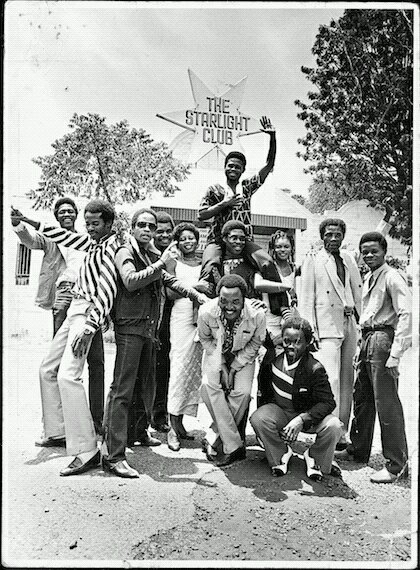
Orch Virunga in front of Starlight Club, December 1982 (courtesy of Kasongo Wa Kanema). Samba Mapangala, leader, singer, at back with arm raised; left to right: Tabu Osusa (Kenyan manager), Dago Mayombe (singer), Fataki Lokassa "Masumbuko ya Dunia" (guitar/singer), Diana Kodila (trumpet), Marie Gabby (dancer), Bejos Dibuba Jordymicky Mikobi (guitar), Erica (dancer), Coco Zigo Mafwala (singer), Zorro Mapangala (Sam's brother); front row crouching, Kasonga wa Kanama (singer) and Tabu Ngongo (sax). Missing are Lawi Somana (sax), Nsilu Wa Bansilu Manitsho (bass), Niki Djo Walengo (bass).
Formed by Samba Mapangala in Nairobi in 1981 after the breakup of Les Kinois. They are named after the dormant volcano in the Ruwenzori range of Eastern Congo, the third highest peak in Africa. According to Doug Paterson, in the liner notes to African Classics, Samba was on the verge of going back to Kinshasa to start a new band when he teamed up with some ex-Bana Ngenge musicians in Nairobi to make a record and it turned out to be the smash hit "Malako." Four songs from their golden age can be heard on VIRUNGA ROOTS VOLUME 1, including "Africa Dance," "Ntumba," "L'Argent" and "Losako" (VS001 CD), and a must listen is African Classics on the Sheer Sounds label (SLCD149). See also Les Kinois
|
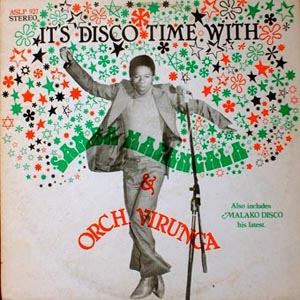
courtesy: Matsuli
|
LPs/CDs:
IT'S DISCO TIME WITH SAMBA MAPANGALA & ORCH VIRUNGA (ASLP 927 p.1982)
A1. Malako
2. Mwana Mboka
3. Christmas
B1. Sunday
2. Mpenzi Rudi
3. Safari
|
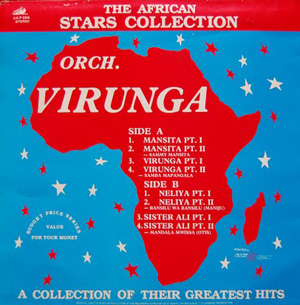
courtesy: Zim Bida
|
THE AFRICAN STARS COLLECTION: ORCH. VIRUNGA (JJLP 006)
A1. Mansita I
A2. Mansita II (Sammy Mansita)
A3. Virunga I
A4. Virunga II (Samba Mapangala)
B1. Neliya I
B2. Neliya II (Bansilu Wa Bansilu Manju)
B3. Sister Ali I
B4. Sister Ali II (Mandala Mwissa Otis)
Note: First three tracks included on Virunga Volcano CD (see next entry); "Sister Ali" included on African Classics CD.
|
 |
VIRUNGA VOLCANO (English compilation, produced by Trevor Herman, released on Earthworks in 1984 as MALAKO, then on CD CDEWV16 in 1990). The breakthrough album that launched Virunga to international stardom.
Tracks:
Malako (Samba Mapangala) also on SLCD149
Ahmed Sabit (Samba Mapangala)
Virunga (Samba Mapangala)
Yembele (Samba Mapangala) also on SLCD149
Neliya (Bansilu wa Bansilu Maniju; aka Wabansilu Manysho)
Mansita (Sammy Mansita)
|
|
FEET ON FIRE (Sterns 1036 1991)
Sungura (also on SLCD149)
Vidonge (also on SLCD149)
Toweli nini
Unisamehe
Jaffar
M'Safari
Safari
All songs composed by Samba. Produced by Charlie Hart. N.B. There was a 1988 Kenyan cassette titled "SAFARI" that probably had some of these same tracks
Personnel:
Samba Mapangala - vocals
Rissa-Rissa - Conga & backing vocal
Mokili Sesti - Lead guitar
Bavon Masudi - rhythm guitar
Juma Kachenchy - bass
Abdallah Kodi - drums
Rama Athumani - horn arrangements
CDs:
|
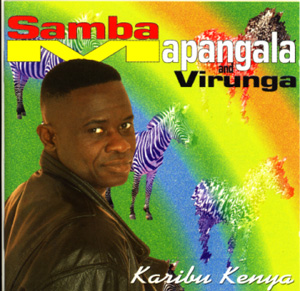
|
KARIBU KENYA (Sun Records 912956 1995)
Tonga Zala
Karibu Kenya
To Coopere
Ikolo kolo
Wajuku
Weso Sina
Aicha
Africa Yetu
Personnel:
Samba Mapangala - vocals
Abby Surya / Wuta Mayi / Bibi Den's - backing vocals
Mavoungou - percussion
Syran Mbenza - lead guitar and production
Caien Madoka - lead, rhythm, bass guitar
Diblo Dibala -lead guitar
Miguel Yamba - bass
Komba Bellow - drums
Pablo Lubadika - bass on "Ikolo kolo"
Thierry Galion - keyboards, programmation
Alain Hato - sax
Philippe Slominsky - trumpet
Jacques Bolognesi - trombone
Boncana Maiga - horn arrangement
All songs composed by Samba.
|
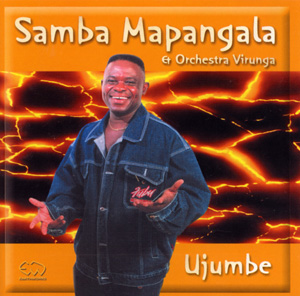
|
UJUMBE (Sterns/Earthworks STEW43CD 2001)
Siri (also on SLCD149)
Dunia Tuna Pita (also on SLCD149)
Muniache (also on SLCD149)
Umoka ni nguvu
Vijana
Ko seka te
Mbona mimi?
Ufunguwo
Dunia tuna pita (extended mix)
Personnel:
Samba Mapangala - vocals
Nyboma Mwan'dido - backing vocals
Mavoungou - percussion
Caien Madoka - lead guitar
Bopol Mansiamina- rhythm guitar
Boss Matuta - bass
Komba Bellow Mafwala - drums
Yuma Kasongo - sax
All songs composed by Samba. Produced by Samba and Bopol.
|
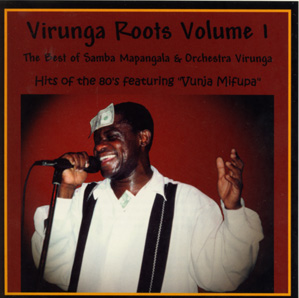
|
VIRUNGA ROOTS VOL 1 (VS001 1988-9 recordings)
Africa Dance*
Vunja Mipfupa
Ntumba*
Tolinga Virunga
L'Argent*
Belle femme
Losako*
Marina
Personnel:
{*Nairobi 1988} Vocals: Samba Mapangala, Fataki Lokassa, Dago Mayombe, Coco Zigo, Kasongo wa Kanema, Moreno Batamba, Ibrahim Pepe, Kwempa Risa Risa
Guitars: Beya Mikobi Dibuba, Nkulu Mwilambwe alias Django, Bavon Masudi, Siama Matuzungidi, Jhonny wa Lengo, Sammy Mansita, Nsilu wa ba Nsilu alias Manitcho, Juma Kachenji
Drums: Lava Machine, Willy Chomba, Caillou, Abdalla Kodi, Jean-Claude Mulamba
Sax: Ntalu Nkatu Talos, Twahir Mohammed, Rama Matungunja
all other songs recorded in Paris, 1989, with Samba, Passi Jo, Wuta Mayi, vocals
Syran - lead guitar
Bopol - rhythm
Miguel Yamba - bass
Komba Bellow, Ti Paul, Rudolph - Drums
All songs composed by Samba, except "Ntumba" composed and sung by Django. |
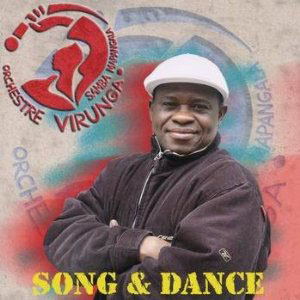
|
SONG & DANCE (VR002)
Adija
Kaa Chonjo
Tafuta kazi
Kwa nin
Nyama Choma
Pangeni uzazi
Siku ya mwisho
Personnel:
Vocals: Samba Mapangala, Dodo Munoko, Nyboma, Komba Bellow
Guitars: Caien Madoka, with Syran on 3, Dally Kimoko on 5 & 6
Bopol - rhythm
Fiston - bass
Komba Bellow - drums
Deba Sungu - conga
Jimmy Mvondo - sax
All songs composed by Samba Mapangala.
|
|
AFRICAN CLASSICS (Sheer SLCD149 2008)
Sungura (also on Sterns 1036)
Malako (also on CDEVW16)
Fonseka (first time on CD)
Muniache (also on STEW43CD)
Yembele (also on CDEVW16)
Sister Ali (first time on CD)
Siri (also on STEW43CD)
Mabiala (first time on CD)
Vidonge (also on Sterns 1036LP)
Dunia tuna pita (also on STEW43CD)
"Sister Ali" written by Mandala Muisa, all others composed by Samba Mapangala.
|
| MABIALA (Tamasha Budget Beater CD; reissue of ASLP*)
Mabiala
Betty
Kimotho
Rama
*1983 recordings; only the title cut had appeared on CD previously
|
|
MAISHA NI MATAMU (LIFE IS SWEET)
(Virunga Music 2011)
After a digital only release of a live concert (on CD BABY), Samba took a band to perform in Zanzibar, Africa and laid down this studio album in Nairobi with many guests, including Suzanna Owiyo, Awillo Mike, Wuta Mayi, Ballou Canta on vocals, Jimmy Mvondo (sax), Syran, Huit Kilos and Beniko Popolipo (guitars), and Komba Bellow (drums)
Maisha ni matamu
Zanzibar
Jirani (Neighbors)
Nipigie simu (Call me)
Tupande miti (Let's plant the trees)
Tupendane (Let's love each other)
Les Gorilles des montagnes
Jirani (Inst.)
|
courtesy: KenTanza vinyl |
Virunga 45s:
Cido (ASL 2284 P1981)
Doctor Oleich (Eds Virunga EDV 006 1983?)
Embaga Eyengedde Amina b/w Rwenzori by Freddie Kanyike & orch Virunga (Eds Ssanyu BK1 1986)
Fonseca (Eds Virunga EDV 004 1983) on African Classics CD
Kweya (Samba Mapangala) Eds Virunga EDV 005 1983
Mabiala (Eds Virunga EDV001 1983) on African Classics CD
Mansita (Samy Mansita) ASL 2296 AS4883 1982
Miaka kumi enzi ya nyayo (Eds d'Ivoire IVA 042)
Mikoko (Eds Virunga EDV 003 1983)
Moninga (Samba Mapangala) ASL2274 (P)1981
Nellya (ASL2291 1981)
Riziki (Lotaka "Mayer") Eds Chris CJ010
Safari (Eds d'Ivoire IVA 036; also on FBR label 1988)
Sister Ali (ASL2308 1982) on African Classics CD
Virunga (Samba Mapangala) ASL 2258N / AS 4713 1980
Vunja Mifupa (Eds d'Ivoire IVA 059 1989; backing by Quatre Etoiles, Paris)
Yembele (Samba Mapangala) ASL 2264N/AS4733A 1980, on African Classics CD
An odd 45 by Virunga:
Mangwana Pierre Systeme acc. by l'Orch Virunga "Elda (Alima)s " Editions d'Ivoire IVA 076 (CBS Records)
Suggests this was a supersession with Sam Mangwana, Pierre (Moutouari?) & (Madilu?) System in Paris, backed by Virunga, or else just someone who fancied a name
|
|
Orch. Viva Makale (Alimasi)
|
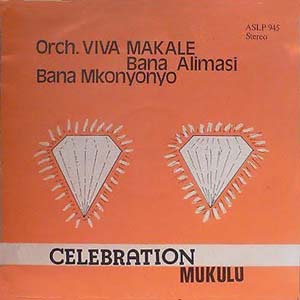
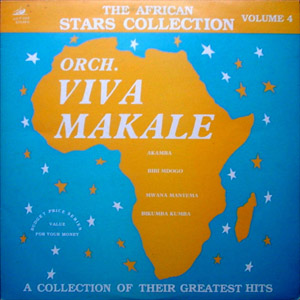 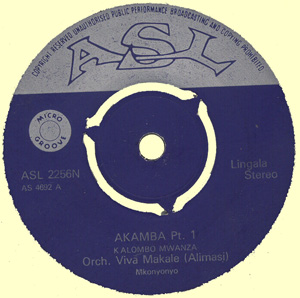
|
Saxophonist & vocalist George Kalombo's outfit (after the collapse of Orch Bassanga), featuring Coco Zigo on vocals, Thomy Kabeya Ilombo Lomboto, bass, Mokili Sesti, guitar, among others. Unusually they also included an electric organ. Moreno and Monimambo also sang with them before starting Shika Shika. Siama Matuzungidi recalls: "In 1979 Bwambe Bwambe was kind of gone, that's why Kasuku Armstrong of Garden Square asked George Kalombo and Buami Walumona to start Viva Makale and he would give us a contract at Garden Square with Les Mangelepa. Kasuku hired us Kombe Kombe musicians to join Viva Makale. Then we had George Kalombo, Buami Walumona, Leyla on trumpet, Tshiamusoke, also on trumpet, the singers were Kalombo Muanza (also on sax), Coco Zigo, Tambwe Mandola, and Jimmy Monimambo for a short time; lead guitar "Chery" Matumona, rhythm Siama Matuzungidi, Thomy Kabeya Lomboto on bass guitar. Thomy Lomboto now lives in Bangui, Central African Republic. I don't know where George Kalombo is since 1983 when he left Nairobi and went to Zambia. Later I heard that he went back to Congo after divorcing his wife."
LPs:
Celebration Mukulu (ASLP 945 p.1981)
By Orch Viva Makale -- Bana Alimasi -- Bana Mkonyonyo
This is solid gold! -Editor
A1-2. Opallo
A3-4. Celebration Mukulu
B1-2. Mandola Lobanzo
B3-4. Souza
(Thanks to Doug Paterson for the info)
African Stars Collection Volume 4
A1: Akamba (George Kalombo)
A2: Bibi Mdogo (Coco Zigo)
B1: Mwana Manyema (George Kalombo Mwanza)
B2: Bikumba kumba (Kabeya Ilombo)
45s:
(Info from Africa Rouge, Alan Wheeler, Paul Johnston, Tim Clifford, Peter Toll, Juan Carlos and Muttu Mondiya Mama on Julian Thorpe's no-longer extant web page)
Akamba (Kalombo Mwanza) Sango; ASL 2256 1980; also on ASLP 425 Yester Decade (1987)
Bibi Mdogo (Coco Zigo) ASL 2269
Bikumba-kumba ASL 2261N
Celebration Mukulu
Jane Mukulu (Koko Zigo "Mike") Safari SAF6
Kampete (Kalombo Mwanza George) ASL 2317 1983
Kulokoko (Lumutu Lava) ASL2279 (also on ASLP951 "Ba Chagrins" by Lava & Viva Makale) 1981
Mama Nala by Kalombo Mwanza George & Orch. Viva Makale (Kalombo) Eds Mwana Mama WEM2 1981 (also released on Makossa USA as M230575 Disco 12" b/w "Safari")
Mandola Lobanzo by Kalombo Mwanza George & Orch. Viva Makale (Kalombo)
Masaku
Mbongo ni pesa (Kalombo Mwanza and Kabeya) ASL 2239
Mopepe ya Mbula by Prince Koko Zigo Mike & Orch. Viva Makale
Mwana Manyema (George Kalombo Mwanza) ASL2305 1982
Mwana Mawa (Kalombo Mwanza) Bolingo DD6
Opallo
Safari (Coco Jericho Zigo) Eds Mwana Mama WEM 7 reissued: Makossa 12" M230575
Sugar Mummy (Kalombo Mwanza George & Orch. Viva Makale) Hit Parade HP013
Suzuki (Tcherry Stone) Mwana Mama MM26
|
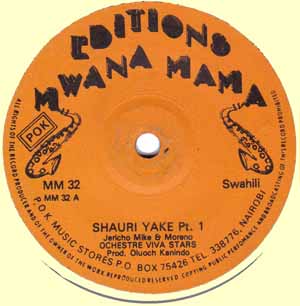
Courtesy: Alan Wheeler |
Viva Stars
A later version of Viva Makale, with Coco Zigo on vocals and Thomy Lomboto, bassist who also played with Moja One. Bibiley was rhythm guitarist. Moreno sings on at least one number, "Shauri Yake," an interesting take on the Nguashi Ntimbo hit "Shauri Yako". Mokili Sesti played lead guitar. Perhaps also connected to Les Jaca. (Coco Zigo died in Nairobi in August 1998.)
45s:
Bora Bora (Coco Zigo Mike) Eds Hudson HUDP01
Horoscope (Prince Coco Zigo Mike) Editions Jaca JRP 35
Mama Mapacha (Thomy Lomboto) Editions Jaca JRP 39
Sali (Coco Zigo) Eds Jaca JRP38
Shauri Yake (Jericho Mike & Moreno) Eds Mwana Mama MM32
Vundumuna
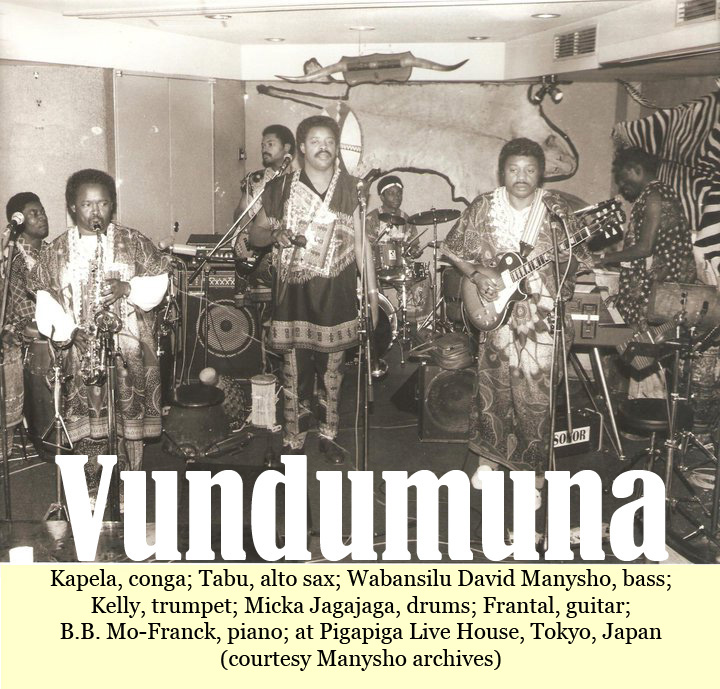
Vundumuna was formed by guitarist Tabu Frantal in 1984. He had started in Kisingani with Orch. Succès le Peuple, then came East with Boma Liwanza and joined Shika Shika then Virunga, before starting Vundumuna with his partner Daid Wabansilu Manysho, the bassist. Ugandan Sammy Kasule (from Special Liwanza) and drummer Lava Machine were also members, though Sammy departed early. They also teamed up with Lessa Lassan, who had sung with African Fiesta, at one point. Kelly Konkou joined on trumpet. Botango Bedjil "B.B." Mo-Frank was keyboard player.
LPs (from Peter Toll):
|
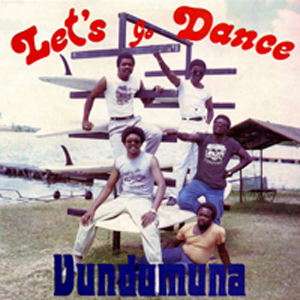
courtesy: East African Music
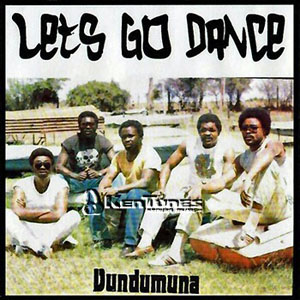
courtesy: KenTunes |
LET'S GO DANCE (ASLP 1013 1986)
A1: Yambula
A2: Unikome
A3: Tega Masikio
B1: Let's go dance
B2: Komilakisate
B3: Omalikama
|
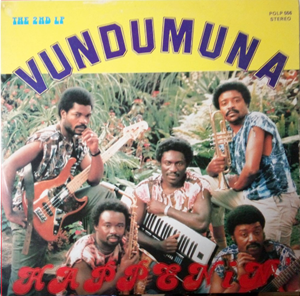 |
Vundumuna: Happenin' POLP 556 1986
A.1. Petite Nzele (Botango)
A.2. Gudi Gudi (Manytcho)
A.3. Benda Bika (Frantal)
B.1. Survival (Frantal)
B.2. Money Pesa "Argent" (Frantal)
B.3. Wivu Sina (Kelly Kanku)
|
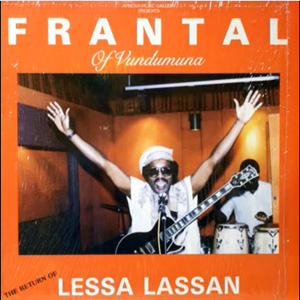 |
Frantal: The return Of Lessa Lassan AMG 005
A.1. Sala Molende
A.2. Inaka Losele
B.1. Nakoka
B.2. Nzawe
(All songs composed by Frantal)
|
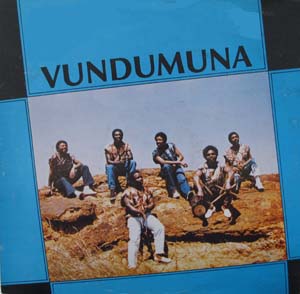 |
Vundumuna: The Original Vundumuna CBS(N) 025
A.1. Mariamu (Tabu/Ngongo)
A.2. Usinitese (Frantal Tabu)
A.3. Unshe (Vundumuna)
B.1. Mwinji (Botango/Kanku)
B.2. Mwami (Kelly Kanku)
B.3. Kagutema (Traditional, arr. Vundumuna)
|
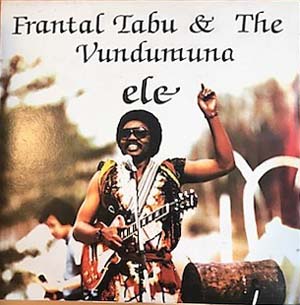 |
Frantal Tabu & The Vundumuna
ELE(Eds D'Ivoire IVALP 043)
A.1. Oluka Makambo
A.2. Tuta-Tuta
B.1. Bibi
B.2. Ele
(All songs composed by Frantal)
|
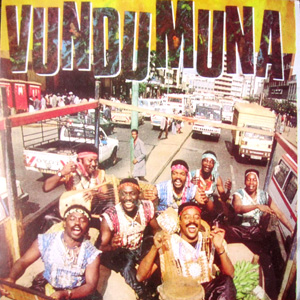
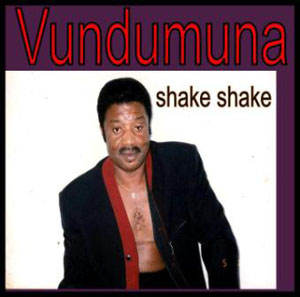 |
Nakata Mikili / Vundumuna Band (Andrew Crawford INTA 18) 1991
Recorded in Japan, released in Kenya in 1991 (Doug Paterson)
on CD as Shake Shake
Shake Shake
Mademoiselle de Paris
Edodokola
Tabu nyingi
Nakata mikili
Salaamu
Moto ya pusa
Leo na suki
Vundumuna 45:
Mwami b/w Mariamu CBS (K)7032
Ndoto () Bolingo
Vundumuna () CBS (K) 7008
|
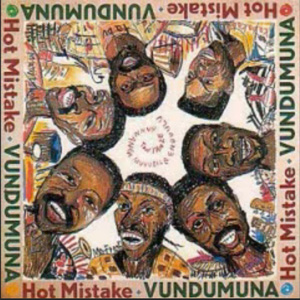 |
CD: HOT MISTAKE (MERCURY/PPD-1051 1989)
Tracks: "Sesse"
"Kagutema"
"Nzawe"
"Iyoliyo"
"Tongo Etana"
"Mee Kakpa"
Prod.: Vundumuna & H. Nagasawa; Vundumuna personnel:
B. B. Mo-Frank (keyboards, vocal, percussion)
Tabu Frantal (guitar, vocals, percussion)
Tabu Ngongo (alto sax, vocals, percussion)
Kelly Kanku (trumpet, flute, vocal, percussion)
Wabansilu Daid Manytsho (bass, vocal, percussion)
Kabakaba (guitar, vocal, percussion)
Kapela (drums, vocal, percussion)
Micky Jagajaga (drums) |
|
Updated 29 Jan 2026
with big thanks, as ever, to Alan Wheeler.
April 2025: new info from Jerome Ogola.
All writing on this site is copyright 2005-2026 by Alastair Johnston. Please seek permission before lifting text and/or images.
You can reach me at contact(at-sign)muzikifan(dot)com

muzikifan by alastair m. johnston is licensed under a Creative Commons Attribution 3.0 Unported License.
Based on a work at www.muzikifan.com.
Muzikifan HOME
|