|
TINARIWEN
TASSILI +|0:| (Anti Records)
This band went from the remote Sahara desert to world music darlings overnight (well, in less than a decade). This is their fifth album and, despite the presence of several Western pop musicians to add some lustre, I can't tell it apart from their earlier albums. In fact I cannot tell one song from the next: they are mournful dirges that mostly follow the 12-bar blues format. It's not, as I said earlier, the Grateful Dead syndrome, because while the Dead would play the same songs over and over, within the framework of each they would explore new ideas, which is why the hardcore deadheads want 60 hours of "Casey Jones." There are scores of Desert blues bands now -- including Tinariwen, Tartit, Toumast, Tamikrest, Terakraft (I'm not making this up!), Takamba Super 11, Taliwen, Etran Finatawa -- so obviously Tinariwen have some appeal, but why didn't Lobi Traore get this kind of attention? Bombino with his one guitar is far more exciting on the same material. Is it simply marketing, connections and festival exposure? As for the added artists on here, I have no idea who Nels Cline is, or TV on the Radio and couldn't distinguish anything different about the jangly open-tuned endless G-chord tracks they are on, except for some wimpy white vocals. Maybe it's just the production that makes this album so bland. There is one track with the Dirty Dozen Brass Band which is very good, as the hornmen go outside and clearly have a good time throwing some Norlins grits into the stew. But for the most part, it's low key and too laid-back and the vocals don't appeal to me. Maybe if I smoked some weed I would appreciate it more, then again it might put me to sleep.
|
|
SIBIRI SAMAKE
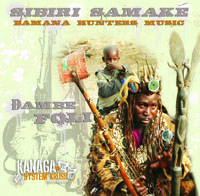
DAMBE FOLI (Kanaga System Krush KSK)
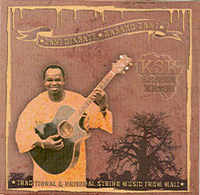
This is Samaké's second album and, like the first, is devoted to traditional Bamana hunters' songs from the Mande people of West Africa. The hunters of Mali predate colonialism, they predate Christianity and Islam. As animists they're in touch with the spirits which are part of their natural surroundings. The lead instrument is the traditional harp of the hunter, a kind of ngoni which is familiar from Ngoni Ba as well as Issa Bagayogo. It's been twenty years since Musique du Monde put out his first album Music of the Hunters of Sebenikoro, which I often aired on my African Music Program on the radio. Back then Sibiri was hailed as a young virtuoso, born into the hunter clan, who had adapted to being a griot as well as a hunter. Traditionally hunters are responsible for the police force and medicine (learned from the forest), as well as providing fresh meat to their communities. Sabaré's bluesy vocals and resonant bass instrument (which is bluesy in the extreme) is accompanied here by karinya, or iron scraper, and kusubu, or shaker. Imagine Jack Bruce & Ginger Baker (with or without the red hair and kilts) & you get a sense of the dynamic jamming interplay between the ngoni and the percussionists. And like "Live at the Fillmore" there are four tracks that were captured in one take each. (Funny that I thought of Wheels of Fire because it also has two really long tracks and two less-long tracks...) The title means "traditional music," but if they had styled it a rootsy jazz-blues jam from the modern city of Bamako it would have made as much sense. Another superb offering from the KSK label.
|
|
RAIL BAND
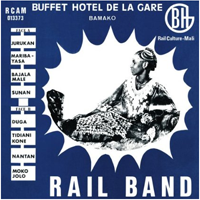
BUFFET HOTEL DE LA GARE BAMAKO (Secret Stash LP)
Released by RCA in 1973 this is the fourth long playing album by the legendary Rail Band of the Buffet bar of the Railway hotel in Bamako, according to Graeme Counsel's discography. The first two tracks were included on Stern's Belle Epoque vol 3. The disc opens with "Jurukan," a majestic unraveling ballad with great sax and young Mory Kante singing. This is followed by an up-tempo funk number, "Mariba Yassa" with some wild breaks on drum and a scorching guitar solo. The third tracks "Badiamale" was gathered in 2008 on Mali 70/Electric Mali. With its horn chorus and filigree guitar work, I would say this is a perfect example of their early sound after Djelimady Tounkara took over as guitarist and band leader. The fourth track, "Sunan," a lilting swinging driving groove, has not been previously anthologized, to my knowledge. Track 5, the majestic "Duga" kicks off the second disc in Stern's Belle Epoque series which, as I have said, is the cornerstone of any Malian music collection. (The Rail Band's "Duga" is different from Orchestre Regional de Kayes' song with the same title and has flamenco flourishes in the guitar.) "Nantan" is a weird little ditty, almost a complaint. It made it to Electric Mali in the African Pearls series. The last cut, "Moko jolo," which features the saxophonist & Mory Kante's attempt to do the James Brown, was on Musique du Mali vol 2 on the Melodie label. As this is a pricy import you may be content with the highlights gathered elsewhere but for Rail Band fanatics there is something grail-like about these early albums in their original sequence and with restored sound.
|
|
SORRY BAMBA
VOLUME ONE 1970-79 (Thrill Jockey)
About 6 months ago roving reporter Zim sent me a link to an African LP on EBay by Mystère Jazz de Tombouctou that had sold for seriously funny money ($760). Then a rare Kanaga de Mopti album came up -- I had neither seen nor heard of these albums before -- but once the first copy of Kanaga passed the $100 mark, the price escalated until one sold for $453; then several more appeared and the price dropped accordingly. But I was curious enough to track them down. The Kanaga de Mopti album, though a bit muddy, had some great work by trumpeter and singer/songwriter Sorry Bamba. Bamba started out in 1960 in a youth band in Bamako called Bani Jazz, who released a single in 1965. Then he returned to his home town Mopti and formed the Orchestre Regional de Mopti in 1969, with whom he won the top prize at the musical contest thrice. Some of that music appears here. From the 1970 disc that appeared on Barenreiter-Musikafon comes "Boro" & "Sekou Amadou." (As I have said before someone would do the world a great service by reissuing all the BM 30L series on CD.) The regional band evolved into Kanaga de Mopti around 1976. Bamba released his greatest work, an LP on the Bolibana label called Le Tonnère Dogon in 1987 (not here as this disc focuses on the 70s; perhaps it will be on volume two). This disc kicks off with "Yayorobo" which was a hit but which he later described as "frivolous." That and the drinking song "Porry" come from an album on Songhoi Records from 1977 called Sorry Bamba du Mali. The elegant, drawn-out "Gambari" & "Sare mabo" from that rare Kanaga de Mopti album that broke the bank on EBay are here along with eight other tracks that have been restored to wonderful sonic fidelity. Mory Kanté plays guitar, but I don't think it's the same Mory Kanté who went on to fame in Paris in the 80s. Digging into the Dogon mask dances for inspiration and playing the fula flute against more sophisticated modern instruments, Bamba creates a real fusion between tradition and innovation. There are several long, moody tracks. "Sékou Amadou," in minor keys, has a sustained litany of what sound like Islamic plaints and a bass and guitar in contest arguing over the right key before the horns and a flute come in to restore balance. This has fake applause grafted on. Nevertheless this is pure joy: not only good value (compared to EBay) but a long, thoroughly satisfying disc.
|
|
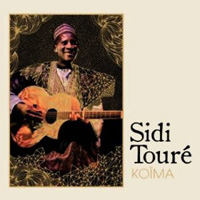
Sidi Touré and his friends turn in nine great acoustic tracks of easy-going West African music with lilting "dry" guitars. Sidi hails from Gao, once capital of the Songhaï empire that sits on the banks on the Niger with its back to the vast Sahara desert. Like Salif Keita, Touré came from a noble family and was discouraged from being a griot: those were lower caste people the Tourés did not mix with, so his brother broke his home-made guitar. But at 16 Sidi joined Songhaï Stars, the Regional Orchestra of Gao. But he is not one to simply reinterpret traditional songs, in fact he likes Kenny Rogers and J.J. Cale. For this, his second solo album, he chose to record with a rotating roster of friends, so each song is a duet, done in one or two takes on his sister's porch. In addition to guitar, the other instruments dueting here are kutigui, a single-string instrument, & kurbu, a 3-string instrument. If Ali Farka opened the door for a wider appreciation of Malian acoustic music, Sidi Touré beckons us in with a warm welcome.
|

|
BOMBINO
AGADEZ (Cumbancha CD-20)
IN CONCERT AT MEZZANINE, SAN FRANCISCO, 9 DECEMBER 2011
One sign the recession is fading was the crowd in the new, trendy Mint Plaza in San Francisco's formerly seedy downtown, and a new club, Mezzanine, which was hosting Niger's guitar-wizard Bombino on Friday night. He is touring to promote Agadez, his new album on the Cumbancha label. After a terrible opening set from Matt Jennings (a talented guitarist with awful material who cannot sing), Bombino took the stage in his white Tuareg robes as whistles and ululations from the Africans present greeted him. I found a spot near the front with another grey-haired gent, this one wearing elaborate African regalia. My companion, Big Steve, who used to be a newspaperman in Oakland, told me he was a Black Panther who had fled to Africa and started a cooperative farm. Bombino looked pleased by the reception and started out on acoustic guitar with his percussionist playing calabash. He played "Tebsakh Dalet" and another ballad from his album Agadez, impressing us with his technical virtuosity. Then the percussionist switched to a drum kit and a rhythm guitar and bassist came on, while Bombino switched to his Stratocaster and turned on the reverb in his Fender Twin amplifier. The club is elegant and has great acoustics and pleasant ambiance plus stage lights with changing-color spotlights, but one unnecessary addition: a smoke machine. -- In San Francisco you just have to leave the back door open and the fog will come in. When the lights turned gold it looked like yellow cake uranium particles swirling overhead. The red-bearded bassist played about three notes all night: I think he was channeling the gimbri; the drummer was rock solid and created some great rhythmic patterns which Steve thought could have been heard in a disco in Tehran, or anywhere in the Arab world for that matter. The rhythm guitarist stayed in the background chopping out chords and sometimes giving a reggae-like backbeat chunk to the music, while the fifth member who was the "buddy" of the band, dressed in blue robes, a blue tagelmust, and a giant ornate leather amulet, thumped the calabash on the one and sang back-up. He was also the "translator," but Bombino only said a few words in French, mainly thank you, and I am moved by your appreciation. While he was enjoying himself he seemed very focussed and lost himself in ecstasy in his solos as the room heated up. There are suddenly lots of Tuareg bands on the concert circuit (no sooner had I slagged off Tinariwen than they were nominated for a Grammy!) but Bombino is something special. He is a truly gifted guitarist and if he continues to write material as solid as that on this album he has a great career ahead of him. After one ornate work-out, someone in the crowd yelled, "Jimi Hendrix says hi!" A mouth-harpist came on and blew some wailing blues harp which ignited Bombino during a long jam. They ended with their "hit" "Iyat Idounia Ayasahen (Another Life)."
|
|
It has been over a decade since we heard from Zani Diabaté. Back then he was heading an electric outfit called Super Djata Band. Raised in a traditional griot family, he played djembé and danced with a folkloric troupe. By his teens Diabaté could play many instruments when he took up the guitar & formed Super Djata. They toured and had a 1988 release on Island which was a global hit among world music devotees. After Super Djata he became director of the National Ballet of Mali and then was appointed Minister of Culture where he was able to work to his goal of preserving the rich cultural heritage of the music and dance of Mali. But in addition to his governmental duties and teaching, Diabaté continues to play guitar and has teamed up with another acoustic guitarist, Moudy Sissoko, who has been accompanying Zani for twenty-five years. They have added vocalist Oumou Diabaté, who became well-known when she fronted Super Rail Band in the 80s, for a great unplugged set of traditional songs. Sadly, Zani died in January 2011 so this is the last we are likely to hear from him, until someone anthologizes his career for a retrospective tribute.
|
|
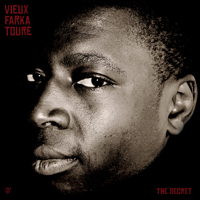
VIEUX FARKA TOURE
THE SECRET (Six Degrees)
With only a couple of albums behind him, Vieux has arrived in the spotlight so recently vacated by his father Ali Farka Touré. On this stately outing he collaborates with a bunch of Western rockers and jazz and bluesmen, including Derek Trucks (slide guitarist from the Allman Brothers), singer Dave Matthews, John Scofield. Even his late dad manages to muster the chops for the title cut. Vieux has adopted the tone of his dad's skirling bluesy guitar over the calabash and bass and occasional Western trap drums. Among the Malians there's flautist Cheick Diallo and Ganda Tounkara on ngoni. But the dominant sound is electric blues, and "Lakkal (Watch out)," while featuring Vieux's guitar and vocals, is mostly given over to producer Eric Krasno's scorching lead guitar, rock bass and drums, and Ivan Neville on a wailing Hammond organ. Another high spot is the appearance of jazz guitarist John Scofield who tears off some Arabic-sounding minor riffs and pushes the rest of the band to excellence on "Gido."
|
|
LOBI TRAORE
BWATI KONO: RAW ELECTRIC BLUES FROM BAMAKO (KSK 2010)
With no preamble, Lobi launches into another scorching set of electric blues from Mali. He has bass and drums backing him, but also a well-slapped djembe and balafon continuo on half the cuts. This album was recorded live in two sessions in February 2007 and February 2008. Throughout he demonstrates the drive and virtuosity that propelled him to the top of my charts with his 2006 release on Honest Jons. This album surpasses even that for intensity and sheer power: he indeed cooks a spoonful. Moribo Kouyate is still with him on balafon; I doubt anyone else could keep up. Unfortunately Lobi died last year -- not even fifty years old. Born in a village outside Segou on the banks of the Niger in 1961 he took to the Bambara culture readily as both parents sang in a secret society known as "Komo." (Komo is one of the three main power societies in Bamana culture: the other two are Kono and Nama. The Bamana have their own system of writing and unique metaphysical and cosmological concepts.) At 16 Lobi moved to the big city and played guitar with a folkloric troupe for three years before joining the Djata Band of Zani Diabaté. After tours of France and Ivory Coast, Lobi decided to go solo. He returned to the Bozo Bar in Bamako and grouped traditional musicians around his electrified lead guitar & power-rock trio. It's unusual to have such raucous guitar in this context but it works well. He recorded half a dozen albums with this combo. He plays long trancelike solos that remind me of ragas while the continuo adds a solid underpinning. This, his latest from Kanaga System Krush, is pure joy. Fans of Cream and Velvet Underground will also be delighted by it. The Bamana blacksmiths are members of the Komo cult because of their ability to transform materials through the medium of fire. Lobi's musical tricks are both incendiary and transformative.
|
|
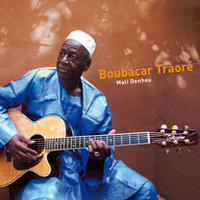
BOUBACAR TRAORE
MALI DENHOU (Lusafrica)
Boubacar is back and that's great news. He was a star in Mali half a century ago at the time of Independence. The Twist and the Madison were big then, as they were in England & the USA (The Madison, which is a line dance, was featured in the cult film Hairspray). Boubacar had hits with those rhythms and was known as "Kar Kar" after one of his biggest hits. The first Malick Sidibe book I bought had a Boubacar CD in it as part of the package; I thought he was one of the legendary old-time guitarists who had vanished: he was even thought dead by the Malian fans! But he was rediscovered and in 2002 a movie about him came out in France (I haven't seen it). But he did come on tour before returning to his homeland. Now, almost 70, he has cut a fine new album of gentle bluesy songs with his acoustic guitar and a French harmonica player. There's also calabash and n'goni. The producers brought us the fabulous Djelimady Tounkara solo album of a couple of of years ago. I hope they repeat the success with this mellow offering.
|

|
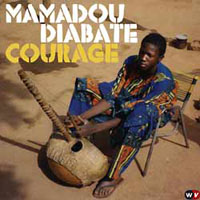
MAMADOU DIABATE
COURAGE (World Village 468108)
This is almost a novelty: a kora album that is purely African. I mean there's no horn section, no banjo, no slide guitar, no trap drums, no Latin beat, no remix, just some great kora playing. I guess that's why it's called Courage! Diabaté's fourth album, Douga Mansa, won a Grammy in 2009. Like the Oscars the Grammies have little weight outside the industry, people stick with what they know and like, but it does mean more exposure. Also Diabaté has lived in the USA so is probably bit more up on marketing strategies and dealing with label folks than his cousins in Bamako. Though there are familiar strains, and a couple of classic pieces, the material is nearly all new, composed and arranged by Diabaté and features, in addition to his kora, a balafon, ngoni and acoustic bass. There is also percussion on calabash or djembe as the mood suits. On "Diayeh bana" the balafon stretches out and touches on "The Flight of the Bumblebee," and "Shortenin Bread" -- or so it seems to me. Beautifully recorded, this is a meditative album, one you can listen to over and over.
|

|
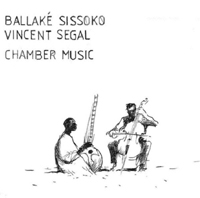
BALLAKE SISSOKO & VINCENT SEGAL
CHAMBER MUSIC (Six Degrees)
Kora & cello seems like a natural pairing. Throw in the occasional ngoni or balafon and you have a really mellow set of chamber music, a magical night in Bamako unlike any other. The cross-cultural fusion works well. The kora leads the way but the cello augments it wonderfully with its woody bowed tones. One thing struck me, and that was the opening of "Houdesti," where, for a second, I thought Sissoko was about to go into the "Deliverance" theme on his kora! Then it goes into a minor key riff, much more evocative of "Good King Wenceslas." I have been thinking about this & similar carols, such as "We three kings of Orient are," over the Christmas holiday as I have been rocking out on the piano. Many of the best carols use minor chords to evoke "the Orient" (where the Three Kings came from). I don't know if early Victorian composers knew about pentatonic scales but they certainly caught the spirit of the mysterious "East". By the height of the Victorian era it was perfected in Russia by Tschaikovsky in his Nutcracker Suite which includes many wonderful pseudo-"Oriental" riffs. But I digress. The Orient is not so far and pentatonic scales are familiar friends. "Histoire de Molly" by Segal has clearly been written out and arranged, so Sissoko's part is not improvised but carefully constructed to tell the story. It works well. Vocals appear unobtrusively on one number, otherwise we are in a twilight of gentle sounds with only the odd incursion of karignan -- the metal scraper -- or bolon, played by Demba Camara. I am reminded of other artists who had African music by heart, South African Dollar Brand & American Randy Weston, but what they created has a universal appeal.
|

|
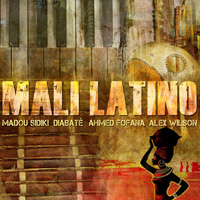
ALEX WILSON, MADOU SIDIKI DIABATE, AHMED FOFANA
MALI LATINO (Alex Wilson, self-published)
This has more the level of energy you would want from AfroCubism. The pinnacle of Jazz or Latin fusion with Malian traditions is still Sarala by Hank Jones and Cheikh Tidiane Seck. Some other outings, notably those of Pee Wee Ellis on Cheikh Lo's, Toumani Diabaté's & Oumou Sangare's discs, have been memorable for their fire and energy. Here is a great melding of kora, balafon and Malian griot singing with Latin jazz. The first two tracks are superb: It kicks off with a rocking "Donkan" and though the next track "Sangre Mandinga" is slower, both explode out of the speakers. Credit Toumani's brother Sidiki on kora and multi-instrumentalist Ahmed Fofana from the Symmetric Orchestra. Things cool down a bit, and the noodly "Voyage" is lost, a trip to nowhere, with Alex Wilson's piano dripping clustered foolery seemingly aping balafon scales. There's also some dated Jan Hammer-like Moog on "Bamako 2000," but the rest of the band are doing their part admirably. So it does go pear-shaped after a promising start. It was recorded in Bamako and at Real World Studios in Wiltshire, probably by overdubs, otherwise the Malians might have pulled the plug on the ostensible leader. In "Joie au village," Wilson gets it together with some decent montuno piano as Ahmed Fofana's balafon takes a very ornamental solo followed by Madou S. Diabaté on the kora. Then fat trombones come charging in from Nicol Thomson and Jonny Enright, like rhinos on steroids. The kora and balafon take the lead in the latter end of the disc. Apart from the lapse in the middle, this is a commendable outing. |
|
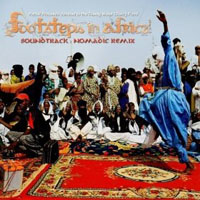
FOOTSTEPS IN AFRICA (Kiahkeya 001)
I have a problem with remix albums. They all sound the same. That is to say the DJs have each other as a frame of reference so they are all trying to ape the success of Gaudi or Cheb i Sabbah. The remixers are not musicians but rather engineers who are adept at looping samples, layering in synth and juxtaposing anachronistic elements to create a new sound. I try to wade through those that come my way, but it's usually sub-disco mush with only a whiff of the original music perceptible under the layers. So when Footsteps in Africa showed up six months ago I gave it a spin and my first thought was, There's already a strong trance element in Saharan music, why mess with it? But then the album resurfaced and I tried it again. After several tries I began to like parts of it; now it's my default album to put on when I want music but don't want to pay attention to it, like when I am reading, cooking, sewing, or just messing about. There's a whole array of famous DJs on here so there is at least some variety to the music though two tracks have been remixed twice and another thrice. I am not going to go blind trying to tell you what's on here because the sleeve has the worst typography I have seen this year: it's 4 and a half point white Uncial type with floating shadow over coloured half-tones. It's too small to read any of it, so the designer also escapes notice. That's the negative part: on the plus side Jamshied Sharifi combines the wobbly sine-wave wash with Gyuto monks and a huge echo chamber that swallows everything whole. But now and then a wild fiddle brings a human touch to the robotic drum beats. What that track has to do with Africa I can't tell you, but the "Red Ladies Tent Jam" clearly has Tuareg ladies making jam with a trap drummer, harmonica player and guitarist learning Mick Abrams's "Cat's Squirrel" atop it. The SonicTurtle remix of more Tuareg ladies' jam is awful, sounds like a hookah bubbling, but that is quickly swept away by the "Tuareg Goosi Jam in Tent." How's that for a nutty title? Then there's a better mix of the "Aheahedon Tuareg Women's Jam" by Nickodemus. The end titles (Solar Lion remix) is oddly a reggae track (with sitar) to change the mood entirely. If you like the Tuareg stuff, especially the stony trancelike women chanting and handclaps, you might enjoy the augmented set here. Worth a listen anyway.
|

|
KHAIRA ARBY
TIMBUKTU TARAB (Clermont Music)
The glittering lure of Tombouctou has faded of late, with tales of kidnapped tourists, so we are back to listening to the music and doing some armchair travel, rather than planning to brave sandstorms and spitting camels to get there. Khaira Arby is a traditional Songhai and Berber praise singer from Mali, untouched by the Western ideas that pushed her compatriots Issa Bagayogo and Rokia Traore into the international spotlight. She sings about people, the anguish of women, religious festivals. The Duchess finds it high-pitched and complaining, but when you are relating tales of female excision or exhausted workers returning from the salt mines, it's hard to be light and airy. Arby has surrounded herself with a band of three rock guitars in addition to fiddle and ngoni. Even the calabash is backed by a western drumkit, so the album has drive, to say the least, and it will be demonstrated in person as she is backing her words with actions on a North American tour, hoping to become as familiar (& popular) as Salif Keita, Toumani Diabaté, Vieux Farka Touré, or Tinariwen to the American concert audience. I hear her live shows are a knock-out. However, it does seem as though she is trying to cram Ali Farka AND Oumou Sangare into the same package. The power rock may be necessary to get attention, but it is the traditional aspect of her music that appeals to me, when its the njarka and backing female chorus trading licks against her strong vocals, with handclaps and calabash creating the rhythm. She moves back and forth between the more traditional praise songs and the rock-inspired outings that should appeal to a broad spectrum of listeners.
|
|
VIEUX FARKA TOURE
LIVE (Six Degrees)
They say we end up becoming our parents. I was hoping after his debut album Vieux would move away from his father's influence, but after his second album it's clear the brand name is bigger than his own ambitions. This live album sounds just like Ali Farka Touré -- if he had spent more time jamming in juke joints in the delta. Not to say it's bad -- au contraire -- it's a hot live album and should increase Vieux's fan base. Vieux Farka Touré doesn't have as strong a voice as his father but his guitar chops are fine, especially in the howling Mississippi blues vein. Fortunately there are some Malian instruments on here too: like calabash (and djembe drums -- are they Malian?). The show was put together from concerts in Australia, plus one in Colorado and one in San Francisco when Vieux was touring last year to promote his FONDO album, so most of the material is drawn from that. There are two tracks not on that CD: "Na maimouna," and a traditional song, "Maiga." There's good call-&-response work between the singers and guitar and even the audience (in San Francisco), who learn a chorus for the encore "Chérie Lé". Those Malian rock and rollers are clearly out to conquer the world.
|
|
SALIF KEITA
LA DIFFERENCE (Emarcy/Universal France)
This album starts on acoustic guitar: I swear it's "Born in the USA." Then Salif comes in singing in his breathy way. When they shift up a key his voice is strained, like they pitched the song too high, or he is losing his pipes. Then the full band comes in with kora accents, synthesized balafon and strings, etc and you think it's back to the 80s. He is re-examining his breakthrough sound from Soro, since I guess he has run out of new ideas. It's too bad. It's a very mellow album and his fans will doubtless enjoy it but I get the feeling he is treading water. Though he peaked with the Rail Band and Les Ambassadeurs, he continued to score hits right through 1987's Soro: definitely a watershed album in African pop. After that everyone wanted those French production values and though in the end it had a detrimental effect on African pop, there's no denying the initial power and impact of that release. Keita had further successes and tours of varying degrees of musical sophistication, but he tended to go for the showboat style with a terrible "Kenny G"-type soprano sax player and French guys who thought they were Jimmy Page on guitar. There's a remake of "Folon," which means "the past," that is the best thing on here. There's a track called "Seydou" which is a remake of Les Ambassadeurs' "Seydou Bathily," and a reworking of "Papa." "Garifou" is a mellow outing with ambient night sounds and "Spanish"-style guitar, joined by kora. Then it becomes too soporific to continue. Even the uptempo "Ekolo d'amour" suggests he is delivering this to a sit-town audience. If Salif has lost the spark he should give up touring and recording. At this point I would rather listen to someone else -- not necessarily younger -- but let's give the other guys a chance.
|
|
BAKO DAGNON
SIDIBA (Syllart/Discograph 6146642)
This is a solid, noteworthy outing from a female griot singer from Mali. While Mali has shot to the top of world music charts thanks to the popularity of artist as diverse as Ali Farka Touré and Salif Keita, Amadou & Mariam and the Super Rail Band, and from Les Ambassadeurs to the diverse women singers such as Oumou Sangare and Rokia Traore, there has been a long-established tradition of griots: singers who deliver the news, singing songs of praise or epics from a deep historical trove of lyrics and melodies. Dagnon grew up in the old ways, learning the Biriko style in her native Western Malian landscape, in the village of N'Golobladji, but also acquiring the Mandinka and Bambara styles as she grew, traveled and matured. She made her debut as part of the national orchestra L'Ensemble Instrumental du Mali. As such she became a cultural repository, called on by Ali Farka Touré or Banzoumana Sissoko to sing famous old songs and tell the tales of her youth that had been handed down for generations. The arrangements on Sidiba are subtle and there is a lot of innovation in the guitar-playing (both acoustic and electric). The album doesn't come out until mid-April so I don't know more than what I can hear. It's traditional music in a dozen, mostly short, songs, with some superb interplay between guitars and hand-percussion and excellent singing. "Badjigui" has the one-string fiddle and some down and dirty blues playing which elicits a throatier vocal from Bako. There's also an atmospheric, dirge-like praise song "Alpha Yaya," not for the famed Guinean guitarist. DJ Akena explains, "Alpha Yaya Diallo was a warrior king of Labe, which was part of the Foulani confederate theocracy of Fouta Djallon. He sold a lot of Africans to the whites, many of whom ended up in this hemisphere. He was captured in 1905 and deported to Benin [Danhomey] and then Mauritania where he died. His life was epic. Dagnon is singing of him." On "Fadeen Tô," she sounds like a flamenco singer, and is abetted by the acoustic guitarist.
|
|
ETRAN FINATAWA
TARKAT TAJJE/LET'S GO! (Riverboat Records TUGCD1055)
Etran Finatawa is one of the better desert blues bands from West Africa. They combine Tourag musicians from Niger with members of the Wodaabe people (the ones who paint their faces). These are two of the eleven tribes that make up the people of Niger, one of the three poorest nations on the planet. Their name means "Stars of Tradition," so they draw from their roots but have a wide contemporary appeal. This, their third album, was recorded in the middle of their 2009 European tour; they have their act together, and are doubtless enjoying the change of scenery from sand dunes and camel herds to Autobahn rest stops and crowds of ecstatic white youth. Actually, come to think of it, I would prefer the former. Lyrically they have moved from wondering how nomads fit into modern society to broader concerns for humanity. The tunes are clipped and defined, with clear vocals and percussion, and move beyond the open-chord-strumming jam bands from the desert that are getting all the press. The album opens at sunset, which sets you up for an evening of storytelling and magic around the campfire. Track two, "Diam walla," addresses the big issue facing desert-dwellers: with global warming where are we going to get water? Their other concerns are universal: why can't we all get along? Let's celebrate our similarities rather than amplify our differences. By the middle of the album, Anivolla the guitarist take a break and we get a traditional Wodaabe song, usually sung by girls, about a handsome boy. The accompaniment is hand drums, clapping and calabashes being beaten by ringed fingers. The call-&-response vocals discuss the boy's long hair -- and long neck! There's also plenty of the spaced-out trance vibes, courtesy of their Fender guitar, to groove on, if that's your dime bag. There's an excellent half-hour video of them performing at Amoeba in LA here.
|
|
BASSEKOU KOUYATE & NGONI BA
I SPEAK FULA (Sub Pop)
I was thinking the great fountain of inspiration from the Sahara sands was starting to dry up, maybe with the arrival of Al Qaeda in Africa in their dunes. (The sudden enthronement of Tinariwen as the hottest thing to come out of Africa also coincided with them becoming a watered-down version of their former selves. Now there are dozens of these Saharan jam bands, it seems, whanging away like the beturbaned Dead.) But my fears were groundless and here we have the latest in a glittering galaxy of musical statements that are timeless: Modern yet grounded in an antiquity that predates Noah. (Depending on who you are listening to, the great flood was not that long ago, but something has always bugged me: If the water reached to the tops of the mountains -- say 6000 feet -- where did it all go when the "waters receded"? Did God pull a plug at the bottom of the ocean?) Ngoni Ba is a group of multiple ngoni players, including Harouna Samake on kamale ngoni and Bassekou himself on the bass instrument. Amy Sacko, the vocalist, is married to leader Bassekou Kouyate. Apart from the Western pop sheen brought by Taj Mahal, Clapton and others, Kouyate has also frequently dueted with Toumani Diabaté the celebrated kora player, and he appears here again. But its the ngoni that takes centre stage. Kouyate had never seen a banjo, the modern descendant of the ngoni, until he attended a banjo pickers convention in Tennessee and was urged on stage. Now Bela Fleck is touring with the group to bring that dueling banjo intensity to the set. Kouyate has played with Toumani Diabaté in an instrumental trio, in the Symmetric Orchestra & with Ali Farka Toure. Ali's son Vieux guests here, as do griot vocalist Kasse Mady Diabaté, plus there's a stellar spike fiddle player Zoumana Tereta playing his soku, which is a horse-hair fiddle. |
|
KASSE MADY DIABATE
MANDEN DJELI KAN (Wrasse Records 248)
Seem to be lots of Diabatés on my playlist this month. I am not complaining, lordnose there are precious few new CDs of any interest coming onto the American market. If we reach out to the European market and find those pricy imports, we can figure out which are worth auditioning from their track record. Kasse Mady is a major figure in the Malian traditional scene. His was the voice of the Symmetric Orchestra, fronting Toumani Diabaté's big band. The title of this disc translates into "The Voice of the Mandinka Griot" and that is what we have here: a traditional set of Malian praise songs, where the voice is to the fore in a lush instrumental setting. Kasse Mady came from a farming family but even at an early age was called on to sing praise songs, and older people said he sounded like his great-grandfather, a famous griot a century ago. But indeed the role of the griot or Djeli is to preserve the seven plus centuries of traditional stories, royal lineages and so on, of his people. From singing in the fields with an ngoni to a star role in the Kangaba Orchestra, Kasse Mady has now reached the grand age of 60 and was captured in Mali with an all-star backing band. Electric guitar sneaks in alongside electric bass. There's a bunch of Kouyatés on guitar, Lansine Diabaté on balafon, Adama Diarra on djembe, Prince (the artist formerly known as Mamadou Koné) on calabash. Mama Sissoko shows up to play ngoni and guitar on one track, "Douga Djabira," and "he who can do no wrong," Cheikh Tidiane Seck is the producer. That's the seal of approval right there. Pure class, all the way.
|
|
RAIL BAND
BELLE EPOQUE VOL 3: DIOBA (Sterns)
It doesn't get better than this folks! I have raved in these pages about Djelimady Tounkara's guitar playing. The third installment of the adventures of the Rail Band covers the decade 1973-83. I think the first Rail Band album I owned was FOLIBA which is the opening selection on here. I remember putting it on and thinking the horns were like a big diesel train, but then the ecstatically fluid guitar of Djelimady banished all such mundane images and lifted me into the sky. It's not a train at all: it's a magic carpet ride. Like the preceding two double discs in the series, this set is drawn from all eras of Rail Band, including two rare 1983 albums Rail Culture Authentique Volumes 1 & 2, which I have never seen. The double disc format, indeed the sextuple disc format if you buy all three box sets, allows the programmers to be expansive. So it's wonderful they found room for one of the greatest Rail Band expositions: the 13 minute "Wale numa lombaliya," which showed up on Mory Kante's Mali Stars album and was featured on the classic Les Nuits de Bamako disc. All three singers are featured and Magan Ganessy is no less thrilling than his famous predecessors Salif Keita and Mory Kante. We also get the wide variety of Malian styles, including Bambara and Malenke, but Djelimady was an innovator and for a while took on the rising third harmonies of Congolese pop (to the disgust of his hard core Malian audience). After missing an important gig he was fired and started a separate band, Le Trio Mandingue, with Djelimoussa Kouyate on guitar and Issa Tounkara on bass. But the Rail Band went into a steep decline, so the more successful smaller combo was reintegrated into the main outfit in 1981. After all Djelimady is the engine driver: he is the one constant throughout the history of Rail Band. This Stern's set is the foundation stone of any Malian music library. |
|
ISSA BAGAYOGO
REMIXED (Six Degrees)
The crisis in the music industry is exemplified by the work of Issa Bagayogo. No one is buying CDs, so the only way an artist can make money is to tour and perform. Issa has a unique sound which is the result of careful studio crafting. Bagayogo is known as "Techno Issa"; the techno part is the result of the programming and overdubs by Yves Wernert, his producer, who has achieved something close to a sonic masterpiece in the albums they have created. Issa has a wonderful gravelly conversational tone of voice and plays a mean ngoni but what sets him apart from other Malian artists is the fine production. Therefore it makes no sense to do a remix album. Having other engineers add house beats, brazilian percussion, or sitar samples is pointless, it only muddies the water. To make matters worse Issa cannot tour successfully because of the highly contrived nature of his sound. I have seen him thrice on tour: The first time at Stanford he had backup women singers and the great Mama Sissoko on guitar; the second time, at the Great American Music Hall, he mainly had a giant reel-to-reel tape recorder which seriously hampered his ability to deviate from the script and improvise or do anything but a "Stars on 45" play along. Everyone left disappointed. He is currently touring with a "band," and I use that term lightly. These are three French guys he found at the Marché aux pouces or flea market in Paris. One guy was leaping about playing a thumb piano (thumb pianos in Mali?) which fortunately was inaudible. Occasionally he strapped on a djembe and beat it like the kid in the Tin Drum, or else he slapped on a giant grapefruit in a box -- or maybe it was a boiled ostrich egg. The worst part of the show though was the mec on Fender Rhodes piano who was louder than Issa and kept pounding away relentlessly. There is synthesizer on some of Issa's songs but just touches, not a whole continuo of bleeding Joe Zawinul impersonations. This was extremely lame and a huge disservice to the great ngonist. The third guy played a laptop. Mainly he stood at the back looking thuggish in a hoodie and occasionally would press a key with great ceremony. The sound was muddy: apart from the loud piano, the synthesized bass was far too high in the mix so Issa was just a murmur in the din. At this point I think he should go unplugged and tour with only ngoni, a calabash and backup singer. As for the remix album, it's available as 99 cent individual downloads; you certainly don't need all of it, but DJs may want to grab their favourite track to create an extended mix for the dancefloor. There's five mixes of "Filaw" and two each of some others.
|
|
ORAN ETKIN
KELENIA (MTM24)
A decade ago, when I reviewed Cheikh Lo's now-classic Bambay Gueej I noted that African music had finally graduated to a new level with the addition of real jazz horns instead of fake synthesized brass. That was the first of a string of triumphs for Pee Wee Ellis, legendary arranger of the Famous Flames, who now has dozens of great Malian & Senegalese albums to his credit as producer. A colleague recommended this, but even well-intentioned friends don't always know what I am going to dig. However this is very easy on the ears and I am sure jazz fans will dig it as much if not more than fans of traditional West African music. Yes there's balafon and calabash up front in the mix (played well by Balla Kouyate and Makane Kouyate), but there's also a sweet acoustic bass (Joe Sanders) and Etkin's superb blowing on tenor sax, clarinet and the B-52 of woodwinds, bass clarinet. Jazz meets ethnic percussion doesn't always mean a hit, despite the brilliance of Diz and other pioneers. The album opens with "Yekeke"; the other recognisable tune is Ellington's "It don't mean a thing," which doesnt work so well. In fact I was put in mind of "Summertime" which the late great Keletigui played on tour with Habib Koité; I think it's better when you don't try to play Western music on a pentatonic instrument: the novelty wears off and you are left with a frayed version of the tune. Quote it by all means but stick to your own ideas, as when in track four -- called "Not a Waltz"-- an original tune by Etkin, he quotes "Careless love" and "A Nightingale sang."
|
|
CHEICK HAMALA DIABATE
AKE DONI DONI "TAKE IT SLOW" (GRIGRI 002)
I put this latest Malian album on and was enjoying it, along with a glass of red wine, when suddenly, in track three, Ed Bradley started delivering a 60 Minutes report about the benefits of red wine. Oh no, I thought, some bloody producer thought it would be cute to juxtapose an American report on the French lifestyle with West African guitar: the irony of the former colonies where people are struggling, etc etc. After a few seconds the 60 Minutes report went on to an interview and I got really pissed off and switched to the next track. To my horror the talking didn't stop, but then I realized my computer was playing a pop-up video in the background from one of those bloody medical websites that seem to be trying to give us all the jitters so they can sell us new improved Nervine tablets or whatever. I had to laugh. Especially at my own impatience and irrational anger. So calm down and get back to the music. It's called "Take it slow" but is rather up-tempo. Accordion, and some other odd t'ings pop up. Diabate is an n'goni payer, but realizes the banjo is a linear descendant, and so brings Bela Fleck into the mix. Diabate is a familiar name, but we know that only certain families can be griots. However, in this case, the Cheikh is a cousin of Toumani Diabate, virtuoso kora player, and also a nephew of the great guitarist of the Rail Band, Djelimady Tounkara. Said Diabate lives in Washington DC where the large expatriate community of West African diplomats, lobbyists and businessmen need praise singers, & he is happy to oblige. "ATT," an ode to the Malian president, is here, along with advice and homilies to those back home who think America is the land of milk and honey. Overall this is a great album, swinging from up to mellow. Traditional, modern -- it's all here. Beautifully balanced, arranged and executed.
|
|
OUMOU SANGARE
SEYA (World Circuit WCD081)
It's twenty years since Oumou broke into the Western consciousness with MOUSSOLOU and six years since her last album OUMOU appeared from World Circuit. I thought her career was over because OUMOU was essentially a repackaged greatest hits. I saw her on her first US tour and thought she was fabulous. Jazz trumpeter Don Cherry was always popping into Round World Music where I worked then, to see if she had anything new (Got the latest from Omo Sangree? he would growl). But things would appear in Europe or on cassette in Mali we would hear about but never hear. I assumed she had retired or was burned out touring when World Circuit shuffled her cassettes and CDs and came up with a collection worthy to stand as her lasting monument. But I was wrong: she is back with more. Not more of the same: more Joy, which is the translation of the title. The Wassoulou sound is represented by outstanding ngoni playing from Brehima Diakité, and there's great subtlety and a band and a half of brilliant guest musicians, including Prince. (No, it can't be him. He plays electric guitar, not talking drum.) The key invitee is producer Cheick Tidiane Seck who plays Hammond organ on two tracks and arranged half of it. There's also the horn duo of Fred Wesley, trombone, and Pee Wee Ellis, sax (who, with Maceo Parker were the JB Horns, creators of da Funk). But wait! You also get Djelimady Tounkara on guitar on three tracks, Neba Solo on balafon on three others, Tony Allen on one track. Everybody's here, the Mamadous and the Papapdous, and then some: probably even some others you have heard of if you memorize liner notes. Great percussion, great variety, great sound mix. This is solid. There ain't a slack track on the front or the back. A must hear.
|
|
VIEUX FARKA TOURE
FONDO (6 Degrees)
Talk about an embarrassment of riches. Mali has more great guitarists than any other African country (unless you value Togo's Barthelemy Attiso as worth 100 others). I lauded Vieux on his debut for stepping out of his father's shadow, but now he is back in the shade. In The Hollow Men, T.S. Eliot's wrote, "Between the idea and the reality, between the motion and the act, falls the shadow." In this case it was probably Vieux's idea to do something new versus his producers telling him he should replicate the Ali Farka sound. So he has retrenched and gives us a solid album, but one that sounds like his father's work. It reminds me of Africando or the Buena Vista Socialists: when one dies you stick another one in his place to perpetuate the brand. I have been thinking about the influence of Western electric guitar on Malian and Senegalese bands and the 70s sound definitely owes a lot to the Englishmen Green, Beck, Page, Clapton, etc, but also to Santana and, it finally dawned on me, "Maggot Brain" by Funkadelic. There's skirling blues riffs to spare here and lashings of power manifest on the trap drums. It's more blues than rock but precariously heading towards Amadou & Mariam. Friends always accuse me of stopping liking things when they become popular; that's not true -- I stop liking things when they become formulaic and predictable. So fans of Ali Farka will be pleased. There's even a duet with Toumani Diabaté the kora virtuoso, but it's mostly traditional Malian rhythms with soaring lead guitar solos. The exceptions are good: "Diaraby Magni" uses a reggae beat with dub effects, like echo and decay on the drums, but the lead guitar stays the same.
|
|
MAMOU SIDIBE
DJOUGOUYA (Akwaaba 004)
Djougouya was originally released in Mali in 2007. This album is now available as a download from Akwaaba music. I suppose with the marketing behind Oumou Sangaré it is likely to get overlooked which is a shame as she has a lovely voice and the music is modern Mali at its best. Mamou Sidibé's music has Ganadougou roots, a region close to the Wassoulou whose traditional music was indeed popularized by Oumou Sangaré. Mamou moved to Bamako, the capital, and became a backup singer for the more famous woman, but now she has followed Issa Bagayogo in adding deft techno touches, a hint of drum programming and some synthesizer, without sacrificing her traditional sound. Melodic arrangements break out into talking drum and electric guitar jams. There is organ, a full female chorus, lots of energy. "Kanakoroto" has a nice funky groove to it. "Mary" is dreamy and reminds me of Issa's mood. "Donso" is even more experimental with a busy scraper and some explosive percussion over ngoni and guitar. The last track, "Mali Mousso," has a whiny insistent guitar lead that for a moment was going to go into reggaeton! It is a great rave-up ending to this fine disc.
You can check Mamou Sidibé out on YouTube here; and here is a track from this album.
|
|
AFRICAN PEARLS
MALI 70: ELECTRIC MALI (Syllart 6141132)
While Stern's marches forward with its stellar series of classic Congolese, Guinean and Malian music from the golden era (much of which we have not heard before), Sylla seems to reissue his back catalogue and throw in a few tracks from other labels to sweeten the pot. But the newest take on Mali in the ongoing African Pearls series is more than a repackaging job. I examined the playlist before laying down mega moolah on it, and I was surprised to find I only have a third of the tracks. But I was suspicious because Sylla has a history of mislabelling tracks, and at $30, including tax, it's a big investment in 2 rather dubious pieces of plastic. Remember when CDs first appeared in 1983? The marketers said they were going to be cheaper than LPs but they were immediately more expensive. They don't last as long and no one ever properly addressed the reduced scale of the package to make the information accessible. Perhaps the era of the CD is already over, to be replaced by virtual music. In future, no two records will be the same. From this set, I would have preferred to download the tracks I wanted and burn a disc to avoid the overlap with other CDs in my Mali shelf.
The first track "Duga" by Orchestre Regional de Kayes is grandiose and declamatory: the singer is almost admonishing you, over a restrained riff, until the electric guitar comes sliding in from the thinnest of thin blue pre-dusk twilight heavens, plaintively ordering the drums. Then the singer commands the sax to appear, very magisterially. This selection comes from a Barenreiter release (as does "Boro" by Orchestre Regional de Mopti, which is B4 here), and reminds me again how I wish someone would do a CD box set of those 15 Barenreiter albums that tell the story of the origin of these youth bands. I have a handful of them on vinyl, but I am missing some (I am sure Barenreiter has outtakes and other goodies, if their vaults are at all organized), and as a compulsive collector and completist I want it all. Malian music (like that of its neighbour Guinée, so well documented by Graeme Counsel on the Stern's Authenticité series) was reborn at Independence in 1968 with the griots going electric and the new black president organizing a biennial battle of the bands to bring the great talents out of the bush. Orchestre Regional de Ségou won the first biennial, in July 1970, and after guitarist Mama Sissoko defected from Regional de Kayes to join them, they went on to win three more times, changing their name to Super Biton de Ségou. One of the rarities is the 1973 Panorama du Mali LP, which featured two songs by Orch. Regional de Sikasso, "Labanka" & "Tiebaou," both collected here. "Badialame," by the Rail Band, is from the same source. Rail Band fans will be glad to hear two obscure 45s by them from 1973, "Tamadiara" and "Nanthan." "Janfa" by Orchestre National A previously came out on Stern's Legendary Bands of Mali, another essential compilation. The two Orchestre Regional de Ségou tracks "Saajuru" & "Sisine," and two National Badema songs were on Syllart's Mali Stars and were also in his Belle Epoque CD series. Among new bands, there is Bida de la Capitale (I don't think it was fronted by Zim Bida, but who knows?) with an organ-driven instrumental groover and percussion that sounds like a steam press. The sax is a bit warbly, due to the poor recording. But the compensations include a smoking Ambassadeurs single from 1976: "M'bouram-mousso." And to think this was a B side! As the fractured-english liner notes explain: "The Ambassadeurs was founded in 1969 under the aegis of police officer Tiekoro Bagayogo who wanted his share of nightlife excitation." Disc one ends with total strangers Le Mystère Jazz de Tombouctou, an earnest and credible entry; but they deliver a blindingly great number on disc two, "Leli," guaranteeing some of that nightlife excitation. The big names, Badema, Sikasso, Ségou, dominate this compilation, which ranks high among classic African reissues.
|
|
ROKIA TRAORÉ
TCHAMANTCHÉ (Nonesuch 465532-2)
I was a little apprehensive about this, after Rokia's failed collaboration with the Kronos string quartet. Someone even said she had gone pop. This is a real problem for successful artists from Francophone Africa, because their European destination is Paris or Bruxelles and they are only going to get worse once they subject themselves to the musical culture of their adopted homelands. Salif Keita and Kante Manfila are shining examples of the wretched depths African artists can plumb once they swap their homespun for designer threads. But Rokia already had class and, as her string of great albums attests, she is a gifted songwriter. She plays to her strengths on this new outing, some of the sound is reassuringly familiar, as if she knows the grooves that work, so "Tounka" sounds a lot like her early work. However she has given up the balafon and the dueling n'gonis that made her first couple of albums (& her live shows) so thrilling. There's a bluesy Ali Farka riff to the opening song "Dounia," but then some atmospheric reverb and her familiar aetherial harmonies come to the fore. "Zen" is an experiment in fusion, hosho and thumb-piano are the main instruments, and there is an unusual hesitant structure to the rhythm on guitar and keyboard. Her voice is thin but miked on top of the sound. Harp duels with ngoni on "Konandi," another outstanding example of her creative use of traditional African instruments with Western ones.
The disc falters towards the end: Rokia sings "The Man I Love" by Gershwin. There are two guitars, one in key and one looking for the key: that's a bad start, then the ngoni player is embroidering with some more distracting pluckings. Rokia sings in French-tinged English which sounds like she heard Blossom Dearie's version of the song. I suppose it's important for foreign artists to appeal to the monoglot world of English-language listeners; it shows where they would like to be considered in the tradition. If you look at the history of "The Man I Love," it was an up-tempo foxtrot in its first incarnation and it was not till Billie Holliday, probably, that it was slowed down to a dirge, but now everyone does it with regret rather than anticipation. The Duchess is more forgiving, she likes the Malian aspect and thinks Gershwin would have dug it too, after all he also went to Paris. But the last track has steel-pan effect on a synth which also seems inappropriate to Rokia's voice.
|
|
MAMADOU DIABATE
DOUGA MANSA (World Village 468082)
There are kora discs and then there are kora discs. Kora is like classical guitar: there are musicians like Andres Segovia who have their devotees, whereas others prefer John Williams, Manitas de Plata or Julian Bream. I like Alhaji Bai Konte and Jali Musa Jawara. It's a matter of taste, but the repertoire doesn't vary much. And unless you are a fanatic you don't really need a lot of kora records, the way you absolutely need a lot of Congolese rumba records, say. Mamadou Diabate grew up in a Mande griot family (his father Djelimory was one of the founders of the Instrumental Ensemble of Mali) and has been playing the 21-stringed instrument all his life. When he was 22, Mamadou moved to the USA (after defecting from a successful Instrumental Ensemble tour) and became more exposed to jazz, blues and pop, collaborating with Randy Weston, Taj Mahal, and Angelique Kidjo, among others. For his fourth album, his second solo, he has gone back to the traditional repertoire. Mamadou attacks the strings with passion and his fingers fly. To me he is a superior talent and I would rank him above Foday Musa Suso or his famous cousin Toumani Diabate. But I prefer Red Garland to Art Tatum, so again make up your own mind. But you just have to hear this album to realize he a brilliant creative artist. And despite his move to North Carolina there is no fusion or borrowing in this set. It's all recorded in one take, without overdubbing, the liner assures us, because otherwise we wouldn't believe it, so sweeping is the flood of scales, the torrent of fluid riffs.
|
|
RAIL BAND
BELLE EPOQUE 2: MANSA (Stern's STCD3039-40)
In 2007 Stern's released the first pair of discs in the projected three volume, 6-disc set of vintage Rail Band recordings. This second pair lives up to the magic of the first and adds more gems to the collection. By now we are familiar with the saga, how the young albino singer Salif Keita, though not a griot, took Bamako by storm with this explosive band. At first he refused to perform for even though he was homeless and unable to work as a teacher because of poor eyesight, he was still a noble and it would be beneath him to perform for money. Then there was his lack of skin pigment. Rumour has it he first appeared with a towel over his head. But the band clicked. In 1971 Djelimady Tounkara joined as lead guitarist from National "A" du Mali. After three years a rivalry arose when the new balafonist, Mory Kanté began to be featured more. Kanté was a child prodigy who also had an unusual way with the kora and he would grab the mike to "accompany" Keita but drown him out. Keita left and started Les Ambassadeurs, based in the local motel as opposed to the railway hotel. With Kanté at the forefront the band became more experimental and in 1977 started playing Afrobeat (e.g., "Dugu kamaleba" included here) as well as pop and traditional Malinké and Bambara tunes which they updated. This was a revolutionary move, to incorporate different ethnicities into the band and the repertoire, and the fluid mix of musicians kept the music always fresh and exciting. A few years later Kanté also departed, becoming one of the first griots to go electric, move to Paris and score disco hits. At the same time the bandleader and saxophonist, Tidiane Koné, left for greener pastures and the leadership fell to the brilliant guitarist Djelimady Tounkara, now acknowledged to be one of the finest African guitarists of all time. But after a trip to Togo with Kanté, Djelimady was barred from performing with his old outfit by the railway authorities. He responded by starting a new band, the Trio Mandingue (documented on the Oriki disc 'Allo Bamako) that soon eclipsed the Rail Band so in the end he had to be allowed back in, with his new cohorts by his side. Another shock came when Djelimady fell in love with Congolese rumba & recorded two albums in Lomé that show the influence of Docteur Nico (The fabulous "Konowale" is included here). Devoted fans will be pleased to hear the earlier version of "Mansa" (redone as the haunting title track of their 1995 Indigo album). Mory Kanté's wonderful, dreamy "Balakononifing" is here. Some of the tracks are familiar from out of print albums that were themselves recompilations of singles, put out by Syllart in the 80s. The on-line discography by Graeme Counsel is useful in keeping this straight. These essential Stern's discs provide another broad spectrum of the group, featuring major compositions from each era of the band. The Rail Band still performs when they are in Bamako but mainly they are out touring the world. With their recent masterful anthologies of Balla et ses Balladins, Bembeya Jazz, Mbilia Bel, Tabu Ley Rochereau and others, Stern's is brilliantly filling in the history of modern African popular music. With our support and encouragement, they will continue this great work.
|
|
ISSA BAGAYOGO
MALI KOURA (6 Degrees 657036 1151 2 5)
Issa's fourth album (to be released in the US on August 5, 2008), his first album since 2004, is cause to rejoice. He brought Malian traditional music into the modern era with a deft touch of electronica. Yves Wernert is back at the controls but the success of the sound is uniquely Issa. The rhythmic loops are based on his kamale ngoni; what makes it memorable is his brusque half-spoken delivery in a language few people speak. If you thought he could not improve on his solid catalogue of sounds, think again: he now adds jazz horns and organ, reminding me of Cheikh Tidiane Seck and the Mandinkas' collaboration with Hank Jones, a high mark in the history of cross-cultural fusion. I got an advance copy so I can't tell you who the horn players are. West Africa is best known for its guitarists -- from Mali, Guinea, Senegal and Togo -- and outstanding among them is Mama Sissoko, who, in a distinguished career -- beginning with National "A" and Super Biton de Ségou -- made a stellar solo album SOLEIL DE MINUIT and has recently toured with Vieux Farka Touré. He has also played with Issa from the start. The production of this album differs from Issa's previous three efforts. First, no studio was involved. Issa recorded his tracks either outside Wernert's Bamako house or in the kitchen, not in the studio. Ba Diallo, flautist with the National Ensemble of Mali, added flute, and the great djembe player Adama Diarra contributed his licks to keep it real. Then, instead of consulting with Issa on the overdubs, Wernert flew back to his home in Nancy, France, where Gael Le Billan contributed guitar, bass, keyboard and accordion, again in a casual atmosphere without a formal studio. There are sympathetic vibes at work here and of course trust, as both producer and star know what they are aiming for. The result is sublime.
|
|
ROUGH GUIDE TO THE MUSIC OF MALI (RGNET1208)
Here's a big juicy slice of the Malian musical feast. While Senegal and Guinée have rich traditions, the music of Mali goes back millennia and many of their most-loved artists have family trees of musicians going back hundreds of years. As testament to the power of this music, although I am a zillion miles, geographically, from Mali, I have seen half of these artists on tour in California. There's a bump in the road early on with a live cut from Mamadou and Mariam, who are blind so they cannot see how white they've become. Their manu-chao produced sound has become like so much other drivelly white rock, worse than that, FRENCH rock. But then the genuine techno beat of Issa Bagayogo wipes away the memory of their lame sampled police sirens, and his ngoni segues into that on the opening of Oumou Sangare and then the njarka introduces Afel Bocoum and we are sailing down the Niger, or wherever our fancy takes us on a hot summer afternoon. There's a brief pause and we are swept away in the ripples of one of my all-time favourite Malian songs, "Kanan Neni," by Rokia Traore, the opening track of her magisterial Wanita album. The very heart of the matter. Malian music, while respecting its traditions, continues to adapt to the modern world and innovators like Bagayogo & Traore (though not of the djali caste: one was a dirt-poor farmer, the other a top diplomat's daughter) are the brightest lights of all Africa at the moment. The familiar cathedral-like chimes of Ali Farka sweep down from his posthumous perch gracing his son's debut. Only one guitarist can top that: Djelimady Tounkara who sweeps in with panache followed by the startling voice of Kandia Kouyate from her Stern's album Biriko. Djelimady must be double-tracked on here, or have a sympathetic accompanist, his finger-picking is astounding in its glittering brightness. The sequencing by Larisa Lassman is great: hats off to her! For variety we hearken back to the jazz-funk of Les Ambassadeurs featuring Salif Keita. A bunch is stuff is crammed in at the end: the great Boubacar Traore on guitar; festival-darlings Tinariwen with an off-kilter droning piece; and then a swinging take on Gershwin's "Summertime" (credited to "Traditional"!!) by Kélétigui on balafon. Very classy, and a lovely capper to this superb set.
|
|
ETRAN FINATAWA
DESERT CROSSROADS (Riverboat TUG CD1048)
Timbuctoo used to be the most exotic place on earth, synonymous with the furthest from civilization you could get, but now the desert blues of Mali and Niger pops up everywhere. People you meet casually say they just got back from Mali or are planning a trip. And the A&R people are out there with their state-of-the-art laptop recording studios capturing the music while it's still fresh to our ears. But by now we recognise the instrumentation: the repetitive rub and drub drum patterns, pulsing bass, wailing chorus and bluesy guitar. Etran Finatawa has recorded before and returns with a strong set of original compositions. The group is comprised of people from two different nomadic tribes: the Tourag (the "blue people") and the Wodaabe. Their first album made it to the BBC World Music Awards shortlist in 2006 and they spent a year touring to promote it, and then in July 2007 went into the studio to record the songs they had written on the road about their desire to go back to Niger and their familiar lifestyle among the sun-baked dunes of the Sahara. The instruments are predominantly acoustic with occasional fuzztone guitar snaking in for a bit of grit in the musical egg salad. The songs are about their desire to preserve their culture. A nice slice of the desert zeitgeist.
|
|
TOUMAST
ISHUMAR (RealWorld CDRW148)
More desert blues anyone? I know it's bad to compare and contrast as a way to write reviews but whereas Etran Finatawa have a clipped, acoustic blues sound, Toumast go for the electrified beat. "Ishumar" is a corruption of the French word for unemployed which is how the Tourags were viewed in Libya and Algeria when they were in exile from their desert homelands in the 70s and 80s. They didn't want to be part of Mali or Niger so took up arms. Band-leader, composer and guitarist Moussa Ag Keyna was wounded in the liberation struggle and recuperated in Paris where he met Dan Levy, the producer. Levy is all over this production, playing bass, drums, keyboard, sax and about a dozen other things as well as producing, so the album has a very different sound from the gritty Tinariwen or the folky Finatawa. As well as guitar there is djembe, played by Aminatou Goumar. RealWorld classifies it as being from Niger/France and it's about 50/50 desert blues and urban pop.
|
|
RAIL BAND
BELLE EPOQUE 1: SOUNDIATA (Sterns 3033-34)
Kids are always being told not to play on the train tracks: but these guys can stop a diesel with their energy! Last year I was craving Rail Band and made a compilation CD of my scattered rare sides. My problem was trying to get it down to one disc, so I had to leave out all but the 15-minute version of "Soundiata." Then I had to squeeze even more when I found a couple of gems buried in the Musique du Mali compilations BANZOUMANA (Melodie 3809901-2) and SIRA MORY (Melodie 38902-2). Now, hot on the heels of the Oriki collection, comes the first double-disc from Stern's in what is projected to be three double discs or 6 hours covering the entire career of the legendary Rail Band. Instead of starting with the first Rail Band album on Barenreiter (BM 30L 2606 1970), Stern's has opted for a different approach, grouping the music by musical affinity: so in this first set we hear three very different versions of the epic "Soundiata," about the 13th-century Malinké warrior king. The album opens with the half-hour version sung by Mory Kanté and contrasts it with the fifteen-minute version sung by Sundjata's descendant Salif Keita. This "battle of the stars" idea was used on the Syllart issue of the album RAIL BAND (SYL 8357 ca 1990). The second disc features a later take by Salif and we also hear from the third, less-well-known, singer Magan Ganessy. The liner notes give a clearer account of the band, the personnel and the politics than we have known thus far. We learn of the personality clash between the shy singer Keita and the brash young balafonist Mory Kanté who would oust Keita. Makan Ganessy was hired to sing the Bambara repertoire as there was a demand for many regional styles when the band toured. For me the voices are sublime but it's the sax and guitar that put this band over the top. Sadly Tidiane Kone left in 1976 to try his luck in Benin. He is one of the greatest jazz saxmen from Africa. As high as people rank Essous, Momo Wandel and Manu Dibango, I think Koné is on another level. Coupled with the propelling beat of the rhythm section and the brilliant guitarwork of Djelimady, this band is unstoppable. There are two version of "Armée Malienne," one of which I had never heard before. There's a wide range of music on here, and if you don't know it, you will soon discover why this is hailed as the best of the Malian big bands. From the moody "Duga" to the wiry "Mali Cebalenw" (which sounds like it really coming over the tannoy in a big empty train station!) to the blisstonic "Mali tebaga mogoma," relax for the trip, let the band stretch out, and look forward to the rest of this scintillating set. |
|
DJELIMADY TOUNKARA & L'ORCHESTRE SUPER RAIL BAND INTERNATIONAL
'ALLO BAMAKO (Oriki SLCD134)
Of all African music, Malian is the only one consistently hitting on all four cylinders and you know my passion for African music of the 70s and 80s, so this can't fail. Frontman Djelimady Tounkara plays guitar like a kora, with lots of twists and turns, complex runs, and massive technique. Rail Band was fronted by Mory Kanté, who took over from Salif Keita in 1972 and was replaced in 1977 by Makan Guessy. Cheikh Tidiane Seck plays piano and organ and you can hear adumbrations of some of his later desert blues collaborations on here. Band-leader Tidiani Koné was a superb saxophonist, but left to join PolyRythmo de Cotonou and was replaced for a while by the great Dexter Johnson with his smooth jazz sound. In 1979 the band toured Ivory Coast. Abidjan was the happening scene in West Africa with high cocoa prices & many migrant workers wanting a good night out. As Paris had not yet developed for expatriate African musicians, there was a thriving recording scene in Abidjan where Sam Mangwana had made a famous stand with his African All Stars. Aboudou Lassissi recorded many of the touring bands for the Sacodis label and half the tracks here made up the AFFAIR SOCIAL LP he issued.
The other four cuts were recorded in Togo by a smaller version of the band, fronted by Djelimady and called Le Trio Manding du Mali, but despite the austerity of the name there are elements of disco and funk in the mix. Plus there's the jazz Hammond organ, now played by Ernest Honny, a Ghanaian. (And to my ears the whole band is there backing them.) The disc opens with the trio's slow smoky take on "Marigoundo," another version of "Madi guindo," heard on the Syllart compilation SIRA MORY. With Dexter Johnson, presumably, on these cuts too, it's a pan-African jazz sound, unusual for the Rail Band. On them the organ is the lead instrument, with the guitar embellishing the chords. This is an exceptional set, wonderfully restored to great fidelity, and shows the broad range of one of African's finest musical dynasties.
|
|
MUSIQUES METISSES
LE MANDINGUE EMPIRE DE LA MUSIQUE (Marabi 46821.2)
If you can't get to all the great concerts & summer music festivals you can listen to the live album and imagine you are there. The plus side is there's no mud, sunburn, queues for toilets, idiots yelling into cellphones, etc. The minus side is no matter how good the live album is you don't get the full effect of being there in the moment (when it's great you forget all those aforementioned problems). I was excited about Musiques Métisses, the festival in Angoulème, because the line-up is stellar: the cream of Malian music, no less. Last year the festival produced the fabulous Malouma album which came out earlier this year. But I was disappointed when this turned out to be a sampler drawn from the studio albums of the participants. I have all this. It's too bad: I suppose they figured it would be better to have a product to sell to the fans at the event, rather than go to the trouble of licensing everything and doing a live album. If you remember the Heimatkläng albums from Germany, they set the standard not only for live albums but for expectations from festivals as well. You can't help be sorry this is not a live album. Rokia Traore is still the best live act I have seen from Africa in the last decade, but she has not done a live album, and her studio albums are very inconsistent.
There's no doubt Malian music endures. Yes, Senegal and Mauretania have wonderful musical heritages also, but the heart of the Manding empire has given us Rail Band and its progeny: Salif Keita, Mory Kanté and Djelimady Tounkara. Mali boasts Bembeya Jazz and its guitarist Sékou Diabaté, as well as brilliant solo artists like Oumou Sangaré, Rokia Traoré, Ali Farka Touré, Boubacar Traoré, or groups like Ba Cissoko and Toumani Diabaté's Symmetric Orchestra. They are all on here, and they have all been reviewed on this website. Yes, it's a great album, lots of stuff you know and probably have, largely drawn from Marabi's own catalogue. There are great traditional tracks, like Nahawa Doumbia's smoking "Sogodounou," and a few that move more to the present, like Amadou & Mariam's "Dounia," but the balance is perfect: All of it wonderful, relaxing, and dreamy, like sipping a glass of prosecco in a bubble-bath. So give us the live album, Marabi!
|
|
VIEUX FARKA TOURE
VIEUX FARKA TOURE (Modiba/World Village 468065)
Music history is littered with the offspring of famous people who tried to carve their own musical career. They may have a novelty appeal (like the Lennon or Marley kids) or even a hit (Nancy Sinatra) but for the most part we think, How sad, and their dad was so talented. Vieux Farka Toure is hamstrung by a name which suggests he is the elder here, but you get an an immediate sense that this is different. His album starts confidently in mid-stride and you know here is a serious contender for his late father's still-warm mantle. Though it is his debut album, there is a relaxed sense of accomplishment: the arrangements are full, the sidemen (some of whom backed his dad) well chosen, and there's the bittersweet element as Ali Farka makes a guest appearance as his swansong. Ali Farka, in fact, didn't want his son to be a musician, knowing full well the years of struggle and hardship that entails. This is traditional Malian music, mess less rooted in delta blues (as his father's was) with njarka (spike fiddle) and calabash percussion. The cathedral-like chimes of Ali's guitar float majestically into the opening of the third cut, "Tabara," with a sacramental tone, but Bassakou Kouyaté's ngoni ruptures the ascending cloud and brings us back to earth with some gutsy skirling. It's a mood more than a tune and drifts off aethereally to make way for a reggae groove that is unoriginal yet accomplished. (I've always been intrigued that African reggae seems stuck on Peter Tosh, not only as opposed to Marley, but as opposed to the musical evolution of reggae in the last two decades.) Mamadou Fofana is double-tracked on bass and that wild Peul flute on the next song, sung by Sekou Touré. Abruptly we gear down for a duet between Vieux and Toumani Diabaté, the virtuoso kora player, on a traditional piece about the last king of the Manding empire, Samory Touré. It's a beautifully done trancelike give-and-take & makes you eager for a whole album of the pair. But there's so much more to hear. Ali Farka pops back from beyond with his rocking "Baby please don't go" guitar lead on "Diallo." Again we are grounded in the savannah by the rocking ngoni contributed by Bassekou Kouyaté. Toumani Diabaté returns for another duet to close the album. All in all a superb production worthy all the superlatives being bandied about it.
|
|
TINARIWEN
AMAN IMAN ("Water is life") (World Village 468067)
The darlings of the desert are back with their gritty blues, which is more Malian Grateful Dead to Ali Farka's John Lee Hooker. The band, who are Tamashek Touaregs, lived in exile in desert camps for years during the rebellion which displaced them from their homeland. They were discovered by the wider world three years ago at the Festival in the Desert and since then have toured the world to acclaim. This is their third album but still has the rough edge that endeared them to the foreigners who first heard them in the Sahara dunes under the moon in 2000. With half a dozen guitars all contributing to the sound they tend to jam on one chord and go into flights of improvised fantasy, some of them just relishing the sound of hammering on and pulling off the fretboard of their electric Gibsons. The ten or so singers clap their hands and find a chorus that goes with the groove. It's an instant trip to the remotest part of the globe, with mint tea and kif to help us on the imaginary journey, instead of the canned soda and dry crackers of more tangible airlines.
|
|
If traditional Malian Mandé music is your thing to stay warm on chill winter nights, then you will bask in the latest (third) recording from Mamadou Diabaté, HERITAGE. He was one of the founders, with Papa Kouyaté, of the Mamadous and the Papadous. Surely you remember their hit "Bamako dreamin'"? (--I'm just kidding.) Guinean guitar wizard Djikorya Mory Kante is on the session. However his acoustic guitar is low in the mix, giving way for leader's occasional pyrotechnics on the kora. The overall effect is of intimate chamber music. There's calabash percussion, superb balafon from Balla Kouyaté, and a jazzy acoustic bass. Mamadou moved to the US a few years ago so he is probably thinking about warmer climes himself right now. His broader horizon means he has played with Roswell Rudd, Randy Weston and Taj Mahal, but it's the musicians on this album that he has been touring with and it shows. It's tight and polished and a fine move for the talented 21-string kora player, ready to step into the shoes of his dad who played kora with the Instrumental Ensemble du Mali or his more-famous cousin and mentor, Toumani Diabaté.
|
|
TARTIT
ABACABOK (Crammed disc CRAW34P)
Traditional Tuareg music comes from a place far more remote than the Timbouctou of Ali Farka Toure's blues. It's full of mirages and the loping gait of riding a camel up and down endless sand dunes. This disc is a fine sequel to the Tartit album on Network, ICHICHILA, from 2000. It is very different from the familiar Malian music, being more trancelike with long cyclical songs with intermeshing loops of refrain, instrumental riffing and the occasional ululation over a base of irregular hand-claps. These desert griots are almost outcasts in Malian society as a nomadic minority, and they have suffered deprivation through drought, lack of social opportunity & even ethnic cleansing. They are unique in Africa in that the men are veiled while the women are not, and the women can divorce their husbands. Tartit consists of five women and four men: the women sing and provide percussion on tindé instruments while the men add the stringed accompaniment, both acoustic and electric guitars, guimbri and electric bass (I am not sure as I got an advanced copy without credits). As winter moves closer it's nice to wander out into the Sahara for a marrow-warming hour of contemplation.
|
|
WEST AFRICA UNWIRED (RGNET1169CD)
I heard through the Motown grapevine that the powers-what-be at Rough Guide didn't like my snotty remarks about their West African Gold compilation. (Someone at another label demurred, saying a critical review on Muzikifan was worth any amount of pablum from ****** [name of slack world music journal omitted].) And what decent publisher in any medium can't accept criticism? I could ignore the Rough Guide CDs but I do take them seriously and if you look through my site you will find lots of prominent reviews of their work, often as the sole representative of a compilation in one genre. Still, when they launched their latest venture TH!NK GLOBAL my first response was "What? Now they've become Putumayo?" This crack also didn't sit well with them. As I've said there are too few compilations and they all feature the same damn tracks. The new Th!nk Global series looks like Putumayo with a rather lame cartoony cover (still not as dire as the feeble work of Nicola Heindl, but why should she worry? Her Putumayo art has reputedly bought her a rural spread of which we can only fume enviously. Undoubtedly Putumayo's Dan Storper has done customer research to convince him that the cartoon identity is a good selling point). However, despite the breathless earnestness of this latest offering (A notice on the back says, in humble typewriter, "End poverty, defend human rights and protect the environment" -- as if buying a CD could make it happen) I must say WEST AFRICA UNWIRED is a great compilation. Mali is musically one of the richest countries in Africa, with Guinea and Senegal right on its heels. This compilation of acoustic music starts with a brilliant event: the first teaming of Baaba Maal and Mansour Seck. Recently I saw them in concert and it was just raucous shtick for the white folks, but DJAM LEELII (first issued on Rogue Records in 1898) is a feuilleton-esque connubium, that is to say a melding of fine-meshed talents, honed to jewel-like perfection.
I am not going to say that all this music is generally available (because it is), but the point is as a sampler, or even a case of letting someone else programme your record collection, it is excellent. From the plangent kora of Toumani Diabate we are swept up in the woody balafon and bright steel-strings of Kante Manfila. Daby Balde's catchy "Kaye waxma" with its choral refrain in bad Italian, is another chunk of fine filigree-work with its dueling guitars and violin. Four of the tracks are taken from recent Rough Guide or Riverboat albums (both are also on the World Music Network label) while two are from PAM and two from STERNS: these are the labels mainly concerned with promoting West African traditional music in Europe, besides Cobalt and BUDA. My currently favourite male Malian singer Issa Bagayogo appears (from Wrasserecords, licensed in the USA by Sixdegrees) but Rokia Traore doesn't. (She has a concert video out but it is damned expensive.) I don't like the Bob Brozman collaboration with Djeli Moussa Diawara, it sounds like Roy Smeck (the Vaudevillian) but it's nice to hear some Extra Dry Guitar from Papa Diabate right after it. We dip into Niger for the washing-machine thud & drub of Etran Finatawa and their blend of nomadic musics before coasting out with Boubacar Traore. Swinging, as it does, from traditional to more pop and danceable tracks, this compilation makes fine listening.
|
|
ALI FARKA TOURE
SAVANE (World Circuit/Nonesuch 79965-2)
Ali Farka Toure's final recordings are lovingly presented here by World Circuit. The sound is great, the booklet exceptional (with photos & lyrics in translation) -- even the cover has thoughtful design (apart from a little obligatory "grunge" factor in the typography) and reminds me of 1950s LP packaging. In addition to a large ensemble including Mama Sissoko and Bassekou Kouyate on dueling ngonis, there's the haunting sax of Pee Wee Ellis on "Beto," and "N'jarou." Harmonica, violin and flute on other tracks add variety. In fact this is really well sequenced because it sounds like several different groups and comes across more as a tour of the savannah than the work of one artist. All his protestations to the contrary, Touré's guitar does recall Mississippi delta blues. There are echoes of Fred MacDowell made exotic by the kora fills sprinkled throughout. On "Ledi Coumbe," Little George Sueref's harmonica also forcibly suggests the American deep south. Though everyone has their favourite Ali Farka Touré album, I think this is perhaps his finest work and a great monument to the Malian giant, who died in summer 2006.
|
|
TOUMANI DIABATE'S SYMMETRIC ORCHESTRA
BOULEVARD DE L'INDEPENDANCE (World Circuit/Nonesuch 79953-2)
Malian music is the only consistently great stuff lately, and here is a real gem. Toumani Diabaté is a well-known kora player. He started out backing Kandia Kouyaté (you can hear them on the lead track on the Mali Divas compilation on World Network), then formed a traditional trio with ngoni and balafon, but since his first solo album, KAIRA, he has collaborated with flamenco artists, pop, blues and Hindi musicians. He has endeavored to make traditional West African griot music vibrant and contemporary, not just to sell records to his Western fan base but to keep Malian youth attuned to their own heritage. His Symmetric Orchestra is a big band that is a big attraction in Bamako -- the presence of the legendary Rail Band notwithstanding. They have a gig every friday night at the Hogan, an outdoor club, and have been there for ten years while the Rail Band has been jetting around the globe. Their concerts last for hours and are open-house for any visiting musicians so end up being a public rehearsal. There's kora, ngoni, balafon and traditional percussion like sabar and djembe at one end of the musical spectrum, and the electric guitars and drumkit of the modernized bands at the other, and it all flows perfectly. Diabaté is staking his claim to all West African music as a statement of the pan-African reach of the Manding culture, which was the biggest kingdom in West Africa in the 13th century. For this album, Nick Gold has brought in the master Pee Wee Ellis, who has been a crucial part of so many great West African albums with his soulful or funky horn arrangements. It's traditional stuff: the title cut was the first recording of Djelimady Tounkara of Rail Band fame, but it has all been updated. Kasse Mady does guest vocals on "Ya fama" which has the big Malian sound associated with Salif Keita. "Mali sadio," a lament for a beloved hippo shot by white hunters, is a dirge with a "We will rock you" bass and hand-claps beat with flashy kora fills from Diabaté. There's even a salsa-mbalax number (shades of Africando) but it keeps the programme interesting and diverse.
|
|
SALIF KEITA
M'BEMBA (DECCA B0006740-02)
Salif Keita's last album MOUFFOU was a new departure in one respect and a return to his roots in another. In this latest outing he also retrenches somewhat. He has gone back to the sound of his 1987 breakthrough album SORO and re-assessed his position. Gone are the synths and rock guitar that have marred his tours for the last two decades. He has a solid line-up of three acoustic guitars, kamele n'goni, djembe, electric bass and percussion. His old buddy Kante Manfila is aboard on acoustic guitar, and Salif is in strong voice. The overall impression is mellow yet half-way through he kicks things up a notch and the two middle tracks "Kamoukie" and "Yambo" have the energy of a live concert and would work well on the dancefloor. Guests Toumani Diabaté on kora, Lansana Diabaté on balafon, and Mama Sissoko on n'goni add richness to the sound of the title cut "M'bemba." Buju Banton shows up (I thought it was a found Bob Marley tape) & there's a gratuitous disco remix of one song with electric guitar, synth, etc, but don't let that put you off.
|

|
MIDNIGHT IN MALI (Sterns STCD1102)
A one-off concert, held at the French Cultural Center in Bamako at Christmas 2004, brought together many top-rank Malian musicians who jammed in various combinations all night. This disc is a record of that evening. Yves Wernert was twiddling the knobs to make sure it all sounded right. Among the big guns are Djélimady Tounkara, the extraordinary guitarist, and right at the outset he is trading licks with Madina Ndaye on kora. Living legend Kélétigui Diabaté was playing balafon and Habib Koité also played guitar. Djélimady's work is easily identified though & you can hear him pushing the other musicians to try things they probably wouldn't normally do, like playing behind the bridge & detuning which gets a bit tired, though the audience seems to eat it up. There's the late Vieux Kanté on kamalen n'goni and virtuoso youngster Basékou Kouyaté on plain ngoni. There are several vocalists, djembe and percussion players, and Alou Dembélé plays bass (a web search brings up a Camerounian soccer player of that name!). Samba Sissoko (from Djélimady's acoustic group and the Rail Band) sings, along with a couple of noted female vocalists and Djélimady's daughter on backing, but there's none of the Cobalt crew normally found in Wernert's studio. After the blisteringly great opener it gets folksy for a spell but during "Farafina (Cradle of humanity)," Djélimady pops in for another of his smoking extended solos. The kora on this is played by Madina Ndaye, a blind woman singer, quite unique in contemporary Malian music. Habib steps up for the bluesy "Forobana," but is quietly upstaged by Samba Sissoko with the 13-minute "Souaressi." It's a simple 1-4-5 pattern and comes off like one of the old Mande epics we love from the classic repertoire. Kélétigui keeps it all together and seems to be driving from the back seat, pushing the set along with his occasionally Mexican-marimba sound (I guess he's well-traveled). This concert united diverse styles of Malian music that cut across cultural divides and shows the rest of us how to get along. Diénéba Seck delivers "Signana," the crowning glory of the set, and everyone throws their best pentatonic riff at it, even the one-string horsehair-fiddle player, Zoumana Téréta. For the coda, Keletigui picks up his violin and Habib plays finger-picked acoustic guitar. I leaped up and grabbed the booklet, thinking it was Fairport Convention!
|

|
ETRAN FINATAWA
INTRODUCING ETRAN FINATAWA (World Network Intro105CD)
Fans of Tinariwen will snap this up. It's more of that droning insistent nomad jamming. There's the washing-machine thud of a big drum, hand claps, the occasional reedy gasba and some jangling guitar. I predict this will spark a new wave of hippie youth going off to ride the Marrakesh Express to the sandy wastes of West Africa. It is traditional music but the electric guitars give it a contemporary spark that makes its appeal international. The band comes from Niger and is comprised of four Tuareg and six Wodaabe musicians. (The Wodaabe are the ones who paint their faces.) The mix is good because the result is more flavourful than the generic Tuareg music. Many of the songs are grounded in nature and talk about sand dunes and camel races, but of course there's also the lovely young girl they call to come and dance. They also talk about trying to reconcile their nomadic lifestyle with the strictures of Islam when they sing about Anadjibo the herdsman who is trying to pray at the same time his cattle are running away.
|

|
DJELIMADY TOUNKARA
SOLON KONO (Marabi 46810.2 Harmonia Mundi)
You may be thinking, Hmmm, another Malian acoustic guitar album, but if you have heard Djelimady play solo acoustic guitar you know he is ace. Best known as the driving force behind the Super Rail Band de Bamako, Tounkara is unquestionably one of the most versatile guitarists living. If you read my interview with Djelimady on the MALI LIVE page you will see he is influenced by flamenco, and that's apparent from the opening cut, a virtuoso piece of Spanish-style playing. This album is mellow yet bristles with energy. There are even two electric tracks for the Rail Band fans who need a shot of that endless line of burning steel running through the sands. One of them, "Sarankégni," is a reworking of a very early Rail Band hit when Mory Kanté was the singer. It's delivered in a beautifully reconsidered rendering sung by his youngest daughter Mariam Tounkara. Recorded in Bamako's Studio Bogolan where the redoubtable Yves Wernert runs the board, Djelimady is backed by family members and a new band of fresh recruits to the Malian trad music scene. The djembe and doundoun are undermiked, to keep the guitar forward in the mix, and the singers on top. Young Mountaga Diabaté from the Rail Band is the featured singer. SOLON KONO is the perfect demonstration of traditional music in a modern context.
|

|
LOBI TRAORE
THE LOBI TRAORE GROUP (Honest Jons HJRCD13)
I thought Lobi Traoré was one of the older generation of Malian acoustic guitarists starting to mellow, but he hits the ground electrified and running in this outing and doesn't stop till you are exhausted. True, he has to contend with Mama Sissoko, Sekou "Bembeya" Diabaté and Djelimadi Tounkara to be fastest guitar in the West, but he leaves no doubt he is a contender. The liner notes of this handsome package are succinct: "Recorded October 2002, outdoors in Bamako City. Continuous takes, no overdubbing." That says it all. There's Lobi on electric guitar and vocals, two bass players (I guess the first one wore out), balafon, traps and djembe. It is a smoker. I am trying to think of other Malian bands that have a power trio line up like this, mixing in traditional instruments with Western rock and blues guitar. You can hear the balafon clearly and it is not just hammering a continuo, Modibo Kouyaté solos like a dervish and takes the lead while Lobi chords and does some wild experimenting. In fact he is great at holding down some trance-inducing riff to let the balafon solo and then break into an inspired lead, equal parts Jeff Beck, Ali Farka, Sonny Boy Williamson, and sorcery. Meanwhile the djembe player, Boubacar Sissoko, is no slouch. That doesn't leave much for the drummer who works his foot pedals keeping up a hissing high-hat and bass drum bomp to ground the rhythm while Lobi takes flight. IJ has already accorded this "African album of the year" status. I've heard this album compared to Captain Beefheart and Buddy Guy! Hats off to Lobi.
|

|
SALIF KEITA & KANTE MANFILA
THE LOST ALBUM (Syllart 079.0003.026)
Sylla strikes again. Salif Keita changed the course of African music with his album SORO, released by Island in 1987. Before that he had gained a considerable reputation as the singer of Les Ambassadeurs but he ascended to the pantheon of great solo artists with the release of SORO. It combined his traditional melodies with a high-tech production unlike anything heard before from Africa and, as a result, African musicians flocked to the Paris studios to replicate the sound. Ultimately it became a disaster and we had more than a decade of samey albums ruined with synthesizer washes and le programmation terrible. Recently African artists have increasingly gone back to their roots, unplugged their instruments and rediscovered their traditions. A younger generation of Malian artists, notably Issa Bagayogo and Rokia Traore, have found a new direction out of the bush with the help of studio skills and found a progressive route that is not so culturally hidebound by French disco. Salif reached the nadir when he did an album of covers of French pop songs (I assume it was a nadir, I never listened to it) but then turned around and recorded MOFFOU which showed he had not lost it after all. But now we get a rediscovered historic album that shows him steeped in folklore, soon after the initial electric impulses of Les Ambassadeurs. He and bandleader Kante Manfila (who came from Guinea) spent the end of the 70s in Abidjan, Ivory Coast, which at the time was the nexus of creativity in African pop, hosting many of the emerging Congolese bands such as Sam Mangwana's African All Stars and Empire Bakuba. Surprisingly Manfila and Keita decided to record an acoustic album then, and in 1980 laid down 5 tracks which have resurfaced now thanks to King Midas (Ibrahim Sylla of Syllart records). The liner notes tell you nothing about the session or personnel, just that Salif had a lonely childhood, being an albino, wasn't supposed to be a singer as he was from a noble cast, and couldn't get a job as a teacher, which is when he joined the Rail Band in the late 60s. THE LOST ALBUM has balafon and kora on it, as well as acoustic guitar (played by Kante Manfila). Looking at some other albums recorded by Manfila I would guess that the kora player is Mory Kante and the balafonist Ibrahim Diawara. Ousmane Kouyate could be on second guitar, there is even a piano. There's a wandering muted trumpet that floats in and out, occasionally going off key in a wonderous manner. And some uncredited female backup singers. Salif's impassioned voice soars over the arrangements. It's a strong recording. The only odd part is they tacked on WARA, an electric rocker, to end. No complaints, it just changes the mood. All in all, this is essential Malian music.
|

| LOBI TRAORE
MALI BLUE (World Village 468033)
Lobi Traoré is an unsung hero of Malian guitar. Unjustly so, as he is every bit as good as Ali Farka Touré and sounds even better on this well-constructed album that has been assembled from his last few releases. Lately every single Ali Farka track has reappeared in some form or another and it's getting pretty monotonous. Tinariwen has that Creedence Clearwater rumble going to make them vital, but Lobi still wakes you up with his version of the Desert Blues. The presence of Yves Wernert, super-producer of the Issa Bagayogo albums, lends a lot to several tracks. Ali Farka sits behind the board and twiddles while Lobi burns. (Actually he plays matchbox on one track! No lie.) There's a big dose of rock and roll but things cool on the fifth track which, with its ngoni lead and female chorus, sounds a lot like the great Issa Bagayogo albums. A couple of French rockers show up with jazz guitar in mind and change the whole sound for "Ni tougou la mogo miko" (Don't touch me tomato?) Zani Diabaté sits in on djembe on this slow smoker. Much is made of the blues roots heard in Malian music (you get it here on "Wolodennu"), but this is more of a rock album, with lots of crunching guitar, wah wah, harmonica, drums and bass, but there's also enough of the genuine Malian soundscape to make it compelling.
|
 |
MORY KANTE
SABOU (World Network TUGCD 1034)
For Mory Kante it's too little too late. He should have made this album over fifteen years ago. He was the first to rush off to Paris and become a disco fool, scoring a monster hit with "Yeke Yeke" in the late 1980s. Finally he's taken a clue from Salif Keita, his old bandmate from Super Rail Band days, and returned to a traditional sound. But the world has left him behind. Malian music has evolved beyond where he was at as a youth, and we have Rokia Traore and Issa Bagayogo to thank for it. Malian music quietly joined the modern world so the ancient Manding kingdom with its epics and shimmering kora lines is now truly a historical style, and this is where Mory Kante has gone. The album is well-done, a good mix, clean sound, but it's seriously dated. Kante also plays most of the instruments so I suppose it's a studio creation with him adding the layers without the wit of that affable idiot OutKast in the green satin jockey get-up. This is already being hailed as a masterpiece, nothing short of genius, breathtaking, and (fill in the blank). It's got the heavy big Malian epic sound with all the traditional instruments, like kora, balafon, calabash, koro, calignan, mute calignan, cabassa, bolon and small, medium and large dunduns--all of which Mory plays himself on the opening cut, as well as doing the lead vocals. He plays acoustic guitar, electric bass and djembe on other tracks. If you don't already have a ton of this stuff you probably will enjoy it. Others should just spin LES NUITS DE BAMAKO instead.
|
 |
ISSA BAGAYOGO
TASSOUMAKAN (Mali K7; in USA: Six Degrees 657036 1103-2)
When Issa Bagayogo burst on the scene in 1999 it was a fresh start for techno music. Instead of Paris synthesizers and relentless soukous drum programming, we had an intelligent approach to sound. The traditional instruments, like kamélé ngoni and flute were foregrounded. The studio atmospherics came in subtly in layers and were very much behind the singer instead of dominating the sound. This is due to Yves Wernert in Bamako who returns to produce a third album by Issa. Wernert plays bass and keyboards and does the programming but keeps it gentle and tasteful. Primarly, there's a metal scraper, rather than a TR-707 drum box set to 188 bpm. Another key to the sound is the floating female chorus in the background. At first you might think Issa hasn't progressed beyond his previous two albums, but once he gets in the swing, you are on cloud nine with those heavenly voices & wispy synth strings. The great Mama Sissoko gets room to swing on his electric guitar without turning it into a rock outing. Olivier Kaba takes over keyboards and programming on two cuts and this makes an interesting contrast to Wernert's efforts: his electric piano on "Djigui" is excellent. He is also backed by Adama Traore (another Mali K7 artist, ex-Balazan de Ségou) on Yalomba (I think this is an 8-stringed gourd resonator instrument). Tassoumakan is a solid continuation of Issa's first two albums and doesn't push towards a global sound (that screwed up Rokia Traore's last outing). Carefully crafted over the last year, the album shows strength and maturity and, above all, that Issa has retained his magic. This goes to the top of the playlist for the summer.
|
 |
TINARIWEN
AMASSAKOUL (Wrasse Records WRASS 125)
One of the outstanding tracks from the FESTIVAL IN THE DESERT compilation was by Tinariwen. You feel instantly at home in their down-home blues groove. Their name means "Empty places" and they were formed by exiled Touareg in Ghadaffi's rebel camps in Libya. ("Touareg" is an arabic word meaning "Abandoned by the gods"; Ghadaffi is a character drawn by Carl Barks in a Walt Disney cartoon...) They left their fiddles behind in the southern Sahara sands, and took up guitars. Stratocaster knock-offs and tiny Pignose amps. Their songs of exile and dreams of independence caused their cassettes to be banned in Algeria and Mali -- a sure sign of success. By the mid-90s they were allowed to return to their homes in Eastern Mali and perform publicly. Now they are heroes. Their music combines traditional Malian flute, derbouka and singing with rock and roll guitar. There's a lot of Bo Diddley, John Lee Hooker and even, I imagine, Ted Nugent (That's a hypothetical statement since I don't actually know Ted Nugent's oeuvre, but there's a lot of flurried string-hammering on one cut). However the bits I enjoy are the more spaced-out ones with flute and drone. The hand of Yves Wernert is apparent here as he mixed about half the tracks. This is only available in the US as an import, but is well worth seeking out.
|
 | ROKIA TRAORE
MOUNEISSA (Label Bleu/Indigo)
From beginning to end this is a truly superb album and signals a great future for the gifted songwriter who was the "Discovery of the Year" for Radio France International in 1998 upon her debut with this album. Rokia Traoré made such a huge impact with her second album WANITA that Label Bleu/Indigo France reissued her debut album. MOUNEISSA overflows with her lovely voice, delicate songs and the unique mix of ngoni and balafon (with bass guitar and ticking percussion). The trance-like rhythms of her childhood home in Upper Volta lend themselves to her slightly mournful intensity. This album makes a nice contrast to the more urban sound of Issa Bagayogo and Mamou Sidibé that show the techno side of modern Malian music. It's hard to think of things to say about this music, though I play it frequently. It creates a mood that doesn't resolve readily into prose. I suppose I should cop an idea from the Berkeley wine merchant who, to sell his wine, provides prose poems that say a lot without really mentioning the taste of the wine. Yes, occasionally he runs down the old platitudes: "Fruity, structure a-plenty. The body is earthy, organic..." But then suddenly you read: "A taste of harsh mountain air, of a freshly bathed peasant girl who rode a donkey down that Corsican mountain trail... the fingers of the amorous... the breasts of a hearty woman bent over to milk her goat." Hmm? Well, let me just say about Rokia Traoré's album, I think of rumpled bedding in the afternoon, the dark silhouette of a slim girl, her black tangled hair the forest at night, her buttocks raised towards me as I reach under her warm belly to caress her berrylike nipples, mingle with her earthy organic aroma..."
[N.B. Disclaimer: this is not a personal reference to fantasies about Ms Traoré, nor is it intended to be a racist characterization, as one reader suggested. Just believe me, I know the party involved.]
|
 | ROKIA TRAORE
WANITA (Indigo)
Malian music has such timelessness and staying power that from the opening notes of WANITA you know you are in for a great musical odyssey with Ms Traoré. Though it's traditional Malian music, WANITA struck me as the finest new release from Africa in 2000. It's folksy -- that is if you play it at such a low level you can't hear the lyrics you might think it was Fairport Convention! But bring it up into earshot and you start to hear the pentatonic marimba, the slap of the gourd, the sussuration of the rattles.
A handsome booklet (that is too big for the slipcase) comes with the CD, replete with color photos and translations of all the Bamanan lyrics into French. Although WANITA is only Traoré's second album, it shows a mature approach to the music. The only electric instrument is bass, otherwise her melancholy is surrounded by traditional Malian instruments: balaba (balafon), n'goni, karignan, gaïta, djembé, and female chorus. There are guest appearances from kora player Toumani Diabaté and guitarist Boubakar Traoré. The harmonies are flawless and the whole album emanates the warm dreaminess of the Sahel at dusk.
|
 | ROKIA TRAORE
BOWMBOÏ (INDIGO LBLC 2954)
I finally plopped down serious money for the import version of Rokia's third album, only to be really disappointed. The producers clearly didn't take into account her electrifying performances. This should have been a live album to bring her excitement home to listeners; instead it's another mellow album, much like the first two, but this time has completely egregious string quartets added to really put you off. The western classical tuning does not enhance her voice the way Malian instruments do. Kronos Quartet are decidedly passé (not that they were ever particularly good) and this was a bad move on the part of her management. She doesn't need to be propped up by bogus appurtenances of Western culture: she has plenty of her own high class to spare. There's mellowness aplenty and most of it is enjoyable, though it doesn't come up to the first album's plateau. The highlights of this album are "Déli," a simple almost acapella number (which she did in concert last year) with the basslike bolon accompaniment, and "Mariama," a duet with Ousmane Sacko. "Nienafing" is the liveliest track, with the dueling ngonis that blew us away in concert, but it still seems understated. Yves Wernert appears as "assistant" on the Bamako recordings. Oh, would that he were given control of the knobs. Fire your producer, Rokia, and take it from the top.
|
 | BOUBACAR TRAORÉ BOUBACAR TRAORÉ [KAR KAR] (Indigo)
Boubacar Traoré brought his Malian blues to Ashkenaz in Berkeley on September 20th 2000 and wowed the crowd with his guitar virtuosity. For accompaniment he had a solitary calabash player, but Traoré mixed it up, changing tempo and hitting "power chords" to excite the crowd. Though a comparison to Ali Farka Touré is inevitable, Traoré holds his own. His style is notably different from Touré's, and while his singing is rough, his playing is inspired and complex. He throws in flamenco-style strumming and dramatic runs, soloing and chording at the same time. It was a great show and many of the folks I talked to wondered why he hasn't done a live album. In fact his latest album is so mellow it kind of drifts by.
But short of seeing him live, the self-titled album is a well-recorded selection of his material. This is his third album since his return after a twenty-year hiatus in his career. On it he is joined by Habib Koité, his young protégé on guitar, Sidiki Camara on djembe, and one of the legends of west African popular music: the great Kélétigui Diabaté on balaphone and violin. Though it's a dreamy album, BOUBACAR TRAORE [KAR KAR] is perfect late-night listening. "The Madison" was a popular dance in the sixties, like the twist (I had the 45; I think it was by Joe Loss!). Kar Kar's version of it, featuring blues harp and balaphone, was previously included on an e.p. that was packaged with Malick Sidibé's wonderful photos of Mali in the sixties. It provides a rocking conclusion to the new album.
|
 |
BOUBACAR TRAORE
JE CHANTERAI POUR TOI (Marabi France, distributed by Melodie)
This is a mellow acoustic album, but does beg the question, How many Malian guitar albums does one need? Ali Farka Touré, Ballaké Sissoko and even Rokia Traore, show up to add their talents. I imagine the film will make it more compelling, but will it ever play in the US? Taken on its own the album is worth hearing: the spontaneity is what makes it appealing. The songs seem unrehearsed, there are snippets of background noise, traffic, playing children, a bird. I've played it a few times and it does tend to fade into the background. At one point Boubacar was doing a duet with Kélétigui Diabaté (The "Lionel Hampton of balafon" as Malians call him) and I had completely spaced out, reading a magazine, and in my subconscious I thought I was listen to Balinese music! As a bonus the album ends with two of KarKar's biggest hits from 1963: "Mali Twist," and "Kayes Ba," which, like the opening track "Mouso teke soma ye," were included on an mini-CD tucked into copies of Malick Sidibé's monograph of Malian portrait photos from Scalo.
|
 | SALIF KEITA
FOLON ... THE PAST (Island 162-531 022-2 1995)
In 1987, Salif Keita scored massively with SORO, an album that blended traditional griot music and West African rock in a Parisian studio production. Since then he has been touring the globe with an arena rock stage show. Now he has paused long enough to put out a comparable album, featuring the best talents from Mali. Ousmane Kouyaté and Djely Moussa Kouyaté on guitars and Djanka Diabaté on backing vocals are experienced enough to know when to put intuition to the fore. The blistering guitar in "Africa" recalls the speedy riffs that characterized Keita's first group, the Rail Band. After quitting the Rail Band, Keita joined Les Ambassadeurs, and on FOLON he revisits one of their classic songs, "Mandjou," which has aged well. The atmospheric intros that made SORO so successful are also reprised here, most effectively on "Nyanyama," where Keita sings about the musician's role as the needle pulling together the social fabric. "Dakan-fe" is a credible sortie into African reggae (which is mostly late-Wailers style). The title track and the last cut, "Seydou," utilize traditional instruments to bring the raucous mood down to contemplative level.
|
 | SALIF KEITA
MOFFOU
Imagine one morning Salif Keita wakes up and thinks, Man I really blew it. I tried to ingratiate myself to the French kids but they are a bunch of racists and never really dug my music. What am I doing with these cheesy synthesizers and tweaky soprano saxes in my band? I need to go back to my roots, like Issa Bagayogo... He goes into the studio with acoustic guitar, ngoni and just enough technology to sweeten the sound and presto! He's back on top. That's clearly the case with his new album MOFFOU, but the bad news is there's no American distribution for it, so you'll need to get it in Europe.
One of the dozen tracks, "Souvent," is an up-tempo rocker, influenced by Issa but a bit too busy and nowhere near as subtle as the Yves Wernert-produced stuff on Cobalt. However, most of the album consists of the slow smoky laid-back cuts that he used to do with the Rail Band and Les Ambassadeurs du Motel in his prime. It's a welcome change. Now Salif finally sees he's never going to be Charles Aznavour or whomever he was trying to become when he recorded with Weather Report. When you cut away all the French goop ("la goupe") that ruined his career for the last decade or more since 1987's SORO, you can hear his superb voice. That was a breakthrough album and at the time we welcomed the introduction of synthesizer, but it signaled a turning point in African music, as Africans' main goal suddenly became to get into a Paris studio and have "le programmation" take over for the rhythm section and "le synth terrible" replace les cuivres. Because of the vagaries of promos, I only heard part of this album so didn't get to hear the first cut which apparently features Cesaria Evora on vocals in a duet with Keita. I found a review on-line from the Bangkok Post but none of the local stores are stocking it, having written off Keita after his last few lackluster efforts.
Not only does Salif reteam with Kanté Manfila, guitarist of his Ambassadeur days, but he has returned to the acoustic sound that made his 1985 FOLON such a classic. Djelly Moussa Kouyaté from Guinea also appears on the album on acoustic guitar. The title refers to a new nightclub Salif has opened in Bamako, so he has indeed returned home and this album shows more than a welcome return to his musical roots.
|
 | SUPER RAIL BAND DE BAMAKO SUPER RAIL BAND DE BAMAKO (Indigo HM 83 LBLC 2500)
In Mali, West Africa, despite military coups and other endemic problems, things seem laid back and no one wonders if the trains will ever run on time. Super Rail Band de Bamako is the first recording in over a decade by the Malian band that spawned Salif Keita and Mory Kanté. Though the electric griots have departed for Paris and fame, the band still sounds fresh and soulful with their veteran sax player and guitarist doing most of the work. Long unravelling songs like a rail journey through the desert, with Islamic harmonies, superlative guitar and horns.
|
 | SUPER RAIL BAND DE BAMAKO
KONGO SIGUI (Indigo LBLC 2581 HM 83)
This needs no recommendation from me. Long-awaited, the return of Super Rail Band and their finest offering since the 1985 classic "New Dimension in Rail Culture" on Globestyle, this is one for the ages. Their classic sound is intact, stripped of the horns, which may or may not be a blessing, and a kora thrown in for good measure. Djelimadi Tounkara rules the whole thing like the king he is. We have the West African triumvirate back in control now: Baobab, Bembeya and Rail Band, what joy!! Perhaps best known as the spawning ground of Mory Kanté and Salif Keita, the Rail Band, nonetheless should be acclaimed for its guitarist, Djelimadi Tounkara. Though their music is often described as electrified folklore it still has a folksy heart and the electric factor seems a bonus rather than something that has stripped its essence through modernization. Their musical influences span the globe, from Spain to Cuba to Congo, and they have matured with time. In fact the world has gone through more changes than the Rail Band and miraculously they sound as good as they did on their 1970s albums. We've also heard the unplugged version of the title song, "Kongo Sigui" on the recent stripped down mini-tour by Tounkara. Here you get it full force, with the pulsing bass busily filling the beats between the spare percussion, and the second guitar holding down the tune while Djelimadi gets to soar off into the heavens. Ballaké Sissoko appears on kora for a duet with Djelimady on acoustic guitar, on a traditional hunter's song. There's no djembe eruption, like you'd expect, but the big energy burst happens with the next track on which the percussionists are barely in check under the vocals. By the guitar solo, limbs are truly flying in all directions: classic Rail Band -- full steam ahead! Even the ballads have that barely contained energy as Tounkara fires off ideas and blistering runs at double tempo. Beautifully recorded, this is a magnificent album.
|
 | VARIOUS ARTISTS THE ROUGH GUIDE TO MALI AND GUINEA (Rough Guide RGNET)
I have to admit I dismissed the first few Rough Guides as strictly for newbies, but soon realized my mistake as they are keystone collections for any area of world music. This one has a good cross-section of contemporary griot music from Francophone West Africa. There are plenty of classic tracks: Bembeya Jazz National's electric interpretation of the traditional song "Lan Naya" recorded when young Sekouba Diabaté became their vocalist; Momo Wandel Soumah's jazz classic "Basa" form his superb album MATCHOWÉ; Nahawa Doumbia singing "Fanadugule" from her album YANKAW, which was not widely available in the USA. Rail Band and Balla et ses Balladins are both here (with songs recorded in the 1970s): they are among the finest bands ever to come out of Africa. For guitar fans, there's Ali Farka Touré (dubbed "the John Lee Hooker of Mali") and the collaboration of Taj Mahal and kora player Toumani Diabaté on "Atlanta Kaira" from their album KULANJAN. Jali Moussa Jawara, the finest contemporary kora player, gives us "Haidara," the title cut from his out-of-print album of the same name. There are a couple of more poppy things, but on the whole this is a well-balanced and sequenced compilation that reveals a little of the riches of the West Africa musical tapestry and will send you off to explore these great artists if you don't already have their recordings.
|
|
JEAN-JACQUES AVENEL
WARABA (SGL SA 1549-2)
There have been many profitable junctures between jazz and Manding music, the best being pianist Hank Jones' 1995 collaboration with the Mandinkas on SARALA. Fra-Fra Sound from Holland are also worth checking out. The latest (to my knowledge) is bassist Jean-Jacques Avenel who has teamed up with some traditional musicians from Mali for a mellow hour of jazz. There is quite a bit of continuity here: Cheick Tidiane Seck, who led the Mandinkas, also appeared on Fra Fra Sound's MALI JAZZ album, along with Toumani Diabaté, kora, and Lansiné Kouyaté on balafon. Lansiné Kouyaté appears on Avenel's album, along with Moriba Koita, of the Mandinkas session, on ngoni. Therefore we can assume these Malians are at home with Westerners' sensibility when it comes to soloing or accompaniment. It's a very low-level recording, in order to make the double bass audible, but quite soothing, without going off towards ECM (German for "on-the-nod") dozing. Michel Edelin, another Frenchman, joins on flute and it does get wet for a while but as Ray Charles said, when Bill Cosby pointed out that his backing band at the Playboy Jazz Festival were all white, "They don't sound white!" When the balafon comes in things rock out in a restrained way. I'm assuming it's a pentatonic instrument, but there is a definite "A minor--E minor" air about the jam called "Guelema," which starts out with a strong suggestion of "Louie Louie"! WARABA could use a little more percussion to wake it up, but all in all I'd recommend this album as a cut above dinner jazz.
|
 | VARIOUS ARTISTS WOMEN OF WASSOLOU (Sterns STC 1035)
WOMEN OF WASSOLOU is a well-planned introduction to the animated women who front some of the best traditional bands of West Africa's embattled desert nation, Mali. Drawn from the Syllart catalogue, this material shows the importance of women in West African music. However, of the five featured, I had only heard Oumou Sangaré before, so this compilation fills an important gap. Coumba Sidibé turns in classic praise songs backed by electrified ngoni (a distant cousin of the guitar), synthesizer and bass. The adaptation of traditional arrangements to an electric band has been handled with great restraint. Elegant flutes ornament the melodies over an insistently percussive background. The surprising Sali Sidibé performs a resounding "Djen Mali" which reminds me of Velvet Underground at their best, raw and raunchy with a manic fiddler stringing out the John Cale part.
|