 |
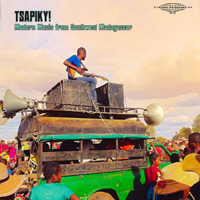
Many sub-Saharan African artists of the past four decades, from Franco to Fela and back again, have covered American funk music, as we are all too aware. More recently the Tuareg guitar bands from the South Saharan desert seemed to reflect the open-ended open-chord jamming of the Grateful Dead in their musical explorations. Now we have found heavy-metal punk in the shape of Tsapiky music from Madagascar, but it is not actually derivative of American or European punk music, that's just a vague musical reference to introduce you to the rawness on display. There is no subtlety here: just screeching guitars, pounding drums and vocalists who are shrieking into the mikes causing all sorts of distortion. However, sometimes that's what it takes to get you moving. The useful liner notes tell us the bands have to alternate between distinction and imitation; they have to know all the current hits to please the audience before they can play their own material. Their concerts are dirt-floor dance parties which can last from three to seven days and celebrate weddings, funerals and other rites such as circumcision parties (?!). Loud-speakers are hung in trees so people for miles around can attend or just listen in. This distinctive music is like no other. In August 2023 Maxime Bobo, a saxophonist, who himself plays in one of these bands, Mahapoteke, attended several of these events and his field recordings were edited for this stellar compilation which is one of the most original-sounding recordings to come out of Africa in a long time. |
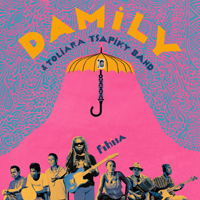 |
DAMILY & TOLIARA TSAPIKY BAND
FIHISA (Self-published)
Our Bristol correspondent Tony spotted this on bandcamp and I jumped on it. It's raw and rootsy music from Madagascar, and it is fantastic. The band who have been playing for 30 years are comfortable just jamming. Toliara is a place in the island; Damily is the largest in the cover photo, holding a Fender guitar which he plays on the first track in a style reminiscent of Remmy Ongala and other East African musicians who migrated from the Congo. The difference though is in the rhythms, the drums are simple, there is added D-I-Y percussion and an electric bass. All I know comes from the bandcamp page where they say there was a live recording going on in the village during a funeral, but then a cyclone hit the straw hut where they were gathered. It's quite intense: apparently they wired the electric guitars through a Chinese-made karaoke system as amplifiers. The mikes were hooked up to Indian loudspeakers. This is familiar last-ditch desperation to anyone who has been in a band! The second track, "Lihy avaratsy," features accordéon and spoons, or washboard? At moments the washboard and accordéon shuffle sounds like zydeco music, but it's from a world away. The planned session had to be compressed to a few hours of live takes, when the rain stopped, but that gives an urgency to the album. "Zavao ny lala" is call and response singing with a gravelly male lead and a high pitched female response, with beaten sticks and thumping percussion: about as roots as you can get. Acoustic guitar comes out for some numbers, played in a more familiar Malagasy style. The album is only 30 minutes long, but packed with great Tsapiky style music. |
|
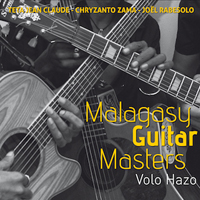
MALAGASY GUITAR MASTERS
VOLO HAZO (Carthago music)
Madagascar entered our consciousness with the wild home-made zither of bicycle spokes on the famous OCORA Valiha albums. Now a generation later three masters of more orthodox six-stringed guitar get together to jam and show off their jazzy chops. They are Teta Jean Claude, son of an accordionist, who plays tsapiky style, which is traditional, though his influences are Hendrix, jazz and blues. Chrisanto Zama is self-taught and a mainstay of the Ny Malagasy Orkestrail who play rhythmic music for wrestling matches as well as funerals. Joel Rabesolo is considered one of the most versatile guitarists on the island and also loves jazz. At first I heard Georgian bouzouki music in here, but that is possibly the last influence you could expect. As you know Madagascar is a big island off the Southeast coast of Africa, so the mainland influences come from South Africa and Kenya as well as Congolese guitar which influenced everyone. The Kenyan flavor is more likely Taarab than Benga, but there is also the Arab lute music that drifted down from Yemen. The pervasive valiha sound, on the other hand, can be traced to Indonesia, according to the liner notes. There are traditional tunes here, used at various rituals, but also modern ones played purely for entertainment, and if you need a benchmark, say Django, they rip up a wild version of Ellington's "Caravan." The recording is superb: produced by Tao Ravao, himself a guitarist who has recorded D'Gary, Rajery and even Sekou Diabaté of Bembeya Jazz.
|
|
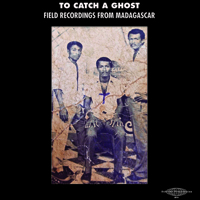
This is apparently the second volume of fields recordings made by Charles Brooks who spends a lot of time in Madagascar. He has assembled a dozen folkloric tracks played on the valiha and other indigenous instruments. The valiha is a unique metallic zither made from recycled wrecked bicycle wheels. The other instruments heard here are equally unique: lokanga (another metallic-sounding guitar-like instrument attached to a gourd resonator), kabosy (more like a mandolin, with four to six strings made of fishing wire), and jejolave (a one-stringed musical bow, like a berimbau, again with a gourd resonator). On the acapella "Banaika" (which closes side A) the harmony singing is interesting because the chorus seems to be on a different "page" from the lead vocals, creating wonderful counterpoint and tension. Side B kicks off with dueling pennywhistle flutes and a soft susurration like a rain stick which mimics the sound of insects. Prosper Razafimamdimby comes in with a "5-stringed violin", though it has the plucked metallic twang of the valiha. He has a pleasant soft but raspy voice that matches the tone of his instrument.
|
|
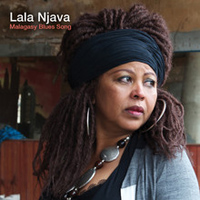
LALA NJAVA
MALAGASY BLUES SONG (Riverboat TUGCD 1069)
With her throaty voice, Lala Njava may remind you of Cesaria Evora or other African songstresses who have broken through to Western listeners. Njava has a good shot at this hope for a breakout with her strong solo debut. The opening track, "Soa Gnanay," has familiar instrumentation: acoustic and electric guitar, bass and drums. There's a ton of echo on the guitar, but just as it starts to get deep, it ends. All the songs are short. She has a cracked bluesy voice, which you will love or hate. For the second cut an accordeon and a banjo join in. Her band is a family business (including her sisters) and as Njava they moved to Europe in 1990 and cut some tracks for Deep Forest, who should remain nameless. Despite her new base, she still sings about Madagascar and the many problems in her homeland: strife and the struggle for women's rights. The guitarists have been listening to a wide range of music: I can hear a Malian influence in the acoustic guitar (on "Sweet Lullaby") played by Dozzy Njava, as well as Nigerian afro-funk in the bass (on "Pardon à l'Africa") played by Maximin Njava. This is a very enjoyable set from some highly accomplished musicians.
|
|
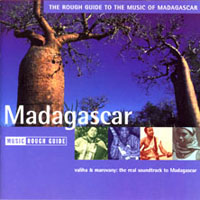
ROUGH GUIDE TO MADAGASCAR (RGNET 1163CD)
Sailing south down the East coast of Africa we come to Madagascar, a huge diversified island with a lot of interesting music. Back in the 70s we grooved to the OCORA Valiha album with its eerie sounds coming from plucked bicycle spokes & brake cables. Like other strife-torn African countries Madagascar has musical currents that thrive in adversity. Ian Anderson (of Froots and not Jethro Tull, I imagine) put together this album which starts with the pop sounds of Jaojoby from, it seems, years ago. Their four bars of fame are a speeded up version of "Hey Joe" proving that good pop riffs never die. But then there are musical affinities that recur coincidentally, so it's probable that D'Gary knows Bert Jansch's "Blackwater side" from the first Led Zep album, but can I really say it's the source of his "Zera Somondrana"? This is a pure pop album which may not wear as well as the deeper folkloric stuff, although the persistent valiha and percussion drive of Daniel Tombo's "Taraka" is folksy enough, and really gets under your skin. The other folk tracks are the most appealing to me: Vilon'Androy's fiddle piece has foot-stamping accompaniment that is supposed to echo the sound of cattle rustlers. Toto Mwandjani's dombolo guitar is bright and accomplished; Claude Teta of the band Teta plays blistering, skirling pop guitar that reminds me of Bikutsi music. But there's a lot of lightweight fluff on here, like the cute furry lemurs that populate the island. Maybe it's the French influence, or the sea shanty detritus that washed ashore in some accordion parts, transposed to indigenous instruments like the marovany. The speedy dances, in 6/8 time, dominate the pop stuff on here and it is exhausting but fun if you are in the mood to bop about.
|