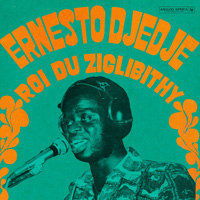
ERNESTO DJEDJE
ROI DU ZIGLIBITHY (Analog Africa AADE015)
Samy ben Redjeb continues to amaze us with his musical revelations. In some ways he is following in the footsteps of Günter Gretz, who put out 50 essential CDs and LPs in the 80s and 90s. The original idea behind Popular African Music was to showcase each genre of African music, with gems from Sam Mangwana, Youssou Ndour, Philip Tabane, Baobab, Balla et ses Balladins, and Kante Manfila setting the course. Ben Redjeb seems to have had a similar mandate, starting out with Green Arrows and Hallelujah Chicken Run Band of Zimbabwe, before getting deep into a Benin groove in the first decade of this century. He too has unearthed great music from Senegal, Cabo Verde, Mali and Angola but also branched out to Brasil, Colombia, and beyond, and in a similar time period has issued over 100 recordings of infinite value to DJs, collectors and aficionados of world music. This new LP is a 4-track reissue from Ivory Coast's Badmos label, containing dance tracks from the 1970s. The reason I thought of Popular African Music was Günter touched on Ziglibithy in his "Reminiscin' in tempo" series of "Dancefloor classics". In fact the second track on here, "Ziglibithiens," was also the second track on PAM ADC 305 by Ernesto Djédjé, which included most of his great first album Vol 1 (on Badmos). This Analog Africa disc is not a rival to the PAM compendium, which was an overview, but rather a hot slice geared to the dancefloor. Djédjé was a promising young guitarist who dropped out of Amédée Pierre's band Ivoiro Star to go to Paris and study computer science. There he met Manu Dibango and cut a few singles. On his return home in 1974 he looked to start a new band; they went on tour to Nigeria and were blown away by Fela. Fusing Makossa, funk and disco with traditional Bété rhythms proved a huge success for the Ziglibithiens. To capture the excitement of their new sound, Badmos, the producer, sent them to EMI studios in Lagos and arranged for Fela's engineer to record them. Ignace de Souza of the Black Santiagos was brought in as arranger. The first two singles were smash hits and soon led to a whole new genre of music, called Ziglibithy. After six years and a few albums Djédjé died suddenly in 1983 but his music continued to grow in popularity. It was in Colombia where the sound systems accorded the song "Ziglibithiens" legendary status. The album shows Ernesto dressed like a true funk star in a teal stage costume with bell-bottoms and a wide-cut vest and hairdo reminiscent of James Brown. He is right there, bringing the churning funk, with a good deal of soul to boot.
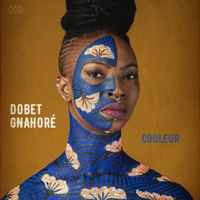
DOBET GNAHORE
COULEUR (Cumbancha)
This is the sixth album from the Grammy winner who broke out a decade ago with electrifying videos and music. It was recorded during the lockdown and has a pan-African sound though not much evidence of the Ivory Coast where Gnahoré grew up. In 1999 she moved to France and soon after began touring the world, explaining that she is restless when she is not on the road. With Contrejour, a Belgian label, she issued four albums. This is her second release with Cumbancha. She was the hit of WOMAD 2010 and won a Grammy for her collaboration with India.Arie. She toured the world with a show called Acoustic Africa so rubbed shoulders with Habib Koité and Vusi Mahlasela on the bus and backstage. She has a great range with her own voice, modeling her singing on Miriam Makeba and Angelique Kidjo, who are also known as dynamic performers. The production here is more rock and roll than folk with stinging guitar riffs from Louis Stephen Djirabou and loads of studio effects on the synth and vocals, but the mechanical drum tracks are kicking. The songs celebrate women's rights and positivity in challenging times; the CD includes the lyrics in English and French. One song in English, called "Woman," is disco and I find it irritating, but it is followed by a soukous track "Vis ta vie," which perks up and even adds a South African vibe to the outtro (In one of the sleek Vogue-like liner photos she is wearing South African beads). Stand-out tracks include "Lève-toi" and the last number which is, as you can imagine, an "everybody get up and dance" groove which actually says, in Kulango, "enough touring: I want to go home to my daughters."
EBA AKA JEROME
SAA KO FAA, vol 1 (downloadable from EMusic, 7digital and elsewhere)
(Once again I am indebted to Ken "Yatta" [not Jomo] for bringing a great CD reissue to my attention.) Here is an hour of uptempo Ivorien music with High Life and Soukous blended. Another friend heard this and excitedly asked me, Who is Eba Aka Jerome? I had to admit I had no idea. (Zim Bida sends a visual discography from Akabola's blog, but there is still no information.) Jerome's 1978 LP Trahison came out on the Papa Disco label but, typically of albums imported into the US in the '70s, the importer razored off the label info to prevent anyone from short-cutting to his sources. The song "Trahison (Betrayal)" sold a million copies in West Africa in 1978. It's one of those glorious work-outs that last the whole side of an LP -- twenty minutes! (He urges the band on for four minutes & gets them cooking, before singing the first verse. Funny such an upbeat and lively song should be about a treacherous girlfriend who betrayed the singer.) One has to assume the visiting Zairois bands of the era caused this seismic shift to dancefloor workouts with building tempo. There are definite echoes of the African All-Stars' style of lead and mi-solo in the guitarwork. The only info on my copy of the album is that the band is Le Sanwi Star, and of course there's less info on the MP3 download page. Jerome also made it to Sound d'Afrique, the Mango compilation LP that came out in the UK in 1981. The "Best of, Volume One," available on-line for download, comprises the first two tracks of Trahison, sometimes called Wonderful of Africa vol 1, "Adeba" from the Je T'aime album, "Aboisso amha" from Mariama and another track, "JB Mockey" which I have not located in his published LPs. The third song on Trahison, "Djiblito," was remade at some point with a syndrum added; I prefer the 10-minute version on the vinyl release to that here. Next to Francois Lougah, Jerome is probably the biggest star from Ivory Coast of the late '70s early '80s and is apparently still recording today, though most of his later music is too synth-laden for my taste. He sings with a warm baritone, reminiscent of Tabu Ley in some places. This is a great disc, worth seeking out in higher quality download.
ZIETI
ZEMELEWA (GriGri Discs GRIGRI04)
Ivory Coast was in the news in early 2012 as fans worldwide followed their team's progress in the Africa Cup of Nations. The elephants' success was being widely celebrated as giants like Senegal went out with a whimper. I found some Ivorienne music that is also global in its sweep. Half of Zieti is Yeoue Narcisse, singer, and Tiende Laurent, guitar, but the big sound of the album indicates there's more going on here. There's a pleasant 70s feel to the music, with organ, trap drums, live horns, and insistent bass. Apparently drummer Alex Owre and guitarist Michael Shereikis, the other half, met the two Ivoriens while living in Abidjan and developed a musical rapport with them. They jammed for a couple of years and performed on the beach adjoining Abidjan's shanty town, then finally went into the studio to record a ten-track album. Unfortunately those tapes vanished after the Americans had been repatriated in 1999 and the country descended into civil war in 2002. So they started over, by remote. After the Ivoriens' songs were recorded, the tapes were mailed to Silver Spring, Maryland and the other instruments were overdubbed. There is nevertheless a live feel, and it would be great to think this album will succeed and allow the musicians to actually play on the same stage at the same time. At Studio EZ, Owre's drums were added; at The Treehouse Brian Simms added keyboards and accordion. Then at Rootstock Studios we find Shereikis with his guitar, bass, and percussion, as well as djembes, saxophones, and other percussionists drawn from his bandmates in Chopteeth and emigrés in D.C. From a small stumbling start a grand opus has emerged. The full sound is rich, the songs go from lovelorn ballads to out and out jamdowns. The musical rapport is intact, across an ocean. And a wonderful side-project has developed, which is to send instruments to Abidjan to help the ever-evolving music scene there.
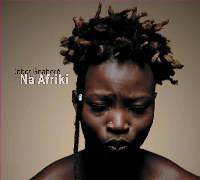
DOBET GNAHORE
NA AFRIKI (Cumbancha CMB-CD4)
Dobet Gnahoré comes from Ivory Coast where she grew up in an artists' enclave. Her father was a famous drummer and by the age of 12 she had dropped out of school to stay home and learn music. But there were dancers, actors, puppeteers, painters, sculptors, poets and dramatists all living in this community, a rural idyll set in the bustle of Abidjan. A French guy showed up with a guitar and stayed three years, taking the teenager back to Europe in 1999 and in 2006 she was nominated for a BBC Radio 3 Newcomer Award. I saw her on the Acoustic Africa tour and was not particularly impressed, but this new album showcases her fine singing and is well arranged. "Inyembezi zam (My tears)," sung in the South African language Xhosa, has an irresistible groove. She also sings in Malinké, Wolof, Lingala, Fon, as well as the languages of Ivory Coast. "Ma poo (My breath)" has a soukous kick to it that picks up the tempo after a few sleepy songs. However it fades just as it gets to a breakout point. Then we get some pygmy hocketing for a minute, and right back into a ballad. Gnahoré shows many facets on this disc, her sentiments are heartfelt and earnest. It's true good songs are also social comments, but I found all the songs about Massacre, Incest, Pillage and Mourning too preachy, and felt she was over-reaching in trying on so many styles. Still Dobet Gnahoré deserves to be heard.
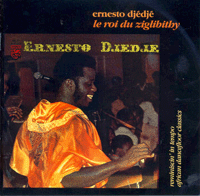
ERNESTO DJÉDJÉ
LE ROI DU ZIGLIBITHY (PAM ADC305)
Like me, you've probably heard of Ziglibithy, a musical style from the Ivory Coast, but couldn't really describe it. Now is your chance to get inside the music with the King of Ziglibithy, Ernesto Djédjé. Parallel to the archival work at RetroAfric there is Günter Gretz, musicologist of Frankfurt and genius behind the POPULAR AFRICAN MUSIC label, all of whose products are carefully considered gems. Gretz is responsible for bringing back Balla et ses Balladins, and finding Super Cayor de Dakar, among other coups. The fifth entry in his African Dancefloor Classics series is devoted to Ernesto Djédjé, LE ROI DU ZIGLIBITHY, and compiled from two of his hit albums released in the Ivory Coast in 1977. Ziglibithy is Ivorienne music but adapted from black roots music like afrobeat, rock, blues and soul. You might even detect a taste of reggae in the rhythms. With his afro hairdo and flashy clothes, Djédjé was a huge star in his native land. His songs are in his Bété language but the music is international, articulated in complex rhythms, ornate finger-picked electric guitar and crashing horn lines with the trumpet never sure what key the saxes are in. But the groove is there and the instruments are carefully separated so there is air in the songs as the beat comes apart to snare drum and hissing high-hat. The bass returns and the heat builds slowly as the horns fall in. Djédjé was opposed to the "Congolisation" of African music and thought the local rhythms had more than enough to offer the Ivoriens. In 1972 he said, "We should refine our folklore in order to popularize it among the white civilizations, whose interest in African music is growing and growing." In another interview, three years later, he said, "In 1970 the Ivory Coast was the number one importer of records in Africa. This is really a shame in view of the 72 peoples in this country with all their varieties of music. Within two years I will impose an Ivory Coast rhythm." He succeeded spectacularly with the Ziglibithy, adapted from a traditional Bété dance that was originally backed exclusively by drums. Djédjé died in 1983 at the age of 36 of an untreated ulcer (his mother said it was witchcraft). Had he not died he might have attained the international popularity he richly deserved, but thanks to Günter Gretz we can relish this rich moment in popular African music. (Also check out his home page for his perspective on the latest African music releases.)
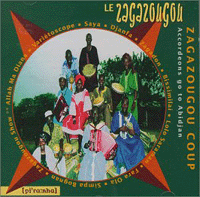
LE ZAGAZOUGOU
ZAGAZOUGOU COUP (Piranha pir 49-2 1993)
Ivory Coast is often considered a musical crossroads. Since independence in 1960 the most popular artist has been reggae superstar Alpha Blondy, but the country has had waves of musical influence from neighbouring Ghana as well as the huge success of soukous. Sam Mangwana brought his African All Stars to play and stayed, then businessman Abdou Lassissi recorded Empire Bakuba and other hot acts in Abidjan the late 70s, releasing them on the SACODIS label. Contrast the music on this CD with the processed muzak one generally hears on the airwaves and you feel the distance we in the West have come from real music. In fact, this album sounds so stark that many folks may not hear it out. This is what is meant by roots music: it's fresh and unpretentious. Subtitled "Accordeons go to Abidjan," it has an urgency to it that reminds me of the MUSIQUE URBAINS À KINSHASA field recordings done by OCORA in 1978. The rollicking Goumbe percussion adds a thudding underpinning to accordion; the heartfelt vocals are perfectly poised. The music is vaguely reminiscent of Zydeco two-step. The group obviously listens to pop music, as a name-check for Franco and OK Jazz on track 7, "Lolo Saraman," attests. The whole thing is wild and catchy. Since its debut in 1992, Le Zagazougou has garnered a huge following in Ivory Coast despite the contempt usually accorded the accordion.