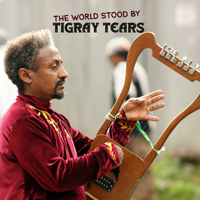
TIGRAY TEARS
THE WORLD STOOD BY (Worldisc)
The world is doing a lot of standing by, it seems to me, as one atrocity after another is allowed to continue and our elected leaders do bugger all to change their stance or bring the planet together. As Russia was invading Ukraine, the Ethiopian army took out a large swath of the population of Tigray, killing rebels and civilians alike until over half a million were dead and two million were displaced. Now there is potential of a war with Eritrea, while the nearby displaced South Sudanese have nowhere to go. I remember running into a panhandler in Khartoum 40 years ago. He was dressed shabbily but spoke English and was very friendly. "I am from Ethiopia," he told me, "I got out of jail tomorrow." The Tigrayans exiled in the Ethiopian capital are gathering the remnants of their life around them and making music to express their plight. Accompanied by a lyre (the five-string krar) and hand-claps, they sing "No Matter Where I am, I miss Tigray," "What is the World saying about Tigray?" and "Remembering the People We Lost in the War." A touch of tenderness appears in songs like "People should Live in Love" and "Let Us praise Kindness." The album was recorded in Addis Ababa and Amhara. It is simple and forceful. There is a tiny bit of vocal processing on "My heart pleads for your forgiveness" and the opening "Wishing for peaceful times to return." It's authentically folkloric (without any outside interference) and stripped down but the variety of singers makes it engaging.
HAILU MERGIA
PIONEER WORKS SWING (LIVE) (Awesome Tapes from Africa)
This 2016 recording, made in Brooklyn, marked Mergia's return to the spotlight. He emigrated from Ethiopia to the US and spent a decade as a cabbie in Washington, D.C., no doubt enduring all sorts of patronizing comments from customers who overheard his cassette deck and inquired casually what he was listening to. "I was a big star back in Addis!" — That's nice, I'm sure. Ethiopian music is very recognizable: the keys, the instrumentation and, as far as cassettes go, the absolutely wretched sound quality. So this album is a refreshing change as it is a professional made live recording of his D.C.-based trio. It's instrumental and very jazzy, though more Ray Manzarek than Jimmie Smith in terms of the mood. His accompanists, Kenneth Joseph on drums and Alemseged Kebede on bass, are the perfect foil, driving the rhythm to leave space for the busy fills of semitone clusters of the star, who takes a turn on an accordion on "Hari Meru Meru." He also plays a Yamaha DX (on the "Hammond" setting) and a Melodica (on "Anchihoye Lene"), so his keyboard sounds cover a wide range. And at 77 he has had plenty of time to work up his repertoire, turning it to a finely honed point. "Belew Beduby" is transformed from its earlier incarnation in 1985. He visits a couple of classics from the Ethiopic catalogue: on "Tizita," he plays it twice, once as a straight cover, then "my way," as a jazzed-up take on the organ which the rhythm section also get into. This is a welcome release for fans of the genre who have long wanted something more substantial, and better recorded, to dig.
IFTIN BAND
THE AL-URUBA SESSIONS (Ostinato Records)
Though billed as "Mogadishu's finest", again I am all adrift trying to get a handle on this. First the sound quality is weird: too much echo on the vocals, some kind of tinny synthesizer and the guitars very hot in the mix. This band played a hotel gig in Somalia's capital during the 1980s and cassettes were run off which explains the poor sound, but of course, die-hard fans want that element, since they associate rubbish cassette quality with authenticity. Once you are resigned to the awful sound and the piercingly high vocals, the guitarist does seem to have chops emerging from the morass of thumped drums, and blur of organ and horns. "Hobolada Hooyibo," a reggae tune, is popular on bandcamp, but the sound is louder and harsher here than before. And it gets worse! Despite rarely listening to Somali music, it all sounds very familiar actually. I searched my archives and found Mogadisco: Dancing Mogadishu, which came out on Analog Africa in 2020 and sure enough, there are two tracks by Iftin Band on there. And that's really enough for me. I guess you had to be there, but then you'd be old and deaf by now anyway.
HAILU MERGIA & THE WALIAS BAND
TEZETA (Awesome Tapes from Africa ATFA 041)
Bandcamp thought since I liked Kolonel Djaffar I would also like Hailu Mergia, but I can't say I do. I know real Ethiopian jazz has a huge following, maybe because of the "exotic" timbre of the pentatonic scale and key changes where they flatten the 2nd and 5th, but to me it all gets stuck in a rut. There's no modulation or differentiation between songs. If I were on the nod I would probably appreciate it as a subliminal background noise, but the musicianship doesn't inspire me. As you may be one of the people who disagrees with me and finds it intriguing I will mention this album. In the 1970s the Walias were a pioneering band in Ethiopia, introducing Western instruments and playing what I would call Lounge music at the Hilton Addis. No songs, just background music, which was soon adopted by the TV station -- as background music. Many famous musicians passed through their ranks. In 1981 they were reluctantly granted permission to tour the USA and four members decided to jump off and not come home. Hailu plays the noodly organ which ebbs and flows. This album came out on cassette in 1975 and Addis Ababans bought it from the band as it contained many popular songs redone in "classical" i.e., instrumental style. A couple of the tracks are slightly more lively, but once the Codeine took over it was all a blur.
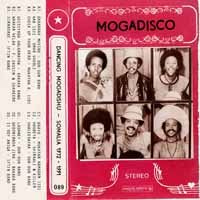
MOGADISCO: DANCING MOGADISHU 1972-91 (Analog Africa AACD089)
Fortunately this is not ALL disco or I would not review it. The 70s were a bad era musically for those who lived through it, and bands who imitated the Bee Gees, Chic, KC & Sunshine Band etc should be shunned not celebrated. I feel the same about African funk which we have finally exhausted. Why listen to bad imitations of James Brown or Kool & the Gang when you have the real thing? As usual, the engaging thing about this package is the "further adventures of Samy" which you can read while listening to the disc. Mogadishu is in Somalia which has been in the grip of a civil war since the last century, and only a madman would want to go there, even if he was hoping to find rare music. Just the other day scores of people were blown up by Al-Shabaab (79 dead) probably because their favorite diner, Al-Kebab, was closed. To prepare for his trip label-boss Samy ben Redjeb wrote several hotels to find out about accommodations. Mostly they wanted cash in US $ and offered add-ons like armed bodyguard for $1200 a day. In the end he did need armed guards at all times. When Samy got to the radio station archives he only had a few names, but they dug out tapes for him to copy. You've heard of Dur-Dur band who have three tracks here, but probably none of the others. The second track, "Hug me" by Omar Shoolil is a reggae cover ("Hold me tight, my baby" may be the original) -- tight organ and sloppy drums make this stand out. The reggae beat is paralleled in an indigenous rhythm called Dhaanto which Shoolil used to update a traditional song. The percussionists on "Brave fighters," a political song by Bakaka are much more assured. They later became Dur-Dur. Iftin Band give us "No secrets" and "Cry for me" which have ample ghostly organ, more Joe Meek than Ray Manzarek and part J-Pop. Mukhtar Ramadan Idii performs a cover of the Meters' "Fiyo on the Bayou" mixed with War's "Slippin' into darkness." However the source is not credited, nor is Carl Douglas mentioned for his "Kung Fu fighting" which morphed into "Ladaney" by Dur-Dur Band. And despite claims of Dhaanto being the source of reggae, Jamaica is clearly the origin of "Choose freedom," the fine second entry from Bakaka. This is an interesting album: having got past covers of "Lady" by Fela, the Somalis were exploring Michael Jackson, funk-era Temptations and Bob Marley, as their country slipped over the brink indeed, into darkness. Siad Barre's military dictatorship collapsed along with the economy by 1991 as the whole country became a failed state and sank in civil war.
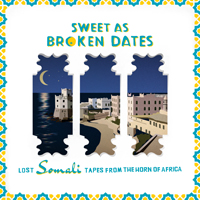
SWEET AS BROKEN DATES
LOST SOMALI TAPES FROM THE HORN OF AFRICA (Ostinato Records)
Fans of the interminable Ethiopiques series or "Lost tapes from Africa" may want to check out Sweet as Broken Dates, a collection of (previously) lost tapes from neighboring Somalia recorded in the 1960s and 70s and released on Ostinato Records. I have listened to it a few times and despite some intriguing hooks, the sound quality is so warped I cannot get into it except in small doses. I am not averse to the music, in fact the distortion factor reminded me a bit of actually being there (in my case Sudan, not quite in the "horn") and hearing distant radio from a transistor fed over a tannoy system in a big public square, so that the music wafted on the breeze as the signal waxed and waned, and mixed with the evening sounds and smells. It's a magical experience and I hope it's one you have had somewhere on the planet. A poet once said there's nothing as lonely as hearing your own pop in a distant land, but that is unlikely now since most pop is a global phenomenon. I had that experience, too, in 1978, in Peru when I was wandering in the backstreets of Miraflores and came to a small square and the tannoy-attached radio was playing "Roxanne" by the Police and I suddenly felt very far from home. But listening to what the locals are listening to is a much more grounding experience and a better souvenir of specific times and places. Now few of you reading this can remember Somalia in the 60s so where does that leave us? Cheesy organ, slap-happy tambourines and vocals in arabic: if that's your thing, here you are. The liner notes are intensely detailed and the booklet is lavishly produced, even detailing the attempts to track down rights holders, but since Somalia in the 60s was a socialist state there was no private ownership, and the music was produced for public broadcast. At the time people would tape it off the air on cheap cassettes and then mass-duplicate them. You know what the result sounds like. There are a few western influences, but even more Indian and Sudanese strains to be heard. I almost said Sundanese since there is also an Indonesian feel to some of the scales. There's one reggae-feeling track, called "Mama." In that regard the music from Hargeisa & Mogadishu has a parallel story to the music in Addis from the same time. In this present instance, however, the fuzziness is not a guitar effect but something left on those overworked tape heads.
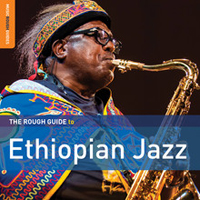
ROUGH GUIDE TO ETHIOPIAN JAZZ (RGNET1350CD)
I know this genre has many fans. The Ethiopiques series on Buda has been growing for two decades now. In a recent interview Samy Ben Redjeb, the force behind the pathfinding Africa Analog label, said he was working on something Ethiopian, after meeting Alèmayèhu Eshèté, but the tracks he wanted ended up on Ethiopiques #28. Historians of the music say Armenians were sent there to train army musicians 40 years ago. Military and police bands were the source of the Ethiopian jazz movement. The pioneers include Mulatu Astatke who went to Wales to study engineering in the late 1950s but ended up getting involved in music instead, going on to Boston to study at Berklee College, where Quincy Jones, Jan Hammer, Juan Luis Guerra, Roy Hargrove and Donald Fagan also studied. Although most Ethiopian music is based on a pentatonic scale, Astatke found a diminished 12-tone scale among the Derashe people of Southern Ethiopia and wanted to foreground this in his music. By the late sixties Astatke was transforming the music scene in Addis with input from Gétatchèw Mekuria on saxophone. In 1973 Duke Ellington came to town with his orchestra and jammed with the locals. However only a year later a Soviet-backed military coup took over and imposed a curfew. It was not until the collapse of the Soviet Union in 1991 and the failure of the Derg dictatorship in Addis that music re-emerged. In 1997 the Ethiopiques series was launched by Buda. I bought the first few then decided I didn't need 30 albums of exotic jazz, though no doubt some will say I have missed out on a great experience. (Liner notes include sentences like: "Mercifully we have not identified the alleged trumpet player," so you can guess what's in store in some of these tracks.) "Out jazz" I don't mind, but Out singing makes me edgy as manifest here on "Aykedashem Lebe" by Tlahoun Gessesse. Gabriella Ghermandi, on the other hand, sings like she listens to a lotta Lata Mangeshkar. (She has also published a novel in Italian.) Overall this is a fine introduction to the music, with some intriguing arrangements and the occasional shining talent on piano (Samuel Yirga), fiddle or sax. While Ethiopiques has put out a couple of samplers, this one takes three cuts from them and the other six are drawn from Daptone, Real World, Jazz Village and elsewhere.
LIGHT AND SOUND OF MOGADISHU (Afro7 AFRCD01)
I like Nilotic oud music, and once you get past Lake Turkana into Kenya I am all ears, but for some reason Ethiopian and Somali music doesn't grab me. Nevertheless I feel I should alert you to this new release because you may like it and in fact run out and buy it, and I wont stand in your way. It's eight tracks -- 42 minutes -- of rare grooves you've never heard before, assembled by the tireless Fred Lavik of Afro7.net -- one of the best and last places where you will find this kind of music for sale as original 45s, many of them previously unplayed. The first four tracks are from the Sharero Band who really work the seventies funk groove. Their leader, Ahmed Naaji, on organ, came from Somalia and worked at Radio Mogadishu as a bandleader, bringing Santana and James Brown sounds to town. The grooves are superb, it's the singing I can't take, I am sorry to say. Lavik licensed this compilation from the Light & Sound label and has tracked down the original artists to tell their stories (The detailed liner notes were written by Matthew Lavoie, formerly of the Voice of America). It's clear they were all much beloved throughout Somalia and the current tragic state of that country needs no explanation: suffice it to say the survivors are all expatriates now. In one bright note and a hope for renewal, John Beadle of the Likembe blog sends a link to an article (and video) about the ongoing effort to digitize the reel-to-reel tape archives of Radio Mogadishu. The second half of the disc (or B side of the LP) contains more traditional tunes, at least old melodies and instruments that remind me of John Storm Roberts' LP Jamiila -- Songs from a Somali City (Original Music, OMA 107) from 1987. The last three tracks are by a popular singer, Magool, who died in 2004 in Amsterdam. They are her hits from 1973.
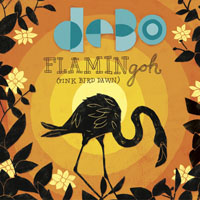
DEBO BAND
FLAMINgoh (Pink Bird Dawn)
Readers sometimes ask me why I don't have a bigger Ethiopian section on here. I figure if you are into Ethiopian music you can buy all 500 volumes of Buda's Ethiopiques series and you will be happy. To me the sound is a bit too unworldly. I like some of the jazzier stuff, and even the odd funk or pop track, but the vocals, for the most part, are too much for me. Boston-based Debo Band is not that alien: they are a retro band playing 70s and 80s style Ethiopian funk. The vocals do sound strained to my ears, but there's rock guitar and jazz horns to counterbalance it. This is a live recording and they are clearly into it. It's only a 4-song EP but is packed with energy.
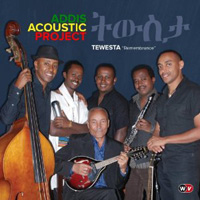
ADDIS ACOUSTIC PROJECT
TEWESTA ("Remembrance") (World Village 468091)
The answer to my problem with Ethiopian music is here. The melodies of the 50s and 60s, familiar to us from that endless series of CDs on Buda are revived in a different context. Instead of cheesy Farfisa and electric guitar we find mandolin and accordion. There's acoustic bass, and instead of fat horn lines a single clarinet. The whole thing has been toned down and made mellow, so mellow it's almost in the 'easy listening' category, but it has a jazz bite to keep your attention. The band is made up of veterans of the Addis scene. Formed by the accordion player Girum Mezmer, he tried out different permutations until he had the sound he wanted and then they gigged in Addis for two years before recording this, their debut album. Consequently it's really polished. The repertoire is mostly love songs. There's the occasional guest: Sudanese oud player Mahmed Elmak appears on "Fikir ayarejim (Love is eternal)" and "Enigenagnalen (We shall meet again)," a folk song, features mandolin and clarinet. The music is authentic yet has been updated with a jazzy sensibility which makes it timeless.

ETHIOPIQUES 8
SWINGING ADDIS (CRC 829282-2)
Some people can't get too much of a good thing, which is why the Ethiopiques series has now reached close to a thousand volumes. For me a little goes a long way. I have one album, Ahmed Mahmoud's ERE MELE MELA, that I like, on vinyl. I had it before the Ethiopiques series came along. It too has been reissued as part of the series, number 7, with extra tracks which don't improve it: in fact I prefer the LP, without the alternate takes. This is strange music, R&B backed, sometimes Bollywood-flavoured, strangely familiar but certainly strange. To me it's a music of extremes: either there's soporific sax or stressful singing. I am not comfortable with the Ethiopian vocal style and whenever there's a familiar sound, like a guitar solo, it seems highly derivative. When people would bug Cheb i Sabbah to play a certain tune he would ask them if they had the album, when they said yes, he would tell them to rush home and listen to it! When pseudo-hipsters would call during my radio show to ask for Ethiopian music I would put on Jabba the Hutt's palace band from the Star Wars soundtrack. Check it out, a pure Ethiopique groove! (It was one of the few things in the station library I could play, everything else was planned and brought from home in a large post office mail tub.) But just to make you ETHIOPIQUES devotees happy I present one outstanding album from the series. Alèmayèhu Eshèté (included here with 6 selections) is one of the best exponents of this music. His largest debt is to Soul Brother Number One James Brown. But it's not your average afro-funk groove. There's army fanfare guys playing the big horn choruses, cheesy wheezy Farfisa organ, and above all that Amharic plaint. This album is a bunch of hits (we must presume) from 1969 to 1975, put out by AMHA Records, a small local label during the final days of Haile Selassie. Influences from Archie Dell and the Drells to Wilson Pickett are apparent in every song. During the rule of the tinpot demi-urge most music was restricted to the Army Band, the Police Band, or the band of the Imperial Body Guard. AMHA was able to record and issue music without going to the censorship committee because things were in such turmoil. But things got worse after Selassie was deposed and a military junta took over putting an end to the swinging sixties that had flourished briefly in Addis. If you want to dip into the ETHIOPIQUES series this is a good introduction to the funkier (& slightly more accessible) flavours.
DUB COLOSSUS
A TOWN CALLED ADDIS (RealWorld USCDRW155)
Dub Colossus is Nick Page, I don't know how big he is (the only other colossus I know is Rhodes which is reduced to submerged ankles), but dub he does. Page started out working with Steel Pulse before taking up bass and mixology himself. He was a founder of Trans-global Underground and a major part of their 6 albums, writing, performing and producing. Now he is indulging his passion for the Ethiopiques series of CDs on Buda Musique which document the sound of swinging Addis in the waning years of the reign of Haile Selassie before the oppressive military regime of Mengistu wiped music off the sand-encrusted map. For A Town Called Addis he found some of the old nightclub crooners and musicians still extant and added a 70s dub sensibility. Imagine playing the Mighty Diamonds in one channel and Alemayehu Eshete in the other, but ultimately that's as close at it comes. Saxophonist Feleke Hailu (a classical composer, lecturer and head of music at the Yared Music School) sounds a bit like Kenny G, maybe it's just the echo, but then the pianist Samuel Yirga also opts for space rather than sound. Teremag Weretow adds his plaintive voice; while his messenqo, a scrapey one-string fiddle, is the most interesting non-Western instrument here. The Dub takes away the exotic edge of Ethiopia but it still has a dreamlike quality as snatches of organ or flute float by. It's not earth-shaking and I don't know how much I will listen to it, but it's worth checking out.