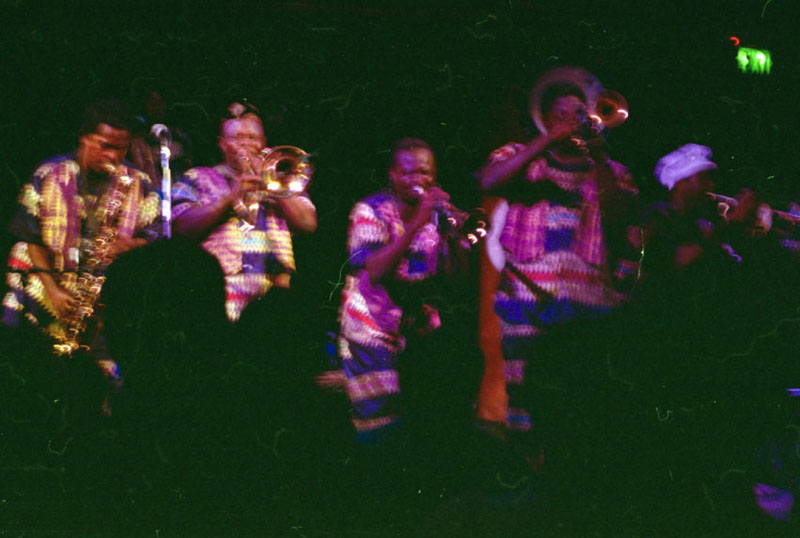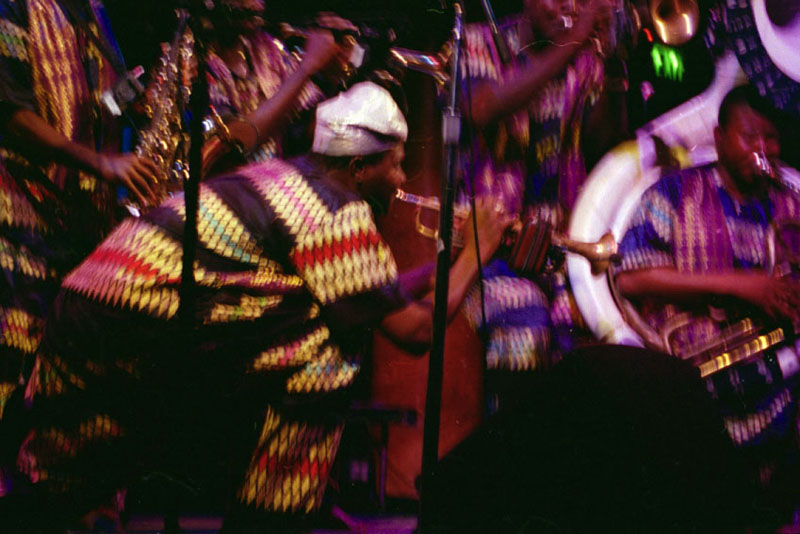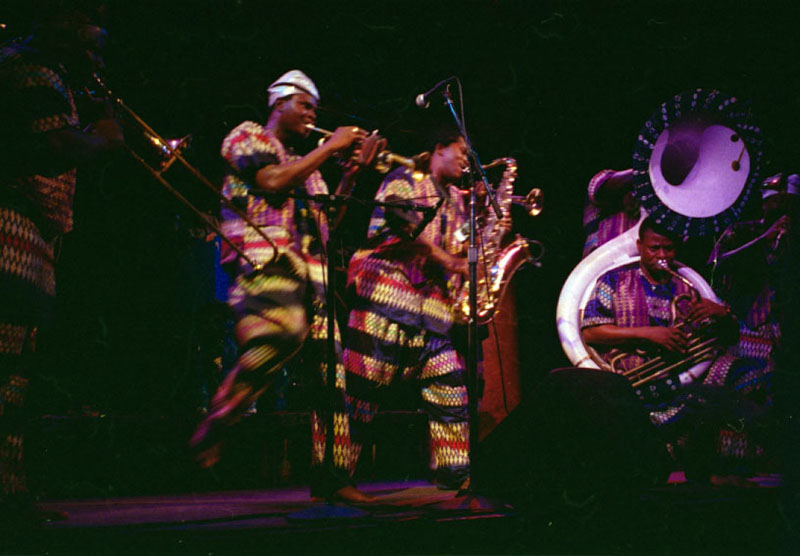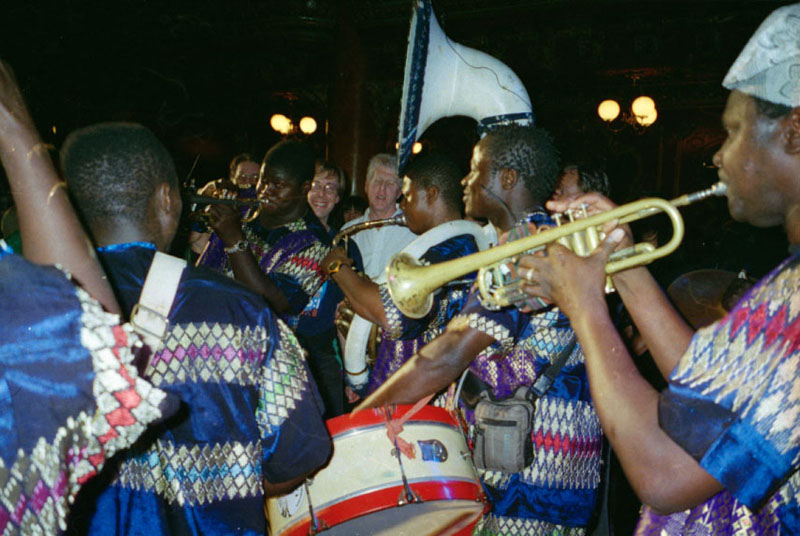
ANTOINE DOUGBE & L'ORCHESTRE POLY-RYTHMO DE COTONOU
1977-82 (Analog Africa AALP104)
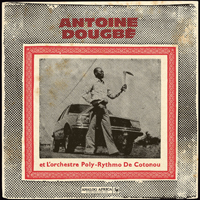
That orchestre Poly-Rythmo are now a household name (at least in our households) is due to the efforts of one person: Samy ben Redjeb, founder of the Analog Africa label. Benin was a relatively sparse part of our record collections until we discovered Gnonnas Pedro in the early 80s. But Pedro and his Dadjes as well as orchestres Les Volcans and Poly-Rythmo were on the radar of Samy when he issued four albums in 2008-9: African Scream Contest, Legends of Benin, The Vodoun Effect and Echos: the latter two featuring orchestre Poly-Rythmo de Cotonou. His enthusiasm led to the band being reformed after a 35-year hiatus, and touring Europe, and further reissues from their vast catalog, including the resurrection of the label Albarika Stores (by Acid Jazz records) which continues to reissue their albums. Analog has given us tastes of Dougbé before but now his three albums have been sampled to make an essential compilation. Dougbé was a Vódou adept but interestingly, neither a singer nor a musician. At least he never performed, but rather took his songs to Poly-Rythmo, who were the main studio band in Benin, and they recorded the music. So although he is posed looking like a rockstar on the cover, standing in front of a new car, holding a machete and an adze (Shango's symbol is the double-headed battle ax), he is only present in the recordings in the background, sitting in the studio, nodding along to the interpretation of his tunes. His religious practices led him to be dubbed "The Devil's prime minster" and this doubtless inspired awe in those musicians who encountered him, but his day job was as a bureaucrat in the office of Social Security Administration! Like others in Cotonou, as a young man he liked Cuban son and Congolese rumba. He particularly liked the Cavacha sound associated with Zaiko Langa Langa. Dougbé took his songs to his friend Melome Clément, band leader and arranger of Poly-Rythmo and sang them while slapping his legs. He called his sound Afro-Cavacha. While some musicians doubtless feared him, the Poly-Rythmo rhythm section, bassist Betho Gustave and drummer Yehouessi Leopold, were also Vódou adepts and so Dougbé respected them. This meant they were also familiar with the Ogbon rhythms played on a talking drum in ceremonies invoking Shango, the warlike Spirit of Thunder (who had crossed the Atlantic with the captives, finding a new home in the New World). The percussion is crucial (definite signs of restless leg syndrome in the drumming), the horns sometimes raggedy, and there is a synthi keyboard, familiar from the Gnonnas Pedro sessions. This is an intense high-energy set. There is a Cuban feel to the guitar in "We tayi sin assi tche," the opening cut. The Cavacha influence is most evident on "Vile de nan gni noude." (I tried google translate to figure out the lyrics: if it's Fon it means "Two villages in a knot"; if it's Fula it means "Village of dwarf knots" — I'll go with the latter.) "Towe nin" seems to be a praise song for Docteur Nico. There is a lot of variety in the arrangements, and the vocals (mainly by Bylleday Guissey) and chorus are in the groove, even if we have no idea what the songs are about.
GNONNAS PEDRO
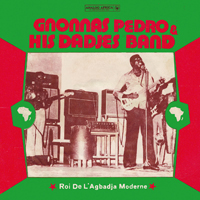
Roi De L'Agbadja Moderne (Analog Africa AALP 100; CD No 40)
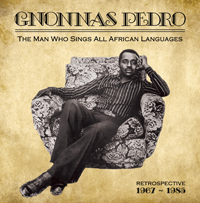
The Man Who Sings All African Languages (Nanga Boko Records NBK 004)
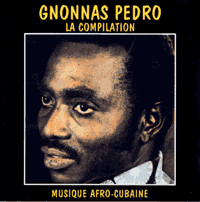
When I started exploring the discography of Gnonnas Pedro, the famed Beninois singer, who straddled Afro-Beat, Funk, the Latin wave and more, I soon realized his legacy was scattered about, some tracks being reissued in France on Ledoux and Syllart, and the odd cut on a compilation. Surprisingly a huge box set came out in Benin in 2007 on the Top Showbiz label with 132 tracks and 8 videos. Now with two compilations released simultaneously on vinyl, we need to re-examine what we find valuable in his work. In the late 70s he and his band the Dadjes released 4 LPs recorded in Lagos. These were called The Band of Africa which was also the name of an earlier series issued in Lagos in 1975. I have two of the later series: volume 1: Kalapchap has two of his great Latin style tunes, while vol 2 has covers of both James Brown and Charles Aznavour, showing the divergent tastes of the time. Gnonnas does have a penchant for bad ballads like "Ahue Viode" which sounds like "Where have all the flowers gone?" He is shown on the cover holding a trumpet and posing with the English caption "I feel alright." Sometime around 1982 Ledoux put out a CD called La Compilation: Musique Afro-Cubaine. This distilled the essence of his work into a dozen tracks, mostly 6 or 7 minutes long, and it became a solid favorite. It is my recommendation if you don't have any Gnonnas Pedro in your collection. A follow-up, Musique Afro-Cubaine, Vol II, added a dozen more cuts. In 1996 he was inducted into Africando, assuring his retirement in comfort. Their third album (Stern's) featured reworkings of two of his hits, "La Musica en verité" and "Dagamasi" (which was his first hit with Les Dadjes in 1977). In 1999 Syllart and Sonodisc put out a compilation called Irma Koi collecting two of his albums from 1983 Mimi Pinson and 1984 Les Femmes d'Abord. The title cut "Irma koi" has echoes of "Africa Mokili Mobimba." In 2011, Syllart issued a two-CD set called La Belle Epoque (one suspects without a contract with the singer) and vacuumed up several works: Africa Tei Cuba, an LP from 1981 on éditions Gnoinsopé (Gnonnas' own label), Agbadja (also Sylla 1999), and all of La Compilation except for the best track "La Musica en Verité."
With the simultaneous release of double albums on Analog Africa and Nanga Boko Records we are faced with a choice. Do we need them? Are the rarities worth having? Nanga Boko Records' double album has 20 tracks and covers the entire span of Gnonnas' work, from 1967 to 1985. "Tembleque," unique here, is outstanding. On the other hand "Intelligemment," a cover of the Beatles' "And I love her," is appalling. More sodden chanson is delivered as a bonus track, "J'ai aimé." I don't know why this type of French ballad is still played or generates any interest outside France. Six tracks are duplicated on the Analog Africa issue with its 16 tracks. Nanga Boko claims to be the only officially licensed release. (There is even a battle going on in the comments section on Discogs where it states that the Analog Africa album is a bootleg, and someone has replied that Analog Africa paid over 4000 euros to the artist's family for the rights, not to mention previous royalties for tracks on three of their Benin compilations.) Half the tracks on the Nanga Boko Record are from singles or obscure albums. It ends with the great "La Musica En Vérité" which was also on the Legends of Benin CD put out by Analog Africa. Analog doesn't include that track but repeats "Dadje Von O Von Non 83," a well-known but solid opener, which was also on the Legends of Benin CD. There are four tracks from La Compilation vol 1, and two from volume 2. Four of the best come from the 1975 album released in Nigeria The Band of Africa vol 1. Half the tracks here are unfamiliar; however they are also on the new Nanga Boko album. "Feso Jaiye" is an upbeat Highlife number with the refrain "Ashiko." Two strong tracks are included from an LP called "El Cochechivo" — the title cut is "Pare Cochero," a Latin dance classic from 1954. Both releases have another standard, "Yiri Yiri Boum," a Beny Moré classic (also covered by Ricardo Lemvo). It is a shame Armand de Presseau and Samy Ben Redjeb did not collaborate on one release.
Warning: An earlier Best of compilation also titled "The Band that Speaks all Languages" came out from African Songs UK in 2003. The highlight was "Manzanillo," a 1958 hit by by Beny Moré, sometimes known as "Massaniyo," renamed "Yo prefeid el son." It is followed by a gratuitous cover of James Brown's "I got you," which is dated, and that song is bracketed by two very maudlin ballads, including a wretched incomprehensible old cowboy song, "Dark as a dungeon" by Merle Travis, retitled "A ma fille." The climactic "Les Commedies," originally by Charles Aznavour, drags on achingly for 12 minutes. This CD has a lot of surface noise from scratched discs and should be avoided.
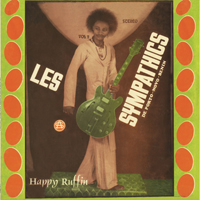
LES SYMPATHETICS DE PORTO-NOVO BENIN
VOL 2 (Albarika Stores)
Acid Jazz continue their retro series with more hidden gems from the Albarika Store in Benin. You know this is authentic from the bad cover art, including the legend "Happy Ruffin" in ugly rub-on script type, which is not explained anywhere, and the fact that bandcamp call them Les Symphatics — well it's not Lymphatics at least. The lyrics are in French and pidgin English and pay homage to neighboring Nigeria, whose highlife is echoed here. There are shout-outs to Georges and Moustique (Mosquito) who must be the guitarists, and recall the snaky twining of the African Brothers or the multi-key harmonies of Orlando Owoh (the latter particularly on the last track); Hernan is on squeaky soprano sax; the guitars are modified with flangers and other toys. Porto Novo (Newport) is the capital of Benin, on an inlet, just upstream from Cotonou on the coast of the Bight of Benin. It is equidistant from Lagos to the East and Lome to the West. A little further, less than 100 miles West, gets you to Accra, Ghana ($3 bus fare, 6 hour trip!), so these four vibrant port cities all have rich intermingled musical heritage. We hear in "The End of Soffer" a remake of Prince Nico Mbarga's "Sweet Mother," probably the biggest single hit to come out of Nigeria. It's changed quite a bit but the lyrics are unmistakable, even if the delivery is rather sloppy. "Cust no de kill" is also in pidgin English and I assume means "Sticks and stones may break my bones, but names will never hurt me." There's a good organ player and solid rhythm section of the Laleye brothers, Herman and Marc. Gangbo Bonheur is the singer and has a relaxed delivery. For some reason I understand his French better than his English! Since this came out in 1979, I detect another influence besides Highlife at work here, and that is the stretched out mellow jamming of Sam Mangwana's African All Stars with Dizzy Mandjeku, Lokassa and Ringo Moya. Their legendary late-70s stand in West Africa also led them to record at Albarika (in 1979, by which point they'd added Syran, Pablo and Bopol, some of the heaviest names in African music).

T. P. ORCHESTRE POLY-RYTHMO
SINGLES & EPs (Acid Jazz, UK 2022)
As expected this album kicks off with a heavy banger from the high-energy band that ruled the dance halls in Benin back in the 70s and early 80s; I suppose the fact that the bass is out of tune adds to the immediacy – it does sound like a live recording – that is, one take, no overdubs. But they could have used a limiter on the mikes to stop the vocals frying. Their sound is a mix of Beninois Voodoo ritual music with American soul and funk, Nigerian Afrobeat, Congolese rumba, Afro-Cuban grooves – you name it, they ate it up. Poly-Rythmo had a businessman backer who helped finance instruments and promote gigs. They traveled to Lagos to record at the EMI studios and reportedly made over 100 singles, and something like 50 LPs. When in Cotonou they backed all the local artists from Angelique Kidjo to Gnonnas Pedro. The rock and roll of the opener gives way to a Cuban tune, "Gendamou na wili we gnannin," based on "Al vaiven de mi carreta," with lots of echo on the lead guitar of Papillon. This is one they clearly rehearsed a lot. It has already been gathered on Soundway's 2004 comp, Kings of Benin Urban Groove 1972-80, as was track 4 "Mi si ba to," and track 5 "Houwe towe houn." I am guessing Albarika stores did not have a deal with Soundway, though that disc was licensed from the band-leader. Albarika have now started reissuing their material via Bandcamp, and also in partnership with Acid Jazz in UK. Soundway was hot on the heels of Popular African Music who had put out a CD in their African Dancefloor Classics series the year before, so, as usual, Günter Gretz was first to bring the band to our attention in the West. Samy Ben Redjeb of Analog Africa became their champion and reissued their first album from 1973 as well as several compilations, which led to the band getting back together and touring Europe in 2008 and 2010. In 2011 they began recording again. The voodoo-based funk tracks are the most interesting here (the more Congolese ones can be heard on the PAM CD); "Zizi" is another Cuban-derived track with elements of "El Manicero." This is a well-rounded and satisfying compilation.
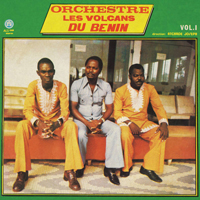
ORCHESTRE LES VOLCANS DU BENIN
VOL. 1 (Albarika Stores ASLS 088 1980; Acid Jazz AJXLP623 2022)
Afro-Latin groove meets Funk and Soukous, where else but in Benin? Originally put out by Albarika Store, this splendid orch Les Volcans du Benin reissue comes from the Acid Jazz label. Les Volcans have previously turned up on Analog Africa's African Scream Contest where they closed it out with the classic "Oya ka jojo," which is also the outstanding track on here. But maybe you are a completist and want to hear the other three cuts from this album. In 1970 they were dubbed the Volcans de la Capitale; changing it to "de Benin" I suppose identifies them a bit more closely and distinguishes them from Les Bantous from the capital of Brazza. Originally formed of policemen, they were anointed the national band, which meant the president might call on them at any time to perform, and their repertoire included rumba, Afrobeat, tango, but especially Afro-Cuban music which all West African leaders seem to have favored. These four cuts show them stretching out with wonderful interplay between the guitars and a solid conga and shekere rhythm holding it together until trap drums and organ return. The brass section is the icing on the cake: sweet and creamy. I got this album from a rip a decade or more ago and have enjoyed digging it out complete with lots of (but not overwhelming) surface noise — the snap, crackle and pop of authenticity; a record that was loved and played repeatedly. "Bella" coasts along over a subtly pulsing organ, then a true "seben" kicks in at 4:30 and we are in the realm of African All-Stars with a long sustained grooving for your dancing enjoyment. This album came out in 1980 which is when Sam Mangwana's popularity was at fever pitch in West Africa but Les Volcans have their own Beninois rhythms to distinguish them.
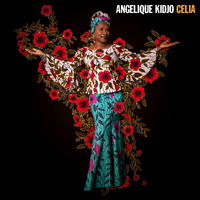
ANGELIQUE KIDJO
CELIA (Verve/Universal Music France)
This has to be the prizewinner for chutzpah. Last I heard Angelique Kidjo was touring in a show based on a Talking Heads album, like Stars on 45, or a Beatles tribute band, recreating Remain in Light as a live show. Now she has come out with an album of ten covers of songs made famous by Celia Cruz. Kidjo assembled a stellar line-up of backing musicians, including Gange Brass Band from her native Benin, ex-Fela drummer Tony Allen, and American singer Meshell Ndegeocello. The songs are all familiar but Kidjo is no Cruz and she fails miserably in attempting to imitate the great delivery of the late Latin "Queen of Salsa." It's as bad as Rokia Traore singing Billie Holiday, or Tabu Ley covering the Beatles. But the up-tempo numbers with brass and percussion deserve better, and I kept imagining ducking out Kidjo's voice and finding an isolated track of Celia's vocals to mix in. I saw Celia when she was in her 70s, with Pedro Knight and Tito Puente, and even though she didn't come on 'til well past 2 a.m. she electrified the place and ripped through her hits like "Quimbara" and "Bemba Colora." There have already been an award-winning musical and a telenovela based on her life. Damn she even got her own US postage stamp! I am not saying the status of Celia Cruz is unassailable: other great Cuban singers will no doubt come along, but tribute albums are almost always doomed to failure. Think of the mediocre Buddy Holly tribute Rave on, the weird Cole Porter tribute Red Hot + Blue (which was redeemed by the goofy performance of Iggy Pop & Debbie Harry), the uneven Fela tribute album Red Hot + Riot, or others too horrible even to recall. The Kurt Weill tribute Lost in the Stars, is the only one I can think of that worked, and that was by several artists. The music on Celia is great, so maybe the producers should have brought in a variety of singers, though again it could have fallen flat. But for one artist, lacking a massive voice but showing a lot of hubris, to take on the well-grounded powerhouse of Celia's repertoire is folly.

AFRICAN SCREAM CONTEST 2 (Analog Africa AA63 LP or CD)
If your idea of peachy African oldies is "Bring da funk" then this is for you. The compulsive propulsive mid-sixties rhythm lessons of the Famous Flames, Kool & the Gang and Parliament-Funkadelic were quickly learned in West Africa (particularly in the largely ignored country of Benin), and guitarists were happy to provide the screeching riffs that soon evolved into heavy metal in the 70s. This time around we also reach back to the Twist with "Asaw Fofor" by Ignace de Souza. And thanks to Samy Ben Redjeb and his quest for the sources of the music, we now add Stanislas Tohon, Les Volcans, Super Borgou de Parakou and Antoine Dougbé to the list of acts like Gnonnas Pedro and his Dadjes, Black Santiago and Poly-Rythmo de Cotonou as the stars of Benin funk. There's bits of happy organ, some heavy drumming and bleary horns, not to mention guitar pyrotechnics. And yes there's lots of screaming. Poly-Rythmo are back with "Moulon Devia" which is pure disco, and fortunately fades out before the wanky Moog synthesizer gets too involved. Their other entry, "Idavi" by Yehouessi Leopold, is an obscure 1974 B-side used as the closer and a wonderfully atmospheric jam. Black Santiago's "Paulina" is more dependably funky with good sax and very intricate drumming. "Gangnidodo" by Cornaire Salifou Michel et l'orchestre El Rego et ses Commandos has a nice Hammond organ break in the mid-section over a clavé rhythm and some jazzy turnarounds which take us to a clarinet solo before trumpet and saxes take us home. There is the usual meticulous documentation in rare photos and stories we expect from Analog Africa.
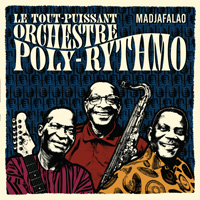
T.P. ORCHESTRE POLY-RYTHMO
MADJAFALAO (Because Music BEC5156646[CD] 5156647 [LP])
Like Orchestre Baobab, Le Tout-Puissant Orchestre Poly-Rythmo are survivors. I know they say the good die young, but Poly-Rythmo are back in force and presumably enjoying being out of retirement. Brazzaville's Bantous de la Capitale made a brief comeback a couple of years ago, playing a gig or two in Europe, but their triumphant return was not to be. By now, all fans of African music know the story of Poly-Rythmo, who spear-headed the Afro Funk movement in the early 1970s. Based in Benin, they grew to rival Nigeria's Fela Kuti, incorporating traditional Beninois music (the roots of Voudou) with American soul and funk, Afro-Cuban sounds and the popular music of their neighbors in Congo, Ghana and Nigeria. They virtually lived on stage, backing all touring artists as well as accompanying most national singers in the studio. But in the early 8os, after the deaths of key members, and a harsh economic downturn in Benin under a military dictator they were forced into retirement. In 2003 Günter Gretz issued most of three albums by them on a CD in his now-legendary "Reminiscin' in Tempo" series (Popular African Music adc306); the following year Miles Cleret of Soundway issued his compilation, Kings of Benin Urban Groove. Determined to collect as much of their music as possible, Samy Ben Redjeb (an undercover superhero record collector masquerading as a Lufthansa flight attendant) went on the hunt, putting out three of their albums on his Analog Africa label: The First Album (1973), The Vodoun Effect and Echos Hypnotiques. Furthermore, Ben Redjeb put additional tracks on African Scream Contest (2008), and Legends of Benin (2009), so that in six short years a mass of their great music was suddenly available. Here was a band that, in their own way, were as important and almost as prolific as the other "T.P." group, OK Jazz of Franco. Samy's dream of reuniting the band and bringing them to Europe was realized but I think he got stiffed on the deal and other producers stepped in to manage them. Strut issued their first new recording, Cotonou Club (2011) with guests like Franz Ferdinand incongruously stuck on there. Their founder, Mêlomê Clément, died the following year, but Poly-Rythmo decided to stick at it, and have now recorded a new album at home in the Satel Studio in Benin where most of their albums were cut. Powerful brass arrangements over their famous poly-rhythmic percussion underpin the vocals of Vincent Ahéhéhinnou and Loko Pierre, their original singers. Despite what you might expect from some veterans, this is young and vigorous music, full of snaky guitar, pounding drums and compelling grooves. (The CD has ten tracks; the LP has 8 tracks and costs twice as much -- your choice.)
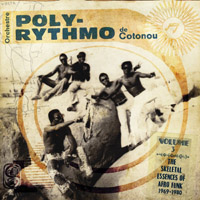
ORCHESTRE POLY-RYTHMO DE COTONOU
VOL 3: THE SKELETAL ESSENCES OF VOODOO FUNK (Analog Africa)
Poly-Rythmo are now up to three volumes of compiled singles in this series from Analog Africa. Other than Gnonnas Pedro, I didn't have a Benin section in my library until Samy Ben Redjeb started crate digging in West Africa and gave us a stream of truly memorable releases. In addition to his half dozen releases focussed on Benin and Togo, we also have issues from Soundway and Strut, jumping on the Poly-Rythmic band wagon. L'Orchestre T.P. Poly-Rythmo de Cotonou thrived in the 1970s: they had the nerve to call themselves "Tout-Puissant" but the aplomb to carry it off. Singing in Fon they covered many styles, from Jerk to Cavacha, from Pachanga to Bossa, and from Slow to Afro. But even tracks labelled "Fon Pop" have aural dynamics you would normally only attribute to pop masters like Hendrix or Cream. They can also do the "Baobab" thing on dreamy ballads, like the Afro-Cuban "Vi e lo." They are relentless and display incredible versatility and drive in their performances. Like the best of them they can take it down to manic snare drum and solo lead guitar and keep you totally engrossed, before bringing back bass and vocals. One of their rhythms is called Sato (featured on volume one The Voudoun Effect, and heard here on two tracks), in 6/8 time: the guitar hits the first and second beat and a tambourine the fifth and sixth creating a wildly off-kilter bed for horns and screeching organ to work out. This is sonically superb and an all-round great compilation.
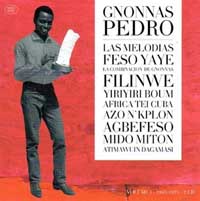
GNONNAS PEDRO
BELLE EPOQUE (Syllart)
I should have known this two-disc set would turn out to be bogus. Gnonnas Pedro, who returned from obscurity to quasi-fame with Africando, died in 2004. His reputation had grown steadily in the 1990s as more of his early music with His Dadjes Band from Benin was unearthed and made it back into print. His song "Von vo nono" was covered by Poly-Rythmo when they reformed last year. This looked promising because there are 27 tracks here so there are bound to be some unknown gems, right? Wrong. It's mostly filler. Half a dozen well-known songs from his other CDs are here and padded out with some real garbage. Gnonnas didn't always make the right choices musically: I don't mean praise songs for Omar Bongo -- that's expected -- but bad covers of songs by Benny Moré or Charles Aznavour, and then his inevitably lame version of "I got you (I feel good)." Despite recording in the era of bad synthesizer faking the horn part, he managed to pull off some gems: The 8-minute workout called "La Combinacion de Gnonnas," a medley of Cuban themes (with real horns), is fantastic. It does include "El Manisero," but that's not the only reason I love it! The guitar plays the piano montuno part impeccably, a sax fills the charanga violin role. It's an exquisite track, the sort of thing we should be beaming out from Mars, not some horse-sh*t by Willy.i.yam. Les Dadjes Band does feature an electronic piano prominently, with its tinny warbly tones, and, I hate to suggest, maybe a beat-box feature. The must-have tracks are "Cicibilici," "Manzanillo," "Mid'ho miton," and "La combinacion," which are on his essential album La Compilation, vol 1 (in that same order), and "Yiri yiri boun," which was on vol 2. "La combinacion," plus the first seven tracks on disc two are all you need, if you don't have La Compilation, vol 1. "Filinwe" is a gem that was on his last CD, Irma from 1999. But "La Musica en Verité" is missing, so is "Von vo nono." As an experiment I listened to all the "extra" tracks back to back. There is still something there: "Oumako" is not bad, and if I didn't know it was the legendary Gnonnas on a flat day I might think it was decent. "Nouo le tchi ngbé" is a cover of a French ballad but marred by poor sound, like many of the cuts on here. "Indomptable Gnonnas" is imitation Fela imitating James Brown. I wonder if it's him on sax. Best of the rest is the charanga "Lo Mejor de mi Treinta Años," with a smoking salsa band (maybe an Africando track?). Considering this is a $40 import, save your money & download a sampler if you don't have his earlier albums.
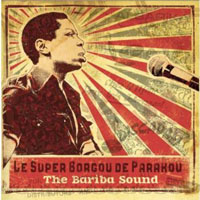
LE SUPER BORGOU DE PARAKOU
THE BARIBA SOUND (Analog Africa AACD071)
Samy Ben Redjeb continues to carve out a niche as one of the most adventurous explorers of African music since Guenter Gretz. In addition he hasn't made a false step yet. His latest is another monster from Benin, the former French colony of Dahomey (now established as a major musical nation thanks to Ben Redjeb's efforts). The first eight bars of the opening cut, "Gandigui," reminded me of Beefheart's Magic Band--now that's far out! Then it turns into a soul jam. Most of the 15 selections on here are 3 or 4 minute pop singles for the jukebox or radio market, but they manage to pack musical surprises into each song. Super Borgou were previously heard on African Scream Contest with the song "Congolese Benin Ye," which tells you a bit about their main influence. But if they were listening to Congo it was more Trio Madjesi than OK Jazz: they have a rapid-fire intensity in their guitar work and a pounding rhythm section. The band did in fact start out in the mid-60s as an OK Jazz cover band. They also incorporated elements of highlife after an early stint in Ghana, but evolved into an original outfit in the 1970s, adding an Islamic lyric strain to the music. By track 3, "Me ton le gbe," I was entranced. Not only is this another version of "El Manisero," the guitarist has been listening to Dr Nico's spiralling runs on his Latin sides. This is a pachanga with a kick. The other tracks romp from Afro-Beat to Soul with a lot of variety, but there are a few other styles, including boucher and cavacha to mix it up and keep it interesting. There's also an organ played with gusto. A Bariba folk tune gives us some insight into the group's backgrounds. The people of Northwestern Nigeria migrated outwards to Benin, Togo and Northern Ghana, an area Ben Redjeb calls "the Islamic funk belt." It's in this traditional music that we hear the germ of what became their own Parakou sound: a drum-driven groove with a melding of Nigerian Afrobeat and Congolese guitar that goes straight to the dancefloor. Dendi Folklore is the basis for "Sembe Sembe Boudou" which leans more to the Malian guitar-band sound. It's only 4 minutes long but really stretches out and as far as I am concerned could go on for an hour. Accompanied by the usual AA detailed full-color booklet, this is an incredible discovery. It seems like Analog Africa will unearth for us a royal flush of new Orchestre Baobabs before they are through!
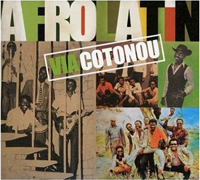
AFROLATIN VIA COTONOU
(Discograph 3246982)
I paid out serious money for this compilation (now that my local friendly record store, Amoeba, has become less friendly & stopped paying more than peanuts for used CDs), assuming it would be the one of the series with unfamiliar music on it. It starts out with Gnonnas Pedro's classic cut "Yiri Yiri boum," which everyone must have in their collection by now. The other two Gnonnas Pedro tracks are also on his popular compilations. Of the Poly-Rythmo tracks, "Le Silence n'est pas un oubli" & "Yao yao" were on Gunter Gretz's "Reminiscin' in Tempo" comp from Popular African Music, Avohou Pierre's "Ma vie va se" was on Analog Africa's Poly-Rythmo vol 2 while Les Volcans du Benin's "Oya ka kajo" which kicks off volume two of this set was the last cut of Analog Africa's African Scream Contest. So there are a few familiar tunes here. But with 28 tracks, getting 21 new ones is pretty good for Syllart. Of course Benin is still unexplored musically with only the aforementioned compilations and Original Music's Ignace de Souza being on the market until now, while great bands like the Black Santiagos, Les As and Les Volcans have remained obscure. Of course in their day they were the rave of the coast from Togo to Ghana on the West side and Nigeria on the East, backing singers on their hits and ever-ready to slip into "El Manicero" at the drop of a few peanuts. There are two version of "El Manicero" here, both intriguing: Pablo Medetadji's has an African percussion groove, while Black Santiago present it as a straight cover. Pablo's singing is more engaging than Danielou Sagbohan of the Santiagos. The big voice, though, belongs to Gnonnas Pedro who ruled with his Dadjes band in the 70s and 80s, scoring many hits. While the selections here are Latin-inflected there are other things at work: "Kissi Noumi" by Poly-Rythmo has definite influence from African Jazz and "Oya ka jojo" from Les Volcans steers more towards a funk groove, then returns to Latin with a fabulous horn outro. Poly-rythmo also have a trumpeter and that weird Mellotron which sounds anything but Latin. Yes, you have to buy it.
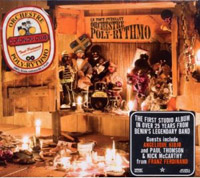
ORCHESTRE POLY-RYTHMO
COTONOU CLUB (Strut)
For their first album in 25 years the legendary band from Benin attack some of their repertoire with gusto. Three wonderful labels (Popular African Music, Soundways & Analog Africa) have reissued half a dozen of their albums over the last 8 years. Like Baobab before them, this attention to Poly-Rythmo in their sunset years led to the band reforming and setting off to conquer the world. Four of the original members have died, but fortunately it's a big band. "Von vo nono" jumps out and, interestingly, it's a song made famous by another Beninois artist Gnonnas Pedro, who died in 2004 after also returning to late-blooming glory (with Africando). Another famous African singer, Angelique Kidjo pops up on "Gbeti Madjro," a storming hit from 1968 which was featured heavily on Voice of America at the time. Kidjo sang with the band as a girl and here joins in on the track you will recognize from African Scream Contest. The Voodoo Funk continues unabated on "Oce" and "Tegbe"-- short and intense anthems, neither of which I've found on their reissues, implying the depth of their set list. Sadly a rather lame synthesizer warbles up on "Tegbe" but is quickly overpowered by the horns. In their 2010 UK tour the band played on the same bill as Oumou Sangaré and one of her singers, Fatoumata Diawara, would join in on "Mariage," a song in which a man asks a woman to make her choice between him and another guy. Wisely, they have recorded that collaboration here, as Fatoumata brings her Malian voice to the Beninois groove. The disc ends with another collaboration with Franz Ferdinand which does nothing for me, but indicates something of the band's new status. However you look at it, this new album is a triumph.
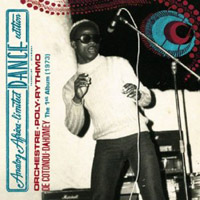
ORCHESTRE POLY-RYTHMO DE COTONOU
THE FIRST ALBUM (1973) (Analog Africa)
Not to be left out of the party, Analog Africa has resurrected the first album of Poly-Rythmo from 1973. The by-now familiar Afrobeat sound reveals itself to have layers of Western (soul and Latin) music grafted onto the Beninois funk. Hot sax and a groove that stretches into 12-minute tracks pour out of the speakers on this disc, which consists of two tracks that were recorded in Lagos and issued at the time, and two from a test-pressing that were rejected because of amplifier buzz, which have been remastered and are presented here for the first time, cleaned up. Short but sweet.
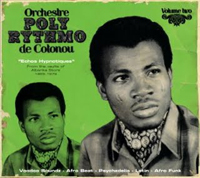
ORCHESTRE POLY RYTHMO DE COTONOU
ECHOS HYPNOTIQUES VOLUME TWO (Analog Africa AACD 066)
Though this is billed as Volume Two it is the fourth Poly-Rythmo CD to appear since their rediscovery and resurrection by avid European collectors. Günter Gretz's Popular African Music found them in 2003, Soundways in 2004, then Analog Africa gave us The Vodoun Effect in 2008, as well as scattered tracks on their compilations Legends of Benin and African Scream Contest. Suddenly we have a Benin section in our libraries -- with Gnonnas Pedro, Ignace de Souza and Amadou Balake too. Far from being mouldy oldies, this music is as exciting as anything new being put on the market and it is wonderful to hear more of it. This disc focuses on the 70s, and comes from the "vaults of Albarika Store" -- a treasure trove of Benin's glory. Though the previous issues have been from lo-fi (used) records, this time we get stuff that was recorded at EMI in Lagos for Albarika drawn from 120 master tapes containing 500 songs. No wonder it has taken 5 years to release. This hoard was whittled down to 200 tracks, then fifteen for this jam-packed release. Since Poly-Rythmo was the focal point of all Beninois music in the 70s they had an endless resource for material and talent. Many Beninois rhythms have migrated to other countries over the centuries and reinvesting them with electricity was only the beginning of the group's inspiration. Traditionally based, the music branches in all directions: there's funky drumming underneath it all but the guitarists and vocalists have their own ideas about whether their are doing soul, funk, R&B or psychedelia. Lead singer, Vincent Ahehehinnou, admits as much in Samy's blog about the disc. There's also a talented keyboard player who adds his ideas to the mix. Due to the upswelling of latter-day fans we saw the re-emergence of Orchestre Baobab to triumphant acclaim, and the less-successful return of Bantous de la Capitale (which had suffered too much attrition over the years), and now it seems as though Poly-Rythmo are poised to return to the world stage. I can imagine these Vodoun trance grooves going on well into the next half-century.
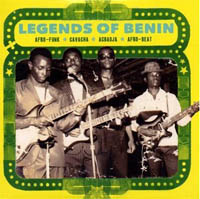
LEGENDS OF BENIN
(Analog Africa No 5)
An OCORA album "Les musiciens de la forêt," recorded in Gabon, was on my turntable when news came that president Omar Bongo had died. He pocketed the oil revenues and famously said that Africa was a vehicle that needed a European driver but Europe was a vehicle that needed African fuel. Because of his long and strong rule, Gabon had remained relatively unaffected by the West, and I suppose the same could be said of Benin, which is one of the last frontiers in the area of musical exploration. It's a skinny country wedged between Nigeria and Togo. It's so small that when you order food in Cotonou they ask, Is that for here or Togo? (Duuuhhhh, sorry!) Samy Ben Redjeb, having found a gold mine there on his travels, returns with some more ore. I missed the last TP Poly-Rythmo album he did because I just don't have the 28 smackeroos it costs here in Bee-ville (that's a load of taco-truck tacos) and I would have to turn in 7 other discs to get it in trade at the current scam trade-in prices being offered by the struggling pseudopodia of Amoeba Music, so it's not economically viable. But I have two great Poly-Rythmo albums on Popular African Music & Soundway to tide me over. So I was pleased when a copy of LEGENDS materialized in my inbox. At the start, middle and end are three cuts by Gnonnas Pedro, the only Beninois "Legend" I'd heard of. After a great cut from Gnonnas and his Dadjes we go into "Tighten Up" by James Brown, performed by El Rego et ses Commandos, renamed "Feeling you got." The novelty of African acts copping James Brown in pidgin English has really worn off though apparently the punters still want more. Antoine Dougbé is more original (with the smouldering "Honton soukpou gnon") and El Rego returns to give us something more African-sounding, possibly akin to a Fuji percussion groove. Antoine Dougbé, backed by Orch. Poly-Rythmo, finds a groove, & even takes a loping reggae approach to one tune, so we get a great variety of musical tastes. The sequencing is great and the excitement builds to Antoine Dougbé's "Kovito gbe de towe," and finally the Big Bomber of Benin, Gnonnas Pedro's "La Musica en verité" is fired up. I first heard this on cassette in the mid-80s and was immediately entranced, it is one of the most magical songs ever waxed, you don't want it to end, and indeed it seems to spin round and round unceasingly with its Melotron lead. This version (from Dadjes volume one) appeared on LA COMPILATION and immediately went onto my Desert Island Discs playlist. There is a long silence at the end (reminiscent of Reminscin' in Tempo with Balla et ses Balladins) and after two minutes or so some talking, and a final blast of music from the past.
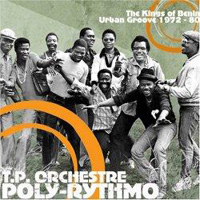
T. P. ORCHESTRE POLY-RYTHMO
REMINISCIN' IN TEMPO (popular african music PAM ADC306)
THE KINGS OF BENIN URBAN GROOVE 1972-80 ( Soundways SNDWCD004)
It strikes me as really odd that people will pay $350 for a scratched LP on EBAY just to boast that they own it. It's not like they have a real connection to it, probably never heard of Benin (which used to be Dahomey), couldn't name the President or tell you the names of any famous Beninois -- even members of this band. So not having $200 for such frippery I finally found the scratch to buy the Soundways album I have been hankering after since it came out in 2004. I did not get it at the time because I was sick of Afrobeat & African funk: it seemed everyone was pushing the same Fela-derived beat & it got monotonous. But I like this band, and while I don't own any of their vinyl, I do have the Popular African Music CD in the REMINISCIN' IN TEMPO series.
The PAM album, which came out in 2003, was the tip of the iceberg. Günter Gretz had found a dozen albums and sampled three of them for this 77-minute extravaganza. The band is still extant and has been working for over 40 years. Being the top band in Cotonou they got to back all the visiting artists: this helped their adaptability to different rhythms & gave them the chops to play a song for ten or fifteen minutes. The speedy guitarist launches into "Wimoweh" during the bridge in "Oh bea"! Local stars such as Angelique Kidjo and Gnonnas Pedro (there's your JEOPARDY answer) also used them in the studio. They toured widely and during a 1980 tour of Angola were issued firearms for protection in case of a very negative reaction from the audience! But in Libya zealous customs agents destroyed their amplifiers looking for hidden contraband. And piracy took its toll on their sales, so their career ground to a halt. Soukous fans will appreciate hearing the early Theo Blaise Kounkou track "Dety motema." He went on to join Sam Mangwana's African All Stars & recorded half a dozen albums in Paris (now out on 3 CDs) that are top-notch.
The secret weapon of the band is Yehoussi Leopold, their churning crankshaft, who is a monster on the drumkit and produces all the polyrhythm you could want. Lead-guitarist Bernard Zoundegnon, a.k.a. Papillon, is the main composer. He likes riffs that sound "flat" to Western ears, reflecting the influence of Oriental Brothers in neighbouring Nigeria, though his arpeggiated style is more a reflection of Congo guitar styles. You know they had to be unique for Tidiani Koné, saxophonist and leader of Le Rail Band du Mali, to abandon his successfully stint in Bamako & join the Cotonou team. While Benin is a francophone country, it is sandwiched between those anglophone giants Ghana and Nigeria so it got the best of both worlds, and the band would often go to Lagos to record and use the advanced facilities there to produce 45s. Of course this meant they also got close exposure to the Afro-funk movement sweeping Lagos in the early 1970s. The heart of the PAM compilation is two 17-minute tracks, originally issued as the album "Cheri coco" / "Mille fois merci" (Albarika Stores 038). Ostensibly a ballad, "Cheri coco" hits the ground running and the guitarists blaze off in a blur of dextrous phalanges, while the drummer sends his high hat into a gnat-biting frenzy. It's reminiscent of Theo Blaise's work with Mangwana and suggests another influence on the African All Stars (or vice versa, the track is from 1977, the same time as "Les Champions" and a year before Theo Blaise joined Mangwana's group). There's even a radical tempo change in the middle, like the B side heard upside down. The sound quality drops off for the last two Latin numbers with a jerky Mellotron pretending to play piano montuno. However they are definitely cooking and demonstrate the popularity of Guillermo Portabales in Benin.
The Soundways compilation is more of T.P.O.P.'s Afro-soul and funk work. Miles Cleret went to Cotonou in 2004 to try & track down the 50 LPs and over 100 45s released by the band, so it's a fair assumption he has his finger on the pulse. It's pretty frantic, poly-rhythmic certainly, with funky and psychedelic overtones, as heard on their Famous Flames-style "Les Djos," with James Brown yelps, even a "give the drummer some" break. This set is geared more towards shorter punchier tracks, the hit singles, as opposed to the album style presentation of the PAM disc. "Kokoriko," which is of course the sound a cock makes to wake you up, really gets your attention. There are also Cuban-influenced moments when they do two more versions of a Guillermo Portabales' tune. These are "Genamou na wili we gnannin," sung in Fon by Meloume Clement, and "Agnon Djidjo." They borrow a Sam and Dave fanfare for "Kou Tche Kpo so o." There is one of the longer jam tracks on Soundways' compilation, "Ne te faches pas." It's my favourite track on here. There's a horn chorus in counterpoint to the vocals and the guitar has a dizzy flanger setting & an itchy restlessness that won't quit.
The two CDs give you 2 and a half hours of one of the greatest unknown bands ever.
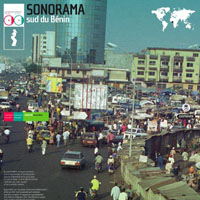
SONORAMA: SUD DE BENIN
(Cosmonote 001)
There cannot be very much music on the planet that remains untainted by outside influences. In the last 40 years the world has shrunk so dramatically because of jet travel and the quest for novelty by curious adventurers. In his brilliant novels Redmond O'Hanlon recounts the exploits of intrepid Brits going up the Amazon or into the heart of Borneo, only to be confronted with natives in GAP T-shirts hoping for batteries to listen to their Michael Jackson tapes. Benin is still unfamiliar terrain, nestled down there in the Bight of Benin with Nigeria and Ghana. The traditional music has a lot in common with Apala and Fuji from the neighbours: drum and percussion-driven, it has long trance-like rhythmic cycles interrupted by call and response vocals.
Cosmonote is dedicated to preserving a visual and aural document of this culture. Their newest project is a 15-track CD of traditional Beninois music and a DVD with 37 separate sections showing rhythms and dances in video and sound with photo galleries also. It's accompanied by a large booklet in French describing all the action. Unfortunately I could not watch the DVD in my MAC or DVD player (It's PC-compatible and I live in the Apple universe though it says it's Mac-compatible also but it could be a RAM problem: I haven't upgraded in at least 4 years.), but I look forward to checking it out eventually. In addition to drumming, there's a harmonica solo, snatches of street sounds ("Ambience au village") & parts of rituals. Cosmonote are now developing a program on the music and culture of Burkina Faso in connection with Al Jazeera's Childrens' Channel. See wonderful images and more information on their site.