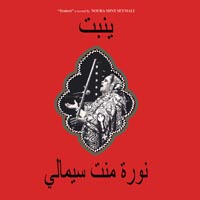
NOURA MINT SEYMALI
YENBETT (Glitterbeat)
For about a dozen years now Noura Mint Seymali has been known internationally as a fantastic griot singer from Nouakchott, the capital city of Mauritania which sits on a high plateau overlooking the Atlantic coast of West Africa. Seymali may have remained in obscurity but for an enterprising American producer named Matthew Tinari who sought her out and recorded her a dozen years ago. In addition he booked her on global tours and the resulting collaboration with her, and her guitar-playing husband, has made her a chart topper in the larger world of "world music". Tinari is not only a fine producer, knowing when to turn on the Echoplex, but he also plays drums with an intensity that might remind you of John Bonham or his African equivalents. But the key instrument here is the electric guitar played by Jeich Ould Chighaly which rocks relentlessly. Seymali also plays ardine (a type of harp), while her husband doubles on tidinit (a stringed instrument similar to an ngoni) and there is Ousmane Touré on electric bass. Despite the thundering power trio backing her, Seymali manages to be heard above the massed instruments. Noura Mint Seymali is the step-daughter of Dimi Mint Abba and carries on the fine tradition of the great griot or praise-singers from West Africa. Her modernization of traditional music has also been appreciated in her homeland. Call it psychedelic rock or Saharan funk, it is unique and beyond anything normally called sub-Saharan blues or categorized in such fashion. Her previous two albums graced my top tens in their years of release and her continued dominance as a musical force is assured with this powerful set.
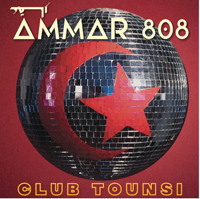
AMMAR 808
CLUB TOUNSI (Glitter Beat)
It's been seven years since Ammar 808 first hit us with his rumbling synth-driven abandoned wildness. The big bad North-African beats are back with the sonic overlay of traditional vocals and instruments. We get a wild bagpipe-like skirl over his grumbling bass synth and relentless beats on this, the Tunisian's third album featuring his TR-808 drum machine. The bagpipes are called mezoued are are indigenous to Tunisia, though any Scot (or Bulgarian) would be proud own them. But such tribal sounds were long banned in Tunis, being considered primitive, unsophisticated music from the dark side of town: the goat obviously tainted with the association to the god Pan in pre-Muslim and Christian societies. Since we get our word Panic from him — we should add pandemonium too — there is an appropriate untamed quality verging on the mystical (especially when you play it loud and damn the neighbors). But, for balance, there are elements of sufi hymns added to the ancient folksongs and the fezzani rhythm, a kicking, off-tempo beat with a tambourine, hand drums and clapping. You soon forget the drum machine. In fact he emphasizes the hand-played instruments against the eternal loops of the electronic ones to set up a distinctive counterpoint. Then there's my other favorite North African instrument, the reedy ney adding to the sonic soup. There are three singers, from different traditions, however they blend perfectly. The traditional "Aman Aman" even adds auto-tune to the vocals for a bizarre twist, it sounds a bit like the muezzin from a cheap cassette heard while you are trying to sleep at 4 a.m. in a frigid camper van in the desert. It is cinematic and eerie and a new take on a lovelorn ballad. This is one for the dancefloor and late nights when the dancers' shadows take on a life of their own.
EL KHAT
MUTE (Batov Records/Glitterbeat)
There's something about raw Arabic music that gets one deep inside. It is music that comes from necessity and is produced on home-made instruments, sung with passion and, even if you don't follow the lyrics (which are included here), tells you of suffering, loss and forced migration. This group started out in their home town of Jaffa, well under it actually, in an underground bomb shelter in Jaffa — a port city south of Tel Aviv, once famous for its orange groves, now engulfed in a vicious struggle. The band members are Jewish and Arabic; their musical aim has been to explore the roots of Yemeni music, ever since the release of 'Qat, Coffee & Qambus, the compilation of Yemeni 45s that came out on Dust-to-Digital in 2013. Khat is a bit stronger, being a mind-altering herb that is chewed, like coca leaves (I tried them in Peru and got nowhere, until someone told me you need a little piece of ash in your mouth to activate them!). Bailing on their precarious home situation, the trio visited Brooklyn and then relocated to Berlin. The leader Eyal El Wahab reflects on his life as an Arab Jew, always on the move since his family were forced to leave Yemen in the late 1940s. But Israel didn't provide the home he wanted, and he sings about old loves ("Thank you for forgetting me / so I can have new memories"), family and the pain of migration. He learned cello by ear and joined the Jerusalem Andalusian Orchestra, playing North African Arabic music, while building his own instruments. You can tell he got into Gnawan music by the trancelike feel here on tracks like "Tislami Tislami," which has a Maghreb vibe. El Wahab is joined on this disc by percussionist Lotan Waish and Yefet Hasan on organ. There is a D-I-Y punk sensibility to their music with off-kilter drums that sound like they are made from plastic buckets. Check out their fine live set on KEXP, which will give you a taste of their style.
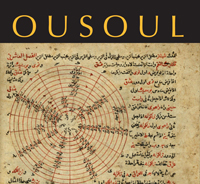
TAREK ABDALLAH & ABDEL SHAMS EL DIN
OUSOUL (Buda Musique)
Recall how big the Ottoman empire was? That massive force that embraced Turkey and several Arabic nations was home to many musical forms that evolved over the six centuries of their sway. The major musical cycles are comprised of opposing strokes that react like call and response, with a beat and a counter or offbeat. In the West we derive rhythms from listening to nature or machinery, such as railway locomotives ("Click clack," "Chan chan," "Train kept a rollin"). Similarly Arabic poetic forms were sometimes created from listening to the work of the blacksmith. These little cycles are grouped into suites that are known as maqâm. The simple instrumentation of this album allows us to hear clearly the two components on the oud played by Abdallah and the riqq (big tambourine) plied by his musical partner El Din. The riqq is skin-covered and struck with dexterous fingers, recalling the subtlety of tablas. The two Egyptians are joined here by Christian Fromentin on violin. Between them the oud and violin create a whole orchestra of sounds. And lest we forget, the Ottoman Empire is more of our time (lasting 600 years from the 14th century to the early twentieth): but the Egyptians have 8000 years of continuous culture which survived Persia, Greece and Rome and then, in the last two centuries, France and England. Their arts evolved but are rooted in the most ancient traditions on earth. There is even humor in here, though I am probably the only one to hear "Willie and the Hand jive" among the riffs of the Raqsa "Dance Nawahand."
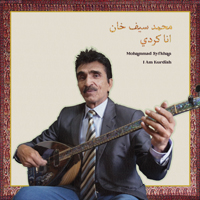
MOHAMMAD SYFKHAN
I AM KURDISH (Nyahh Records 013)
Call me a bleeding-heart liberal but I do not like the way the Kurds have been treated, not just historically — deprived of their homeland (alongside other peoples like Armenians and Palestinians) — but did we not promise them autonomy (that is the US government under George "Shrub" Bush) for helping oust "Sodom" Hussain from Iraq? Clearly not enough shoes were thrown at Bush 2... and why is Türkiye so keen to hold on to the worthless barren rocky wastes that form the Western part of their nation? Anything they build there falls down in earthquakes. Syria: no one can live there anymore, and Iran, well, if Ayatollah once, Ayatollah a million times, no state can prosper as a theocracy, and Iraq, that's a load of Shiites. So maybe the Kurds don't want the whole geographic spread, but it would bring some sort of stability, if their recent track record is studied, to give them back their damned country. However there is one thing we can count on from oppressed people, and I hate to say it, is great music. Music of exile and suffering has been a strength of international music as long as we can remember. Mohammad Syfkhan is a Kurdish singer and bouzouki player who had a nice life playing music in Raqqa, Syria, at parties, weddings and festivals, until ISIS showed up when war broke out in 2011 and killed his son. His family fled to Germany and he ended up with his daughter in Ireland. Now he commutes between Ireland and his sons' home in Germany where he entertains at Kurdish and Syrian events. This new musical environment means he is now jamming with Irishmen in Leitrim, and on this album he has Cathal Roche on sax and Eimaear Ready on cello. He also has some of his countrymen on percussion. It's a success: it flows well and there are some jazzy bouzouki solos to demonstrate his mastery. Plaintive strings ring out but are swept up in a joyous atmosphere telling us to party like there is no tomorrow. He could be right.
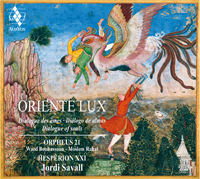
JORDI SAVALL & ORPHEUS 21
ORIENTE LUX (Dialogue of Souls) (Alia Vox AVSA 9954)
The sun rises in the East and if we close our eyes there's spiritual rays coming from that direction also. At least in terms of music which preserves the musical culture of Syria and the Arab diaspora, via Orpheus 21, an organization dedicated to protecting and providing for professional musicians who were refugees. This two CD set is overflowing with riches: right from the opening sweet lyrics from Bangladesh, a Runa Laila cover, which recalls Bollywood movies. The musical heritage of Morocco, Turkey and Belarus is also heard in this vibrant canvas of sound which pays tribute to the devastated culture of Syria which may take a hundred years to recover from its obliteration. This set was recorded live in Paris at the Philharmonic hall and features a wide array of sounds, including the expectant hush of the concert hall between numbers. Jordi Savall who organized it, is a Catalan artist, who got the idea when he went to the infamous "jungle" in Calais where immigrants hope to escape by boat to the Unlikely Kingdom (one wonders why?) and found young musicians to jam with. He met Syrian oud player Waed Bouhassoun and ney player Moslem Rahal in Granada and put together the financial backing to allow these artists to perform and teach others. The youngsters they teach in choirs and on instruments are then invited into the ensemble also. Together they overcome the solitude and obvious heaviness of the situation they are in. The musical memories pour out. To the ney and oud they added darbuk, Syrian violin, tablas, percussion, Armenian duduk, Bulgarian kanun, Kudish saz and so on. There is hope for healing for these few, a talented group who made it to Europe and a new start; the calm and tranquility imbued in their music is a solid rock they can build on and maybe one day return to a peaceful homeland. "Ya Habibi," a traditional song from Aleppo, becomes quite a dirge but the subsequent traditional Syrian song, "'Al maya, 'al maya" soars to the heavens and gets a huge ovation. There's a cover of a tune by Marcel Khalife, famed oud player, and a song "Üskü dara" which brings back memories of Eartha Kitt, who had a hit with the popular Turkish folksong in 1953. "'Al maya, 'al maya" returns to close the set, this time as a rousing anthem of defiance.